
Modern tournament bass fishing and offshore saltwater competition have transitioned into technology-driven disciplines where high-speed visual analytics dictate victory. Competitive boats frequently run synchronized dual-station cockpit architectures: a multi-screen primary helm array at the console steering station, coupled with an auxiliary high-responsiveness display mounted directly on the bow casting deck adjacent to the trolling motor.
Operating these sensitive electronic displays in unshielded marine environments introduces extreme mechanical and environmental stressors: high-velocity saltwater spray, 4G wave-slamming shocks during rough transits, and persistent wet-finger touchscreen interactions.
1. Mechanical Hardening Against Wave-Slamming Dynamic Loads
While console screens receive partial shelter behind acrylic windshield cowlings, bow-mounted casting monitors operate completely exposed. Pounding across choppy water at speeds exceeding 60 to 70 knots exposes display mounting structures to continuous, sharp mechanical shocks.
Dynamic Kinetic Shock Pulse: Peak Acceleration: a_peak = 20G (196.2 m/s²), half-sine pulse width = 11 ms. Applied Force on 15.6″ Unit (m = 5.2 kg): F_impact = m × a_peak = 5.2 × 196.2 ≈ 1020.24 N dynamic shear stress on mounting bosses.
Standard plastic display enclosures assembled with self-tapping screws and snap-fit tabs suffer localized fatigue cracking around mounting bosses under continuous vibration, resulting in compromised seals and saltwater ingress.
To guarantee survival under severe marine conditions, the Tournament Marine Fishing Touch Monitor Dual-Station Sonar features a solid CNC-machined marine-grade aluminum housing equipped with reinforced stainless steel helicoil thread inserts designed to withstand extreme multi-axis torque loads from heavy-duty gimbal mounts.
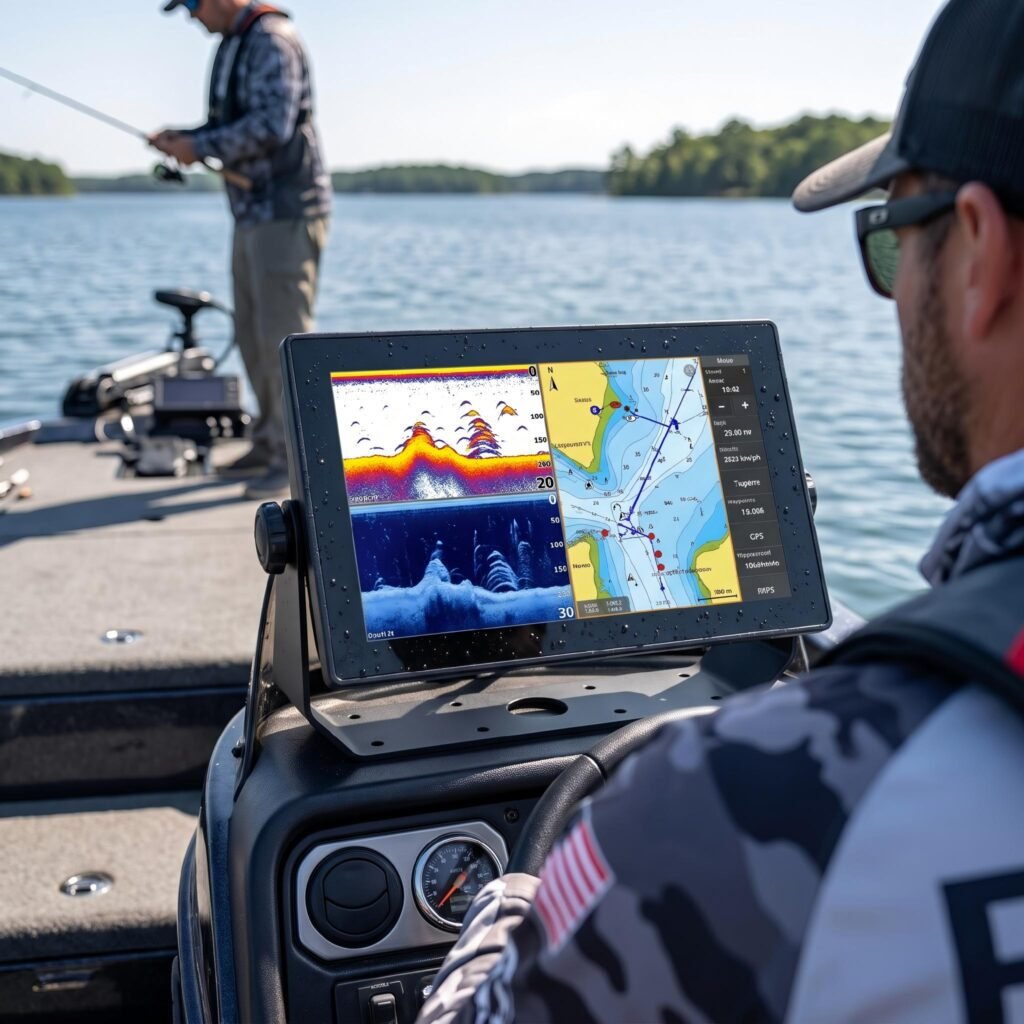
Tournament Marine Fishing Touch Monitor (Dual-Station Sonar)
Built to survive open-deck wave impacts and high saltwater exposure. Features CNC marine aluminum construction, 1500 nits high brightness, wet-touch firmware, and wide 9V-36V DC power input for tournament bass and sportfishing vessels.
2. Conductive Seawater Rejection and Wet-Glove Touch Response
Seawater contains high concentrations of dissolved sodium chloride, resulting in high electrical conductivity. When wave spray puddles across a standard projected capacitive (PCAP) glass panel, surface water creates conductive pathways between electrode nodes that mimic human finger touches.
- Digital Signal Processing Rejection: Dedicated controller DSP firmware distinguishes between continuous distributed water sheets and localized capacitive finger touch profiles, preventing false trigger locks.
- Thick-Glove Tracking Capability: High-sensitivity mutual capacitance tracking allows tournament anglers to execute precise single-touch waypointing and pinch-to-zoom chart commands while wearing thick wet fishing gloves.
- IP67 Fully Hermetic Sealing: Enclosure joints utilize continuous closed-cell fluorosilicone gaskets, preventing water intrusion even during transient deck submersion up to 1 meter depth.
Dual-Station Marine Display Engineering Comparison
| Operational Metric | Commercial Marine Screen | Ruggedized Dual-Station Marine Monitor |
|---|---|---|
| Chassis Material | Polycarbonate plastic (Prone to UV embrittlement) | Anodized CNC marine aluminum with powder coating |
| Submersion Protection | IPX5 / IPX6 splash resistance only | Full IP67 hermetic seal (1 meter immersion rated) |
| Saltwater Touch Behavior | Ghost touches freeze display interface | Real-time water film rejection firmware |
| Input Voltage Stability | Narrow 12V DC input (Drops out on engine crank) | Wide 9V to 36V DC input with transient brownout hold-up |
| Vibration Standard | Unrated commercial domestic vibration | MIL-STD-810H Method 514.8 (Category 4 Navy / Marine) |
3. Multi-Feed Signal Routing on Tournament Bridges
Modern dual-station tournament rigs require seamless video switching between mapping chartplotters and live-sonar black boxes. Incorporating multi-input digital video stages (HDMI 2.0, DisplayPort 1.2, and legacy VGA) alongside independent USB touch feedback lines enables instantaneous source switching:
- Console operators can lock into navigation channels while the bow angler views split-screen forward-facing live sonar with zero frame buffering delay (< 5ms latency).
- Lockable circular IP67 connectors prevent accidental disconnection when pounding through 4-foot offshore chop.
Upgrading tournament fishing vessels with ruggedized dual-station marine touch monitors ensures uncompromised visual telemetry and high reliability across demanding competitive environments. Request engineering integration details for custom mounting brackets, marine cable looms, and OEM boatbuilder specifications.