
Deploying marine navigation displays, open-bridge chartplotters, and commercial fishing fish-finders under direct tropical sunlight exposes human-machine interfaces to extreme ambient illumination levels ranging from 50,000 to over 100,000 lux. Under these lighting conditions, displaying high-resolution bathymetric contours, radar overlays, and AIS target tracks requires high-luminance LED backlights generating 1000 to 1500 nits (cd/m²). However, raw backlight intensity alone does not guarantee legibility.
When displays are constructed using traditional perimeter tape bonding (air gap construction), internal optical boundaries create severe specular reflections. The resulting glare washes out high-luminance backlights, causes visual fatigue, and creates internal condensation when tropical sea air cools rapidly at nightfall.
1. Fresnel Reflection Losses at Refractive Boundary Discontinuities
Whenever light travels across an interface between two optical media with differing refractive indices, a proportion of the light wave reflects back toward the observer. In an unbonded display stack, light emitted by the LCD panel must transition from the polarising glass (n ≈ 1.51) into an internal air gap (n ≈ 1.00), and subsequently transition from the air gap into the outer protective cover glass (n ≈ 1.52):
Fresnel Reflection Formula (Normal Incidence): R = [ (n_1 – n_2) / (n_1 + n_2) ]^2 For Glass-to-Air Boundary: R_boundary = [ (1.51 – 1.00) / (1.51 + 1.00) ]^2 = [ 0.51 / 2.51 ]^2 ≈ 0.0412 (4.12% reflection) With two internal glass-air boundaries, total internal reflection loss exceeds 8.24% of outgoing backlight luminance, while reflecting over 4.5% of blinding external solar ambient light.
In high brightness ip65 computer systems operating on offshore vessel decks, an ambient solar reflection of 4.5% produces over 1,400 cd/m² of white glare. This washes out even a 1500-nit backlight, collapsing the perceived contrast ratio down to an unreadable 2:1.
To eliminate these internal reflection boundaries, marine bridge consoles deploy the 1500 Nits Sunlight Readable Marine Fishing Touch Monitor, which utilizes Liquid Optical Clear Adhesive (LOCA) wet bonding to create an unbroken refractive index match (n = 1.51) from the LCD polarizer directly to the chemically strengthened cover glass.
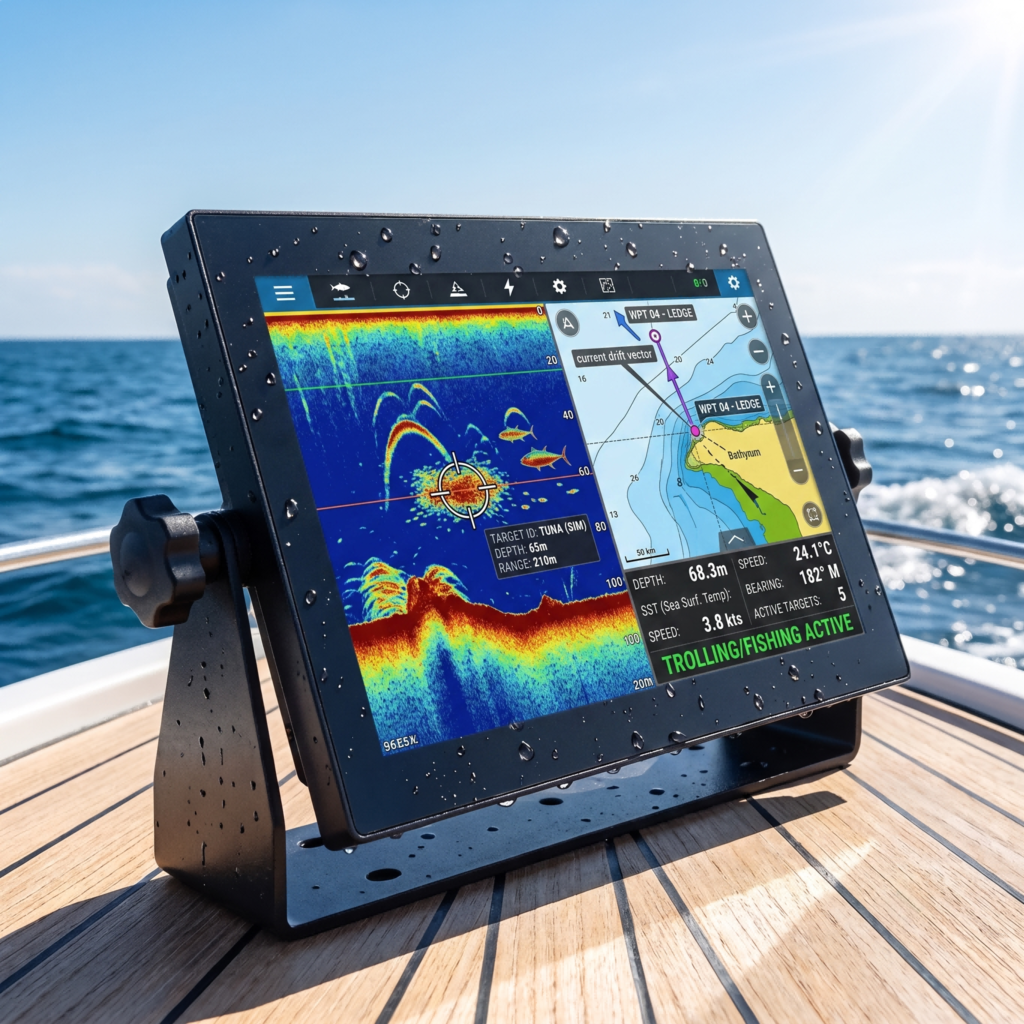
1500 Nits Marine Fishing Touch Monitor (Optical Wet Bonded)
Engineered for open bridge helms and tournament fishing vessels. Combines 1500 nits high-luminance WLED backlighting, full LOCA optical wet bonding, 100% condensation-free construction, and full IP65 waterproof sealing.
2. LOCA Wet Bonding vs. Dry Tape-Bonding Reliability
While low-cost industrial screens rely on double-sided perimeter tape gaskets, marine environments subject optical assemblies to high moisture and thermal cycling:
- Dew Point Condensation (Internal Fogging): Perimeter-taped air gaps trap ambient humidity during factory assembly. When offshore ambient temperatures plunge at dusk, internal air temperature drops below the dew point, condensing water droplets directly onto the inner face of the cover glass, creating persistent milky fogging.
- Index-Matched LOCA Polymers: Liquid optical clear adhesive fills 100% of the void with an optically clear, UV-stabilized silicone or acrylic polymer. Because zero air volume exists, internal condensation is physically impossible.
- Impact Dissipation and Shock Resistance: The cured solid resin layer functions as a mechanical shock absorber. Kinetic energy from heavy tackle strikes or wave-slamming shocks is distributed across the entire display surface, increasing panel fracture resistance by up to 300%.
Marine Optical Display Stack Architecture Comparison
| Optical & Mechanical Metric | Perimeter Air-Gap Bonded Screen | Engineered LOCA Optical Wet Bonded |
|---|---|---|
| Total Internal Specular Reflection | 8.0% – 9.0% (Severe white glare) | ≤ 0.2% (Eliminates internal boundaries) |
| Effective Sunlight Contrast Ratio | ≈ 2.1 : 1 (Faded, low visibility) | ≥ 10.5 : 1 (High-definition readability) |
| Internal Condensation Risk | High (Dew point condensation inside air gap) | Zero (Solid void-free optical polymer matrix) |
| Front Impact Resistance | IK06 / IK07 (Cover glass flexes and shatters) | IK08 / IK09 (Laminated energy dissipation) |
| UV Yellowing Resistance | Standard EVA/Epoxy degrades under UV-A/B | Aliphatic polyurethane / optical grade silicone |
3. Installation & Dimming Calibration Best Practices
- Potentiometer Dimming Integration: For night navigation, verify that the monitor’s display controller supports ultra-wide PWM dimming curves down to 1% (≤ 2 nits). Operating high-luminance displays without wide dynamic dimming blinds bridge crews during night passage.
- Thermal Conduction Path Clearance: Ensure the rear heat-dissipation fins on the cast aluminum monitor chassis maintain at least 50 mm of unobstructed clearance inside the console dash to allow natural air convection.
- Anti-Reflective Coating Maintenance: Clean the front multi-layer anti-reflective (AR) glass exclusively using optical microfiber cloths and deionized water. Avoid household glass cleaners containing ammonia, which chemically strip optical vacuum coatings.
Upgrading marine bridge consoles and tournament fish-finders with index-matched optical bonding guarantees high-contrast situational awareness and prevents condensation downtime. Contact INNODA’s marine engineering team to review optical transmission curves, custom bracket dimensions, and multi-sensor chartplotter integration options.