
Automated Guided Vehicles (AGVs), Autonomous Mobile Robots (AMRs), and modular industrial manufacturing carts operate under continuous kinetic excitation. As mobile platforms traverse floor expansion joints, warehouse dock levelers, and uneven concrete surfaces at speeds between 1.5 m/s and 3.0 m/s, acceleration shock loads transmit directly from polyurethane drive wheels through structural chassis members and into human-machine interface (HMI) terminals.
When engineering teams select an embedded touch panel pc for mobile robotics or high-density machine-vision enclosures, standard commercial-grade displays fail prematurely. Sheet-metal bending enclosures suffer fatigue fractures around retention tabs, while ribbon cable connectors unseat under continuous harmonic resonance, resulting in intermittent touchscreen lockups and motion safety stops.
1. Structural Harmonic Resonance & Natural Frequency Isolation
Every mechanical structure possesses an intrinsic natural resonance frequency (f_n). When the frequency spectrum of warehouse floor roughness matches the natural frequency of an installed panel PC, internal electronic components experience severe mechanical amplification, producing localized acceleration forces up to 5 to 10 times higher than baseline input levels:
Natural Frequency & Resonance Avoidance Formula: f_n = (1 / (2 × π)) × (k_chassis / m_assembly)^0.5 Where: – k_chassis = Structural stiffness of the enclosure (N/m). – m_assembly = Total mass of the mounted computing unit (kg). Engineering Requirement (MIL-STD-810H Category 4 / 24): Industrial AGV excitation harmonics peak between 10 Hz and 55 Hz. To prevent constructive resonance, the assembly’s first fundamental natural frequency must be engineered well above this band: f_n_target ≥ 120 Hz → Demands maximizing chassis stiffness-to-weight ratio (k / m).
Thin sheet-metal enclosures (0.8 mm to 1.2 mm thickness) exhibit low bending stiffness (k ≈ 4.2 × 10^4 N/m), dropping their fundamental natural frequency directly into the destructive 30 Hz to 45 Hz range. Under prolonged transit, this resonance causes micro-cracking across solder joints on BGA-mounted processor packages.
To eliminate resonance fatigue, mobile automation platforms deploy the 10.1″ CNC Aluminum Embedded Panel PC, which is precision-machined from a solid billet of aerospace-grade 6061-T6 aluminum alloy. The monolithic front and perimeter frame achieves structural stiffness exceeding 3.8 × 10^5 N/m, shifting natural frequencies safely beyond 180 Hz.
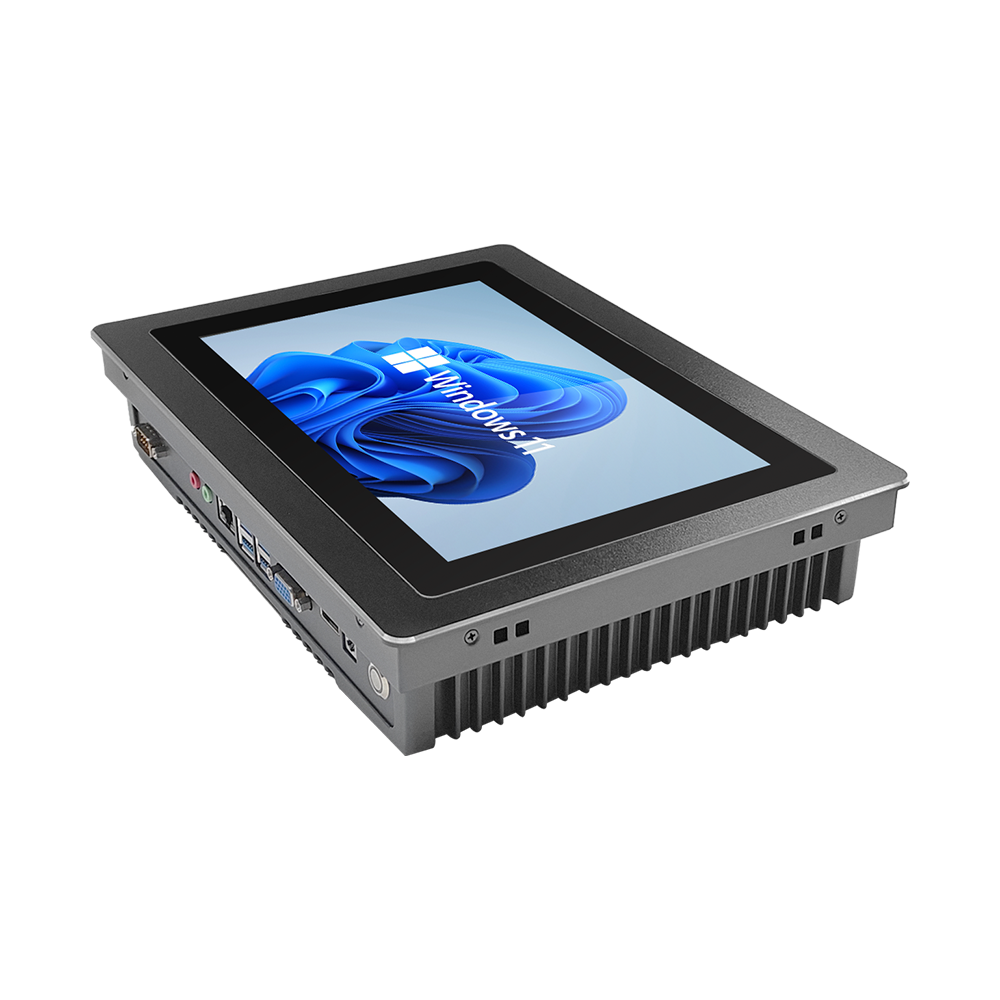
10.1″ CNC Aluminum Embedded Industrial Panel PC
Engineered for mobile AGVs, AMRs, and compact CNC automated workstations. Features a monolithic 6061-T6 CNC aluminum chassis, 7H scratch-resistant PCAP multi-touch, 30G shock survival, and wide 9V-36V DC power input.
2. Conformal Coating & Mechanical Board-Level Retention
Surviving continuous kinetic shock requires engineering internal electronic interfaces beyond consumer specifications:
- Locking Industrial Connectors: Internal display signaling utilizes latch-locking LVDS/eDP connectors paired with industrial silicone compound dampening, preventing high-speed micro-coaxial harness unseating under 20G shock pulses.
- Full Conformal Coating (IPC-A-610 Class 3): Applied automated acrylic/polyurethane barrier coatings protect PCB traces against micro-abrasion from airborne carbon dust and ambient warehouse moisture.
- Milled Compression Bosses: Solid CNC mounting standoffs contact the main processing board directly, transferring shear loads into the rigid outer frame rather than flexing the PCB substrate.
AGV Embedded Terminal Enclosure Specification Matrix
| Engineering Parameter | Stamped Sheet-Metal Panel PC | Engineered 10.1″ CNC Aluminum PC |
|---|---|---|
| Structural Manufacturing | Folded sheet steel with spot-welded seams | Solid billet CNC-machined 6061-T6 aluminum |
| Vibration Standard | Unrated or ≤ 1G (5-50 Hz) domestic rating | MIL-STD-810H Method 514.8 (Random 5G RMS) |
| Kinetic Shock Rating | 10G peak, 11ms (Screw bosses fracture) | 30G peak, 11ms half-sine pulse (IEC 60068-2-27) |
| Power Input Stage | Narrow 12V DC input (Drops out on motor surge) | Wide 9V to 36V DC with transient reverse clamp |
| Touch Sensor Hardness | 3H acrylic or standard chemical glass | 7H chemically strengthened surface glass |
3. AGV Integration & Power Conditioning Guidelines
- Decoupled Power Sourcing: Mobile AGVs experience significant inductive voltage spikes (inductive kickback) when traction drive motors engage regenerative braking. Wire the 10.1″ panel PC to an isolated DC-DC converter output rather than connecting directly across the primary battery bus.
- VESA Mount Isolation: When mounting the terminal to the AGV chassis, utilize high-damping elastomeric rubber grommets (Shore 50A durometer) on all four M4 VESA mounting posts to attenuate high-frequency mechanical noise (> 500 Hz).
- Cable Strain Relief: Clamp all external I/O cables (Ethernet, USB, DC power) within 100 mm of the rear chassis ports using insulated P-clips to prevent harness oscillation from fatiguing physical connector pins.
Standardizing mobile robotics fleets on CNC-machined aluminum embedded panel PCs eliminates chronic vibration failures and guarantees reliable fleet communications. Contact INNODA’s mobile robotics engineering team to request 3D STEP CAD models, custom I/O cable harnesses, and wide-temperature testing reports.