
Modern pharmaceutical formulation cleanrooms, automated dairy pasteurization suites, and high-speed meat packaging conveyors require large visual human-machine interface terminals installed in cramped, space-restricted operator bays. A 21.5-inch widescreen (16:9 Full HD 1920×1080) Android terminal delivers expansive screen space for real-time SCADA supervisory graphics, digital batch records, and automated machine telemetry. However, in washdown environments with limited enclosure depth, bottom-facing or rear-facing cable connections create severe installation clearance and water-pooling problems.
Traditional bottom-entry industrial computers force cable harnesses to bend sharply downward, creating mechanical stress on connectors and requiring large vertical wall cutouts. Rear-facing I/O ports prevent flush wall or arm mounting. Relocating connectivity to a dedicated lateral (side-facing) sealed compartment eliminates clearance bottlenecks, but subjects cable glands to high shear stresses during direct sanitation washdown spraying.
1. Lateral Washdown Fluid Vectoring & Dynamic Gland Shear Stress
During daily hygiene cycles, sanitation workers blast processing equipment with high-velocity water lances delivering pressures up to 30 bar. When high-pressure jets strike an enclosure at an acute angle, fluid dynamics exert high shear and peeling forces across lateral seal boundaries:
Hydrodynamic Lateral Impact Force & Seal Shear Stress: F_jet = ρ × Q × v_jet × cos(θ) Where: – Water Density ρ ≈ 1000 kg/m³. – Washdown Flow Rate Q = 15 L/min = 2.5 × 10^-4 m³/s. – Nozzle Exit Velocity v_jet ≈ 55 m/s. – Jet Attack Angle θ = 45° (cos 45° ≈ 0.7071). Dynamic Normal Impact Force: F_normal = 1000 × (2.5 × 10^-4) × 55 × 0.7071 ≈ 9.72 N. Gasket Interfacial Shear Stress: τ_shear = F_shear / A_seal_lip With a lateral seal lip area A_seal_lip ≈ 1.2 × 10^-4 m²: τ_shear ≈ 9.72 / (1.2 × 10^-4) ≈ 81,000 Pa = 0.081 MPa. Required Gasket Pre-load Compression Stress: To prevent fluid peeling and capillary entry, compressive contact stress must exceed 10x shear stress: σ_contact ≥ 0.81 MPa (Satisfied by CNC-retained O-ring compression).
By engineering a recessed side I/O bay fitted with angled fluid-deflection bezels, the direct kinetic force of incoming washdown jets is deflected away from cable entry glands, reducing direct stagnation pressure by over 60% compared to flat unshielded surfaces.
To ensure total ingress hermeticity without compromising mounting flexibility, food and beverage facilities deploy the 21.5″ Full IP65 Side I/O Android Panel PC, which combines a CNC-machined recessed lateral I/O bay with full IP65 ingress protection across all six axes.
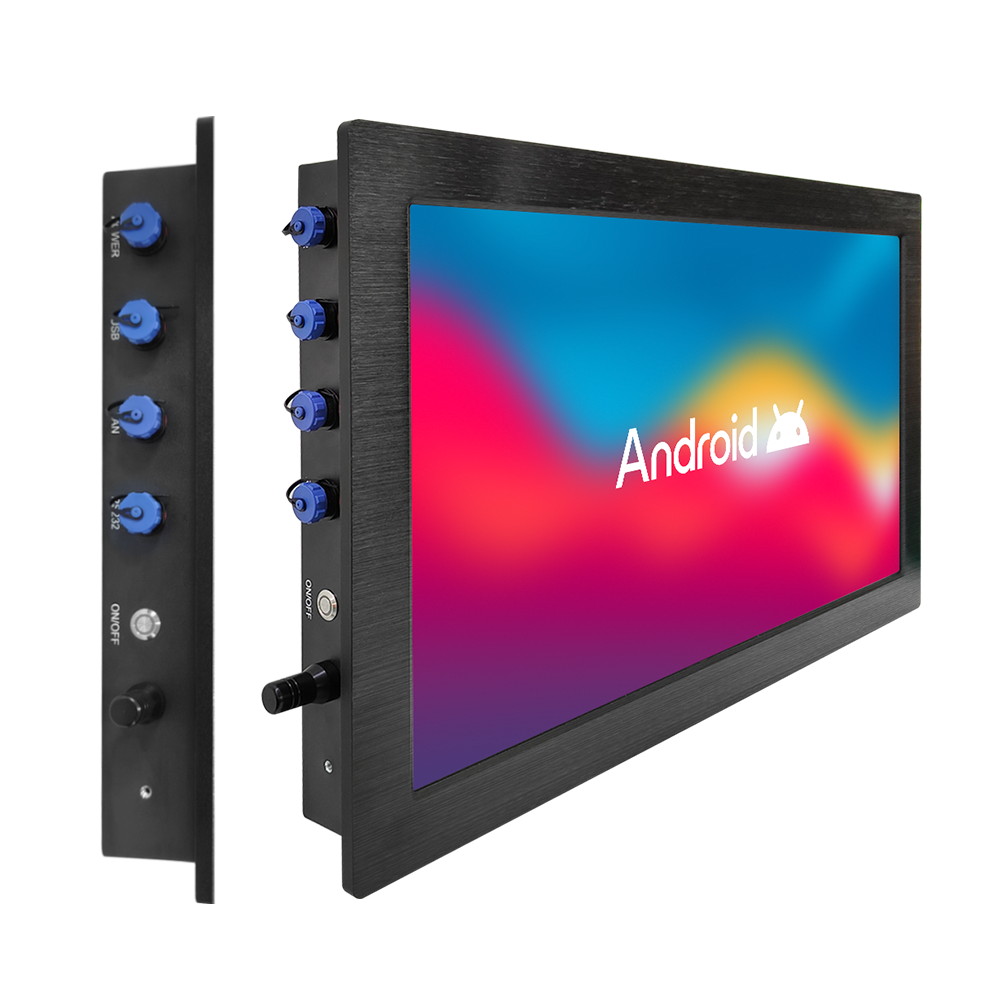
21.5″ Full IP65 Side I/O Android Panel PC
Designed for cleanroom packaging lines, pharmaceutical suites, and food washdown cells. Features an expansive 21.5″ Full HD display, certified full IP65 all-around ingress protection, recessed lateral side-access I/O ports, and high-efficiency fanless Android architecture.
2. Android SCADA Determinism & Rapid Serviceability
Lateral interface architecture provides substantial operational and software benefits:
- Flush Backside Articulating Arm Mounting: Eliminating rear protrusions allows the 21.5-inch terminal to mount completely flat against cleanroom sandwich wall panels or on slim VESA 100×100 articulating swing arms.
- Tool-Less Gland Access: The side-facing sealed cover allows maintenance engineers to plug in diagnostic USB flash drives, Ethernet programming cables, or serial debugging tools in seconds without unbolting the terminal from its wall mount.
- Industrial Android Multi-Touch Firmware: High-performance multi-core ARM processing supports real-time HTML5 SCADA web dashboards with native mutual-capacitance water-rejection algorithms, maintaining responsiveness under heavy mist.
Side I/O vs. Traditional Rear I/O Panel PC Comparison
| Engineering Parameter | Standard Rear-Gland Panel PC | Engineered 21.5″ Side I/O Android PC |
|---|---|---|
| Mounting Enclosure Depth | Requires > 120 mm clearance for cable bends | Ultra-slim ≤ 55 mm flush wall/arm footprint |
| Washdown Ingress Protection | IP65 front only (Rear ports pool water) | Full IP65 (All 6 axes including side I/O bay) |
| Maintenance Accessibility | Must dismount whole unit to reach I/O | Side hatch opens directly for instant cable access |
| Cable Fatigue Life | Sharp 90-degree bends cause copper fatigue | Gentle lateral harness routing (>60mm bend radius) |
| Thermal Dissipation | Internal fan draws moisture and dust | 100% Fanless solid aluminum passive conduction |
3. Installation & Cable Gland Sealing Guidelines
- Gland Insert Matching: Ensure the internal elastomeric rubber cable insert matches outer cable diameters within ±0.5 mm to ensure airtight circumferential compression when the side gland nut is tightened.
- Downstream Drip Loop Formation: Shape external cables into a 100 mm downward drip loop immediately upon exiting the lateral gland to prevent washdown runoff from tracking along the jacket toward the seal face.
- Side Cover Torque Calibration: When re-sealing the lateral access door after maintenance, tighten retention thumbscrews to 1.2 Nm to ensure uniform compression of the continuous closed-cell fluorosilicone perimeter gasket.
Upgrading food processing and pharmaceutical operator stations with 21.5-inch full IP65 side I/O Android panel PCs maximizes spatial ergonomics and eliminates moisture failure risks. Contact INNODA’s cleanroom HMI engineering team to request 3D CAD envelope drawings, chemical immersion test reports, and customized lateral port configurations.