
Automated industrial car wash gantries, municipal wastewater chemical dosing skids, and agricultural fertilizer blending stations operate in environments defined by aggressive airborne corrosives and severe thermal fluctuations. Operators and field technicians rely on large 17.3-inch widescreen displays (16:9 Full HD 1920×1080) to oversee multi-pump telemetry, chemical metering ratios, and real-time fault diagnostic matrices. However, deploying fanless computing hardware in outdoor or unconditioned chemical processing sheds presents complex mechanical and thermal hurdles.
Operating a sealed computer around chemical mist and outdoor heat traps causes two common failure modes: structural warping across large horizontal spans that breaks ingress seals, and thermal saturation inside sealed cavities that triggers severe CPU clock throttling. Achieving lasting reliability requires combining the energy-efficient 10W Intel Celeron J6412 processor with a monolithic CNC-machined aluminum billet enclosure engineered for high radiative thermal emissivity.
1. Anodized Surface Emissivity & Sealed Radiative Heat Transfer
In a completely sealed full IP67 fanless enclosure, cooling occurs through a combination of natural convection and radiative heat transfer. The surface finish of the aluminum housing fundamentally dictates its radiative thermal efficiency:
Stefan-Boltzmann Surface Thermal Radiation Equation: Q_rad = ε × σ × A_chassis × (T_surface^4 – T_ambient^4) Where: – Stefan-Boltzmann Constant: σ = 5.670 × 10^-8 W/(m²·K^4). – 17.3″ Outer Chassis Radiation Surface Area: A_chassis ≈ 0.32 m². – Chassis Surface Temperature: T_surface = 50°C = 323.15 K. – Ambient Environment Temperature: T_ambient = 25°C = 298.15 K. Surface Finish Emissivity Comparison: – Bare Mill-Finished Polished Aluminum: ε ≈ 0.05. Q_rad_bare = 0.05 × (5.67 × 10^-8) × 0.32 × (323.15^4 – 298.15^4) ≈ 2.72 Watts. – Hard-Anodized Matte Aluminum Finish: ε ≈ 0.85. Q_rad_anodized = 0.85 × (5.67 × 10^-8) × 0.32 × (323.15^4 – 298.15^4) ≈ 46.31 Watts. Engineering Advantage: Hard-anodizing the CNC aluminum housing increases radiative heat rejection by over 1,600%, maintaining internal Intel J6412 silicon temperatures well below 65°C without internal cooling fans.
By engineering a hard-anodized black or dark grey surface treatment, the outer chassis radiates thermal energy into the surrounding environment up to 16 times more efficiently than bare polished metals, providing massive thermal headroom during summer operation.
To eliminate thermal throttling and chemical ingress on outdoor processing skids, system builders standardize on the 17.3″ Full IP67 CNC Aluminum Industrial Panel PC J6412, which combines a monolithic 6061-T6 aluminum billet chassis with an efficient 10W Intel Celeron J6412 processor.
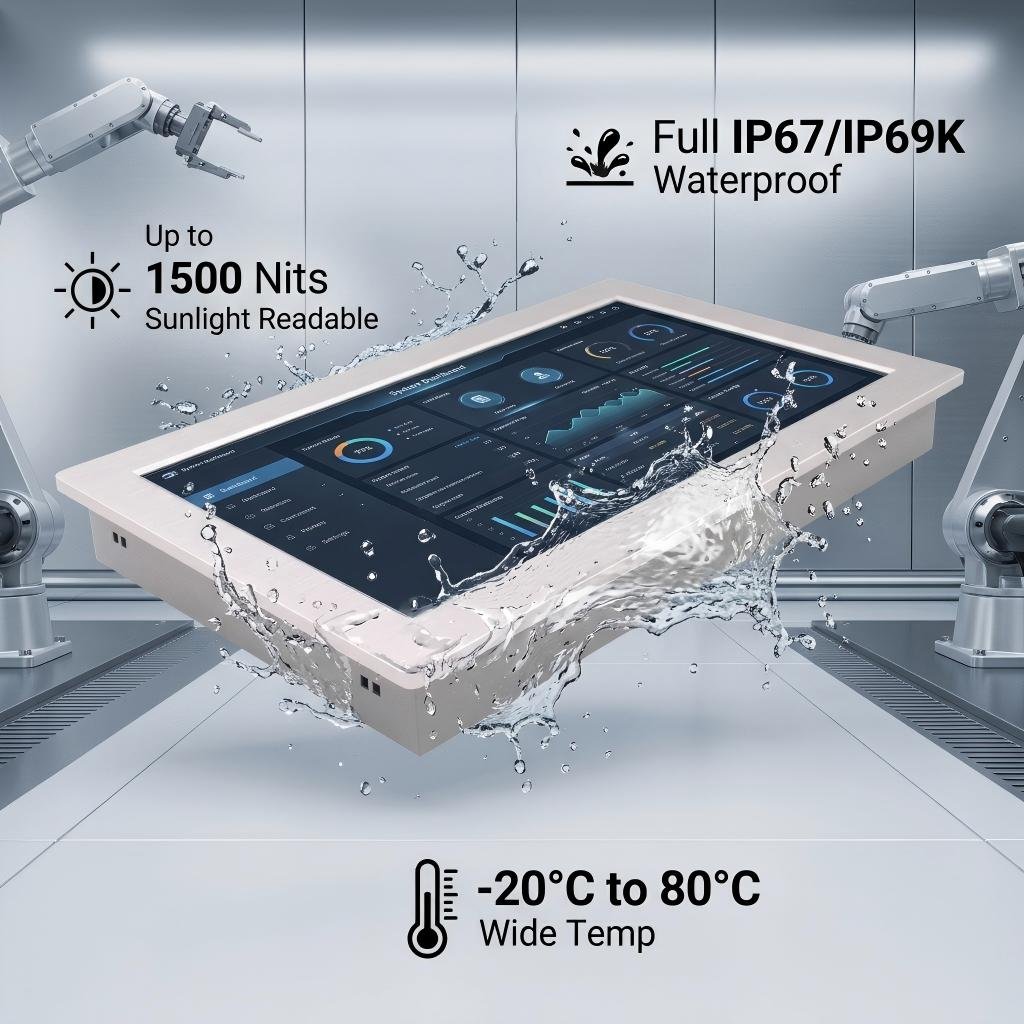
17.3″ Full IP67 CNC Aluminum Industrial PC (J6412)
Built for harsh chemical skids, automated car washes, and wastewater treatment plants. Features an energy-efficient Intel Celeron J6412 processor, full IP67 waterproof immersion sealing, 17.3″ Full HD display, hard-anodized high-emissivity CNC aluminum housing, and all-metal M12 I/O.
2. Monolithic Billet Rigidity Across 400 mm Widescreen Spans
Large-format widescreen displays require high structural rigidity to survive field machinery vibrations:
- Monolithic 6061-T6 CNC Machining: Unlike stamped sheet-metal enclosures that bow under clamp preloads, machining the front and perimeter frame from a solid aluminum billet ensures structural rigidity across its 400 mm horizontal span, maintaining uniform gasket compression.
- Submersible IP67 Immersion Sealing: Precision-milled dovetail gasket retention grooves capture continuous closed-cell fluorosilicone O-rings, preventing chemical foam and water ingress even under 1-meter temporary submersion.
- All-Metal M12 Aviation Cabling: Thread-locking M12 circular connectors provide hermetic connections for dual Gigabit LAN, USB, COM serial, and wide DC 9V-36V power input, eliminating unsealed RJ45 vulnerabilities.
Chemical Skid HMI Enclosure Comparison
| Engineering Parameter | Commercial Sheet-Metal PC | Engineered 17.3″ Full IP67 CNC PC |
|---|---|---|
| Chassis Manufacturing | Folded sheet steel with welded seams | Solid billet CNC-machined 6061-T6 aluminum |
| Surface Emissivity (ε) | Low (ε ≈ 0.20, poor radiation cooling) | High-emissivity hard anodized (ε ≈ 0.85) |
| Ingress Protection Level | IP65 front only (Rear ports pool moisture) | Full IP67 (Front, rear housing, and all M12 I/O) |
| Processor Architecture | High-TDP desktop chip (Requires fan) | Intel Celeron J6412 Quad-Core (10W fanless) |
| Span Deflection under Shock | > 1.5 mm deflection (Breaks gasket seal) | Zero measurable span deflection (<0.05 mm) |
3. Real-World Field Case: Automated Commercial Car Wash Gantry
A regional vehicle wash network in Dallas, Texas experienced repeated terminal burnouts across its automated express tunnels. Commercial IP65 touchscreens installed on the wash gantry suffered internal water fogging and CPU throttling when ambient summer tunnel temperatures reached 45°C alongside high-pressure recycled chemical water spray. After retrofitting the bays with 17.3″ Full IP67 CNC Aluminum J6412 Panel PCs, the operator achieved zero thermal shutdowns and zero seal breaches across 14 consecutive months of 7-day-a-week operation.
Standardizing chemical skids and washdown gantries on 17.3-inch full IP67 CNC aluminum panel PCs ensures reliable widescreen SCADA visualization and eliminates environmental downtime. Contact INNODA’s rugged computing engineering team to request 3D STEP CAD models, thermal imaging reports, and customized M12 cable pinouts.