
Modern petrochemical batching skids, automated water treatment manifolds, building management systems (BMS), and legacy CNC machining skids require industrial computing platforms capable of interfacing with numerous serial field devices. Barcode scanners, weigh scales, variable frequency drives, programmable logic controllers, and Modbus power meters often require dedicated point-to-point serial communication lines. A fanless industrial panel PC equipped with 6 software-configurable COM ports (RS232/RS422/RS485) and running Windows 11 IoT delivers a versatile edge computing platform.
However, running multiple serial communication lines across extensive factory floor distances creates severe electromagnetic vulnerabilities. When multiple external instruments connected to different electrical phases share a common ground bus, ground potential differences generate circulating ground currents that damage serial transceivers. Maintaining 24/7 industrial uptime requires analyzing ground loop mechanics, common-mode transient immunity (CMTI), and preventative serial maintenance protocols.
1. Multi-Drop Ground Loop Potential Differences & Galvanic Isolation Physics
When an industrial computer connects to remote PLCs or motor inverters located 50 to 300 meters away, local electrical earth ground potentials are rarely identical. Ground potential differences (ΔV_gnd) induce circulating DC and AC currents through cable shield and signal ground return paths:
Ground Loop Circulating Current & Transceiver Overstress: Ground Potential Differential between Remote PLC and Panel PC: ΔV_gnd = 15.0 Volts. Non-Isolated Ground Loop Circuit Resistance (Cable ground return wire): R_loop ≈ 1.50 Ω. Circulating Ground Loop Current: I_loop = ΔV_gnd / R_loop = 15.0 / 1.50 = 10.0 Amperes. Transceiver Destruction Hazard: Standard unisolated RS485 transceivers (rated for -7V to +12V common-mode range) experience massive overcurrent, burning out PCB ground traces and silicon driver dies. Galvanic Isolation Barrier Solution: By placing 2.5 kV RMS optocoupler or digital capacitive isolation barriers on each COM port: Isolation Barrier Resistance: R_iso ≥ 1.0 × 10^10 Ω, Barrier Capacitance: C_iso ≤ 1.5 pF. Resulting Circulating Current: I_leakage = ΔV_gnd / R_iso = 15.0 / (1.0 × 10^10) = 1.5 × 10^-9 A = 1.5 nA (Safe, negligible leakage). Common-Mode Transient Immunity (CMTI): Transceiver isolates rapid switching transients up to 50 kV/μs without corrupting digital UART data bits.
Integrating 2.5 kV galvanic isolation and 600W Transient Voltage Suppressors (TVS) across all 6 serial ports prevents circulating ground currents and lightning-induced voltage surges from damaging sensitive internal processor motherboards.
To eliminate serial communication failures across complex factory networks, electrical engineers deploy the Fanless Industrial Panel PC with 6 COM Ports (Windows 11), which combines hardware-isolated serial transceivers with a solid fanless aluminum heatsink chassis.
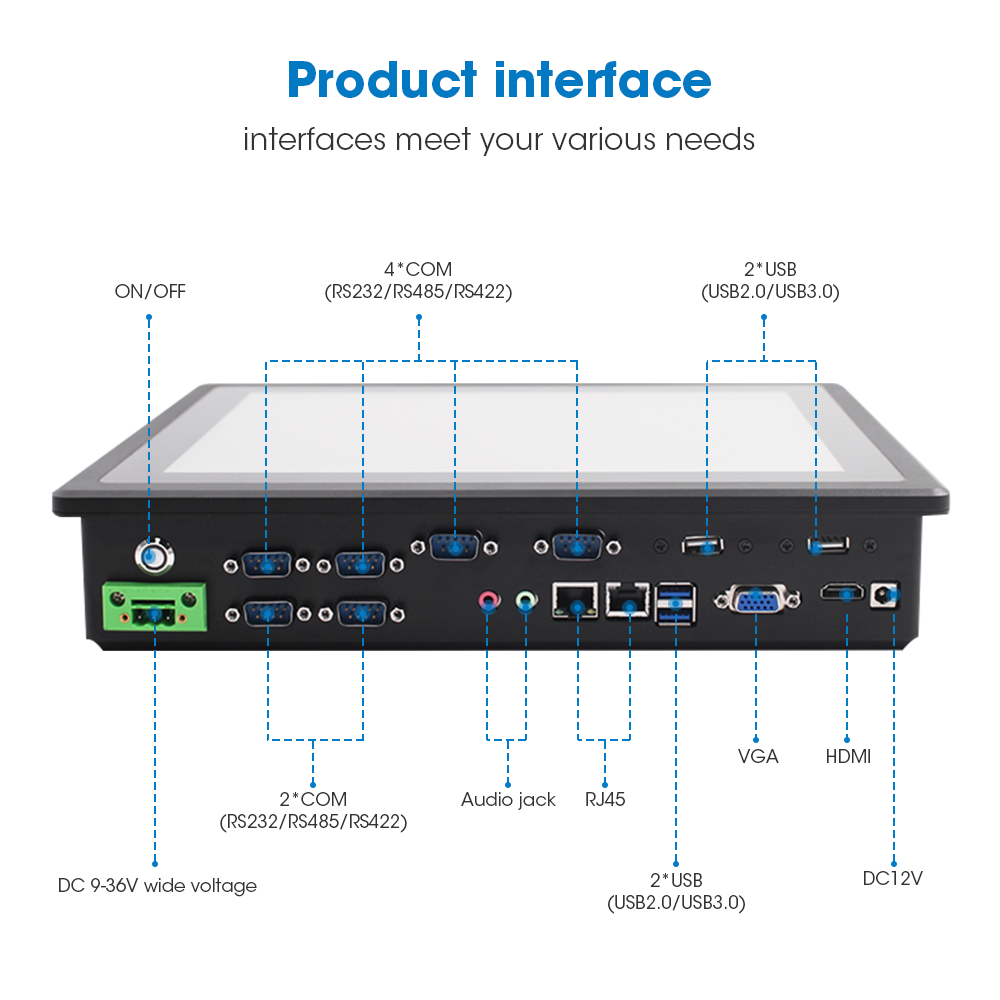
Fanless Industrial Panel PC (6 COM Ports)
Designed for industrial automation skids, Modbus power telemetry, and legacy machine tool integration. Features 6 software-configurable RS232/RS422/RS485 serial ports with 2.5 kV galvanic isolation, 100% fanless passive cooling, IP65 front protection, and Windows 11 IoT support.
2. RS485 Multi-Drop Bus Termination & Windows 11 IoT Tuning
Operating six simultaneous serial communication channels requires proper physical line termination and OS buffer management:
- 120-Ohm End-of-Line Bus Termination: For RS485 multi-drop topologies exceeding 100 meters, engage the 120-Ohm line termination resistor at the two outermost physical nodes. Leaving bus ends open causes signal reflections that corrupt transmission packets.
- Windows 11 IoT Core Isolation & Watchdog Timers: Configure Windows 11 IoT Enterprise to assign dedicated CPU cores to high-priority serial polling threads, backed by an onboard hardware watchdog timer that automatically reboots the system in the event of an unhandled software deadlock.
- Fanless Solid Aluminum Heatsink: The monolithic rear aluminum chassis dissipates heat passively without moving parts, preventing airborne conductive dust and oil mists from being sucked into the internal electronics chamber.
Multi-Serial Industrial Panel PC Comparison Matrix
| Diagnostic Checkpoint | Standard Commercial Panel PC | Engineered 6-COM Fanless Industrial PC |
|---|---|---|
| Serial Port Count & Mode | 1 or 2 fixed RS232 ports only | 6 × Software-selectable RS232/RS422/RS485 ports |
| Galvanic Port Isolation | Non-isolated (Vulnerable to ground loops) | 2.5 kV RMS optical/capacitive isolation barrier |
| Transient Clamping (CMTI) | Unprotected logic pins (Burns out on spikes) | 600W TVS surge clamping with ≥ 50 kV/μs CMTI |
| Thermal Dissipation | Internal fan (Clogs with oil and dust) | 100% Fanless solid aluminum passive conduction |
| Operating System Stability | Consumer Windows 11 with disruptive updates | Windows 11 IoT Enterprise with 10-year LTSC support |
3. Semi-Annual Preventative Maintenance Checklist
- Serial Cable Screw-Lock Inspection: Verify that all DB9 connector retention screws are torqued securely to 0.4 Nm to maintain continuous 360-degree ground shielding contact against machine vibration.
- Ground Potential Verification: Measure AC/DC potential differences between serial cable shields and panel PC chassis ground using a true-RMS multimeter, confirming differences remain below isolated barrier thresholds.
- Chassis Heatsink Fin Clearance: Use clean, dry compressed air (< 2 bar) to blow accumulated shop dust away from the rear aluminum cooling fins to preserve passive convective heat rejection.
Standardizing multi-device factory skids on fanless industrial panel PCs with 6 isolated COM ports eliminates ground loop transceiver burnouts and guarantees deterministic serial telemetry. Contact INNODA’s industrial automation team to request serial pinout schematics, BIOS watchdog configuration guides, and customized panel-mount brackets.