
Modern offshore sportfishing convertibles, commercial charter catamarans, and tournament center-consoles require coordinated navigation across dual helm stations. Skippers and fishing teams operate primary chartplotter and CHIRP sonar displays at the main bridge console while mirroring identical radar feeds, fish-finding returns, and autopilot telemetry at an elevated flybridge or cockpit tuna tower. Operating dual display stations in real time requires robust digital networking and high-speed data synchronization.
However, linking dual marine helm monitors across long cable runs presents severe signal integrity challenges. Connecting multi-drop video distribution networks and NMEA 2000 (CAN bus) sensor backbones over uncalibrated drop cables induces transmission line reflections that corrupt digital packet frames. This leads to dropped sonar pings, frozen chartplotter vectors, and touchscreen command latency during high-stakes fishing tournaments. Solving these challenges requires analyzing transmission line reflections and differential CAN bus bit timing.
1. High-Speed Transmission Line Reflections & CAN Bus Stub Length Limits
NMEA 2000 networks operate on ISO 11898-2 CAN physical layer standards at 250 kbps over a 120-Ohm twisted-pair trunk cable. When a secondary flybridge monitor branches off the main trunk line via a drop cable (stub), transmission line impedance discontinuities generate signal reflections:
CAN Bus Stub Reflection & Round-Trip Delay Physics: Characteristic Trunk Line Impedance: Z_0 = 120 Ω. Unterminated Drop Stub Input Impedance: Z_in ≈ High-Z (Receiver input R_in > 20 kΩ). Voltage Reflection Coefficient: Γ = (Z_in – Z_0) / (Z_in + Z_0) ≈ (20,000 – 120) / (20,000 + 120) ≈ +0.988 ≈ +1.0 (Full in-phase reflection). Signal Propagation Velocity in Marine Cable: v_prop ≈ 0.20 m/ns (Propagation delay t_prop ≈ 5.0 ns/m). For a Drop Stub Cable of Length L_drop = 6.0 meters: Round-Trip Reflection Time: t_rt = 2 × L_drop × t_prop = 2 × 6.0 × 5.0 = 60.0 ns. Bit Sampling Window Timing Margin (at 250 kbps → Nominal Bit Time T_bit = 4,000 ns): Reflection Settle Ratio: t_rt / T_bit = 60 / 4,000 = 1.5%. Engineering Rule: Because the round-trip reflection delay (60 ns) settles within 1.5% of the total bit time (far below the critical 30% sample point threshold), CAN transceiver receivers sample stable differential voltage, eliminating frame error resets across dual stations.
Restricting individual drop stub lengths to under 6 meters while maintaining exactly 120-Ohm termination resistors at both physical trunk endpoints prevents ringing waveforms from corrupting high-priority engine telemetry and sonar sync messages between dual helm stations.
To ensure deterministic real-time data replication across dual steering stations, offshore tournament teams deploy the Tournament Marine Fishing Touch Monitor Dual Station Sonar, which features dual isolated NMEA 2000 transceiver ports and low-latency digital video inputs.
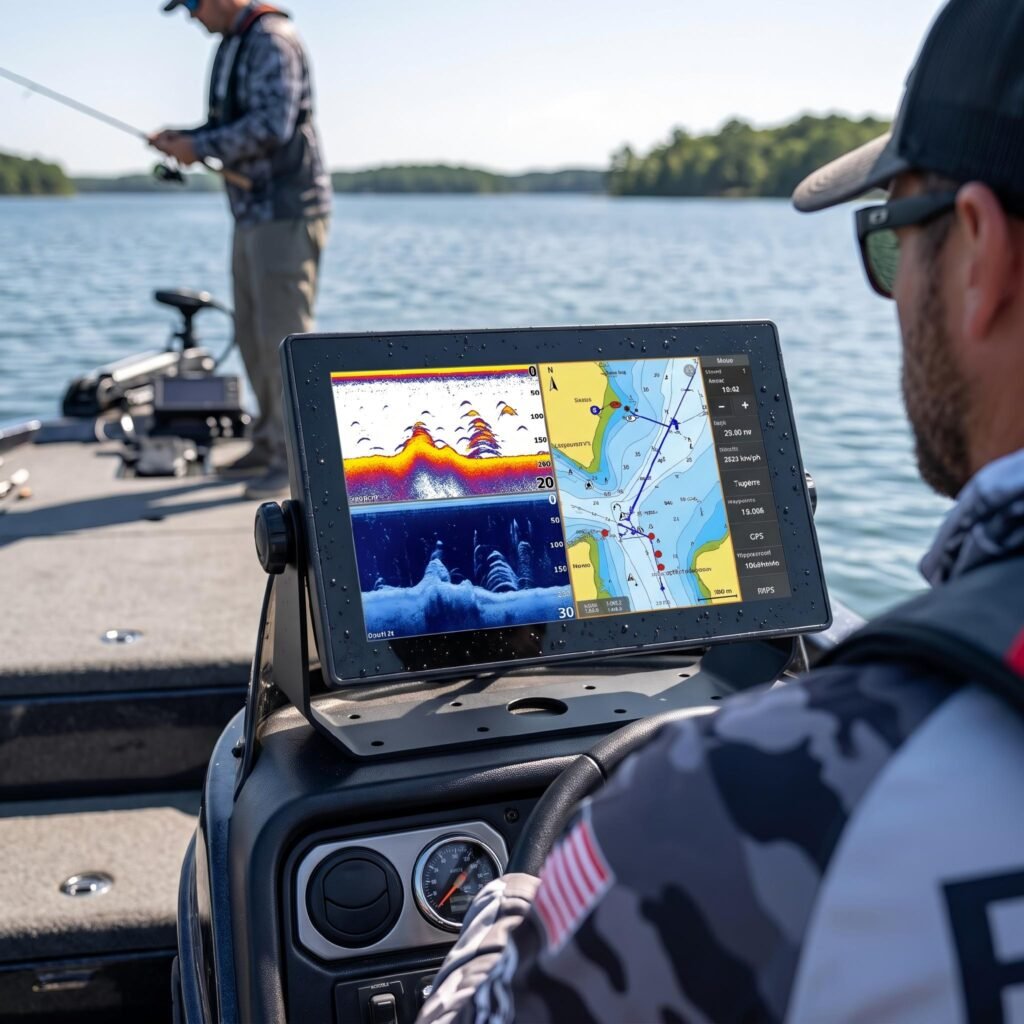
Tournament Marine Dual-Station Sonar Monitor
Designed for offshore sportfishing yachts, dual-helm flybridges, and tournament center-consoles. Features 1500 nits ultra-bright daylight visibility, LOCA optical wet bonding, isolated NMEA 2000 CAN bus interfaces, and responsive wet-finger PCAP touch tracking.
2. Dual-Station Synchronous Control & Marine Salt Spray Defenses
Managing dual-station tournament fishing demands responsive hardware integration:
- Dual Independent Touch Channel Routing: Both main helm and flybridge displays feature independent USB and RS232 touch interfaces, allowing the flybridge captain and deck team to interact with navigation charts simultaneously without input conflicts.
- 1500 Nits High-Luminance Optical Stack: The elevated flybridge station experiences unshielded sunlight glare. Utilizing 1500-nit industrial LED arrays with LOCA wet bonding ensures fish arches and contour lines remain razor-sharp under open skies.
- Galvanic Marine Isolation (1.5 kV): Power, video ground, and network interfaces feature optical and transformer isolation, preventing ground loops between main engine batteries and auxiliary flybridge power banks.
Dual Helm Marine Display Comparison Matrix
| Operational Metric | Consumer Marine Display | Engineered Tournament Dual Monitor |
|---|---|---|
| Flybridge Sunlight Legibility | 600 Nits (Unreadable in open tuna tower) | 1500 Nits daylight-viewable with LOCA bonding |
| NMEA 2000 Integration | Non-isolated port (Prone to bus lockups) | 1.5 kV Galvanically isolated CAN transceiver |
| Dual-Station Input Latency | > 120 ms lag across wireless mirroring | ≤ 8 ms zero-latency hardwired video loop |
| Front Ingress Protection | IP54 / light splash resistant only | Certified IP67 all-weather waterproof front seal |
| Chassis Material | Molded plastic (Yellows and degrades in UV) | Heavy CNC-machined marine-grade aluminum |
3. Real-World Field Case: 55-Foot Tournament Sportfisher
A competitive big-game fishing team based in Cabo San Lucas experienced recurrent flybridge screen freezes during billfish hookups. Standard consumer chartplotters connected via long drop lines suffered communication packet collisions whenever the main helm CHIRP sonar operated at maximum pulse rate. After upgrading both helm and flybridge stations to Tournament Marine Fishing Touch Monitors, the vessel recorded zero network dropouts and instant sonar response across 40 consecutive tournament days, securing a podium finish.
Equipping dual-station fishing vessels with rugged 1500-nit tournament marine touch monitors guarantees deterministic sonar synchronization and eliminates open-bridge glare washouts. Contact INNODA’s tournament marine electronics team to request NMEA 2000 network schematics, dual-station wiring guides, and custom flush-mount brackets.