
In high-throughput automated poultry processing plants, meat cutting facilities, and commercial dairy processing halls, operator human-machine interfaces (HMIs) face the most severe sanitation conditions in modern manufacturing. Routine plant hygiene regimens do not rely on gentle spray nozzles; instead, sanitation crews deploy high-pressure hot water spray lances operating at pressures up to 100 bar (1,450 PSI) and water temperatures up to 80°C. An HMI terminal deployed in these primary washdown zones must adhere to the international DIN 40050-9 and ISO 20653 IP69K ingress standards.
Specifying a standard IP65 or IP66 computer in IP69K environments leads to rapid hardware destruction. High-velocity water jets peel flat gaskets away from enclosure edges, while sudden thermal drops from hot steam washing create internal vacuum differentials that suck liquid water past connector threads. Selecting a durable 15.6-inch stainless steel washdown PC requires analyzing high-temperature hydrodynamic jet impact forces, internal vacuum condensation physics, and hermetic M12 connector retention.
1. High-Velocity Hydrodynamic Impact & Thermal Vacuum Contraction
Under the ISO 20653 IP69K test procedure, an enclosure is blasted from four distinct angles (0°, 30°, 60°, and 90°) at a distance of 100 mm to 150 mm with 80°C water flowing at 14 to 16 L/min under 100 bar (10 MPa) line pressure. The kinetic energy of the high-velocity jet converts directly into a concentrated stagnation force upon striking the enclosure face:
Hydrodynamic Jet Velocity & Dynamic Impact Force: Nozzle Exit Velocity (Bernoulli Equation): v_jet = [ (2 × P_system) / ρ ]^0.5 = [ (2 × 10 × 10^6) / 1000 ]^0.5 ≈ 141.42 m/s. Continuous Impact Force (Mass Flow Rate Q = 15 L/min ≈ 2.5 × 10^-4 m³/s): F_impact = ρ × Q × v_jet = 1000 × (2.5 × 10^-4) × 141.42 ≈ 35.36 N concentrated point force. Internal Vacuum Pressure Differential (Rapid Thermal Shock): When an 80°C (353.15 K) steam-washed terminal cools to a 20°C (293.15 K) ambient room: ΔP_internal = P_0 × [ 1 – (T_cold / T_warm) ] = 101.325 kPa × [ 1 – (293.15 / 353.15) ] ≈ 17.22 kPa vacuum. Engineering Implication: An internal vacuum of 17.22 kPa acts as a continuous suction pump across all perimeter seams. Seals lacking mechanical dovetail compression channels allow washdown liquids to be drawn directly into internal electronics.
Without engineered compression stops and hydrophobic pressure-relief membranes, this 17.22 kPa vacuum differential pulls moisture across rubber seals during shift cool-downs. Precision-machined dovetail grooves retain fluorosilicone O-rings under calibrated 35% mechanical compression, withstanding both 35.4 N dynamic water jet impacts and continuous vacuum suction.
To withstand extreme daily sanitation cycles without moisture ingress, food manufacturing engineers standardize on the 15.6″ Full IP69K Stainless Steel Panel PC with M12, which combines an electropolished SUS304/SUS316L enclosure with certified full IP69K ingress sealing.
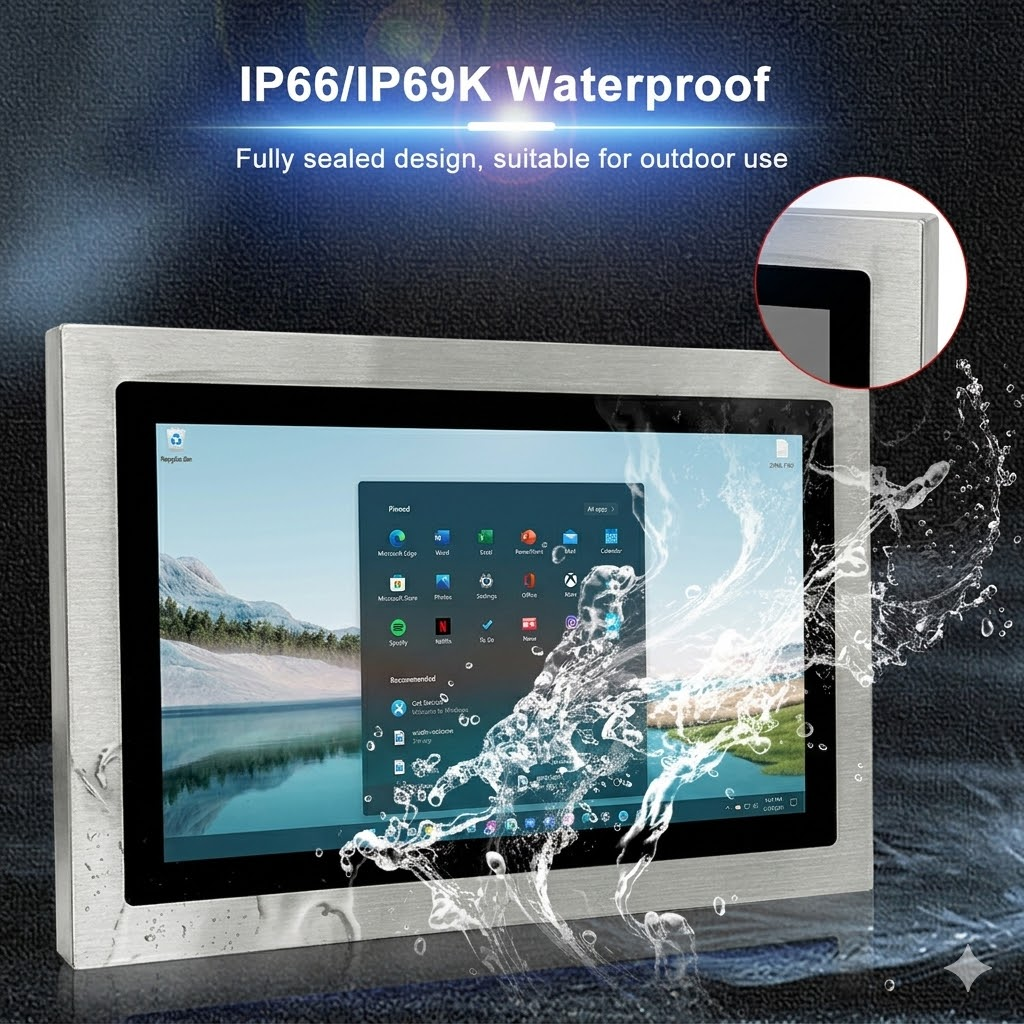
15.6″ Full IP69K Stainless Steel Panel PC (M12)
Engineered for automated slaughterhouses, dairy lines, and chemical washdown suites. Features certified full IP69K ingress protection against 100-bar 80°C steam jets, electropolished SUS304/316L housing, all-metal M12 circular I/O, and thick-glove PCAP touch.
2. Crevice-Free Sanitary Metallurgy & All-Metal M12 Connectivity
Meeting European Hygienic Engineering & Design Group (EHEDG) criteria requires strict attention to mechanical geometry and cabling:
- Electropolished Stainless Steel (Ra ≤ 0.4 μm): Standard brushed finishes leave microscopic valleys where bacterial biofilms anchor. Electropolishing creates a smooth chromium-rich passive layer that releases meat residues and dairy proteins during cleaning.
- All-Metal Knurled M12 Connectors: External power, dual Ethernet, USB, and COM lines route through heavy-duty SUS304/316 M12 circular connectors, eliminating fragile plastic glands that shatter under 100-bar water lances.
- Internal ePTFE Pressure Equalization Vent: An integrated hydrophobic membrane permits bidirectional air exchange to neutralize internal vacuum differentials while preventing liquid water and steam penetration.
Food Sanitation HMI Ingress Comparison Matrix
| Engineering Parameter | Standard IP65 Industrial PC | Engineered 15.6″ Full IP69K Stainless PC |
|---|---|---|
| Washdown Ingress Rating | IP65 (Fails above 0.3 bar pressure) | Full IP69K (Resists 100 bar at 80°C steam spray) |
| Connector Sealing Type | Plastic glands or unsealed RJ45 rubber boots | All-metal stainless M12 circular screw ports |
| Surface Metallurgy | Painted aluminum (Flakes in caustic wash) | Solid SUS304/316L electropolished (Ra ≤ 0.4 μm) |
| Thermal Vacuum Management | Unvented (Draws water across seals on cooling) | Integrated hydrophobic ePTFE equalization vent |
| Wet Touchscreen Control | Erratic touches and cursor lockup in water | Mutual-capacitance DSP water-film rejection |
3. Installation Guidelines for High-Pressure Washdown Zones
- M12 Connector Preload Calibration: Hand-tighten all stainless M12 circular connectors, then apply a calibrated torque of 0.6 Nm using an open-end torque wrench to seat the inner Viton O-rings without over-compressing the elastomeric core.
- Sloped Arm Mounting Orientation: Mount the panel PC on a sanitary stainless swing arm angled at least 15 degrees forward to ensure washdown water and foam cleaners run off naturally without pooling on top surfaces.
- Drip Loop Cable Dressing: Form a 120 mm downward drip loop on all M12 cable harnesses prior to the entry gland to shed water away from the connection point.
Standardizing protein processing and dairy packaging lines on 15.6-inch full IP69K stainless steel panel PCs eliminates water damage downtime and ensures compliance with global sanitary audits. Contact INNODA’s food automation engineering team to request 3D CAD envelope drawings, IP69K test certificates, and custom M12 cable assemblies.