
Outdoor shipboard winches, open-pit mining conveyor consoles, fuel distribution skids, and agricultural batching stations operate in environments exposed to intense ambient sunlight. Operating a human-machine interface under direct solar illumination reaching 80,000 to 100,000 lux creates severe optical washouts. Standard industrial monitors outputting 300 to 400 nits become completely illegible, causing operator fatigue and dangerous equipment control errors. A 15.6-inch widescreen (16:9 Full HD 1920×1080) high-brightness terminal delivers the resolution required for modern SCADA graphics, but introducing ultra-high luminance into a sealed stainless steel enclosure presents formidable thermal engineering hurdles.
Driving an LED backlight matrix to 1500 nits requires approximately 28 Watts of electrical power, generating substantial concentrated heat. In a hermetically sealed full IP67 stainless steel enclosure without ventilation slots or fans, trapped thermal energy can rapidly drive internal liquid crystal fluids past their clearing point, producing black solar blotches across the screen. Overcoming these challenges requires optimizing the display’s Ambient Contrast Ratio (ACR), deploying liquid optical clear adhesive (LOCA) bonding, and engineering internal heat pipe conduction paths.
1. Ambient Contrast Ratio (ACR) Mathematical Modeling under 100,000 Lux
Legibility under direct sunlight is not determined by raw backlight luminance alone; it is fundamentally governed by the ratio between active emitted light and reflected ambient light bouncing off the display glass stack:
Ambient Contrast Ratio (ACR) Equation: ACR = (L_on + L_reflected) / (L_off + L_reflected) Where: – Ambient Direct Solar Illuminance: E_ambient = 100,000 lux. – Equivalent Ambient Glare Luminance: L_ambient = E_ambient / π ≈ 31,830 cd/m². – Display Peak White Luminance: L_on = 1500 cd/m² (Nits); Black State Luminance: L_off = 1.5 cd/m². Case A: Unbonded Air-Gap Display (Reflectance R = 4.5% = 0.045): L_reflected = 31,830 × 0.045 ≈ 1,432.35 cd/m². ACR_unbonded = (1500 + 1432.35) / (1.5 + 1432.35) = 2932.35 / 1433.85 ≈ 2.05 : 1 (Faded, washed out). Case B: LOCA Optical Wet Bonding + AR Coated Cover Glass (Reflectance R ≤ 0.5% = 0.005): L_reflected = 31,830 × 0.005 ≈ 159.15 cd/m². ACR_bonded = (1500 + 159.15) / (1.5 + 159.15) = 1659.15 / 160.65 ≈ 10.33 : 1 (High-contrast, razor-sharp).
Because full LOCA optical wet bonding eliminates internal air-glass refractive index boundaries (matching refractive index n ≈ 1.49), internal reflections are suppressed. The resulting 10.33:1 contrast ratio exceeds the international standard 5:1 threshold for safe outdoor operator readability.
To deliver clear readability under blinding direct sunlight, system integrators standardize on the 15.6″ Full IP67 Stainless Steel Panel PC (1500 Nits) which pairs a 1500-nit high-luminance WLED matrix with full LOCA optical wet bonding.
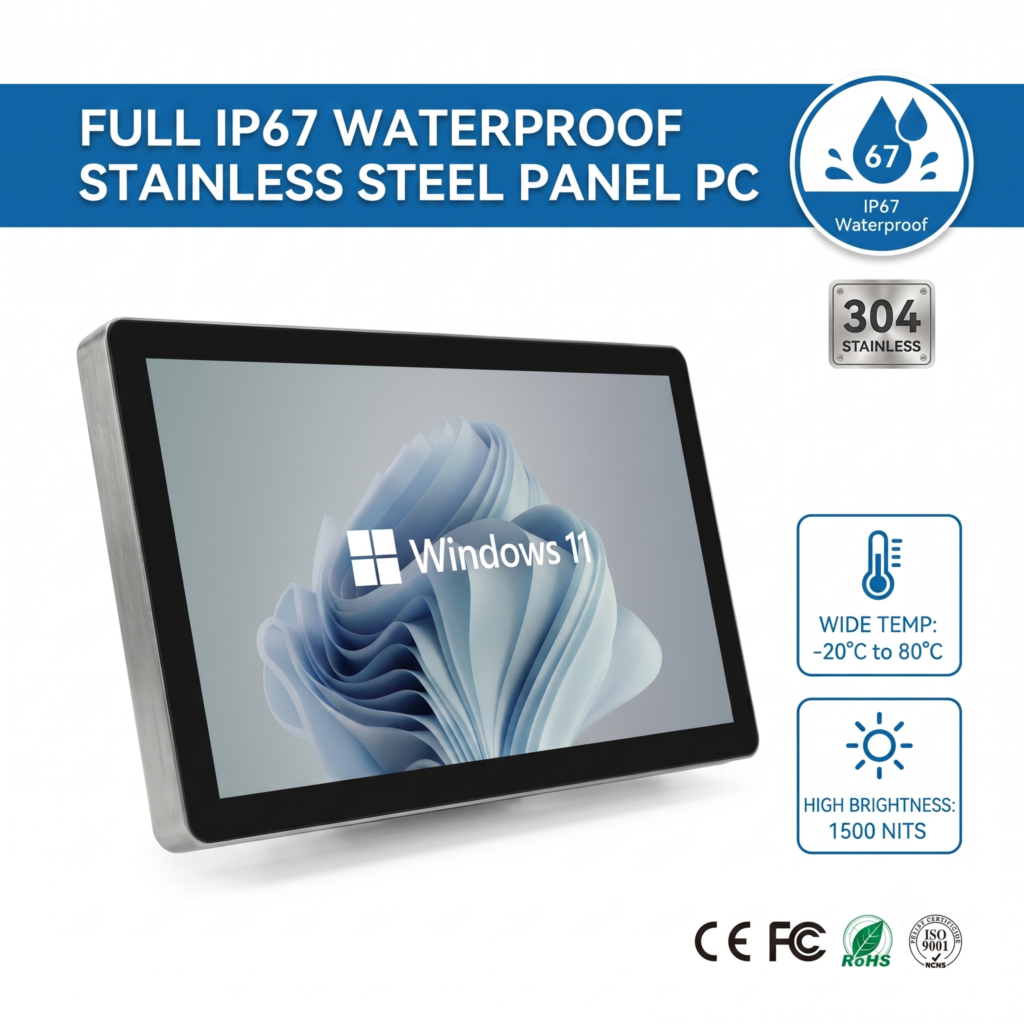
15.6″ Full IP67 Stainless Steel Panel PC (1500 Nits)
Designed for outdoor marine decks, open-pit mining skids, and high-glare industrial terminals. Features 1500 nits sunlight readability with LOCA optical wet bonding, ACR > 10:1 under 100,000 lux, full IP67 stainless steel sealing, and internal copper heat pipes.
2. Thermal Conduction via Copper Heat Pipes in Sealed Stainless Housings
Stainless steel possesses a low thermal conductivity (k ≈ 16 W/(m·K)) compared to aluminum (k ≈ 167 W/(m·K)). Dissipating 28W of backlight power plus 15W of processor TDP inside a sealed stainless enclosure requires engineered heat spreading:
- Internal Sintered Copper Heat Pipes: High-conductivity copper heat pipes (effective k > 10,000 W/(m·K)) bridge the rear LED backlight rail and CPU directly to an internal aluminum conduction spreader, distributing thermal flux evenly across the chassis.
- High-Clearing-Point (T_ni > 105°C) Liquid Crystals: Utilizes specialized wide-temperature liquid crystal fluid that resists solar isotropic blackening up to 105°C, preventing dark blotches from forming under solar loading.
- Full 0% to 100% PWM Dimming: Allows smooth, flicker-free dimming from 1500 nits under midday sun down to less than 1 nit for nighttime operations, preserving operator night vision.
Outdoor Sunlight-Readable HMI Comparison
| Engineering Parameter | Standard Commercial Outdoor Display | Engineered 15.6″ 1500 Nits Stainless PC |
|---|---|---|
| Peak Screen Luminance | 350 – 500 Nits (Unreadable in full sun) | 1500 Nits constant-current industrial WLED |
| Optical Bonding Stack | Air gap (Internal reflection > 4.5%) | Full LOCA wet bonding (Reflectance ≤ 0.5%) |
| Solar Blackening Resistance | Fails at 75°C (Black blotches under sun) | High-clearing-point liquid crystal (T_ni ≥ 105°C) |
| Ingress Protection Level | IP54 / IP65 front face only | Full IP67 (Front, rear, and all M12 ports) |
| Chassis Material | Plastic / painted steel (UV degradation) | Solid electropolished SUS304/SUS316L stainless |
3. Commissioning Guidelines for Outdoor Solar Installations
- Solar Radiation Shielding: When mounting the panel PC on an outdoor marine console or fueling island, orient the display facing north (in the Northern Hemisphere) or utilize an overhead sunshade hood to minimize passive solar heat gain.
- Power Supply Derating: Size the external 24V DC industrial power supply with a 30% power margin (≥ 90W rating) to comfortably supply the high-brightness backlight running at maximum luminance during summer peak hours.
- Optical Cleaning Protocol: Clean the anti-reflective front glass using optical-grade microfiber cloths dampened with pure isopropyl alcohol (IPA). Avoid ammonia-based window sprays that could degrade the anti-smudge surface coating.
Upgrading outdoor process skids and marine consoles with optically bonded 1500-nit full IP67 stainless steel panel PCs guarantees high optical contrast under direct solar glare. Contact INNODA’s optical engineering team to request spectrophotometer reflectance plots, thermal imaging profiles, and custom sunshade mounting brackets.