
Modern commercial dairy packaging halls, meat portioning conveyors, and ready-to-eat food preparation lines operate under strict hygiene regulations governed by the European Hygienic Engineering & Design Group (EHEDG) and the U.S. Department of Agriculture (USDA). Human-machine interface terminals installed directly above open food zones are classified as product-contact or splash-zone equipment. In these sensitive locations, an HMI cannot merely be waterproof; it must be architecturally incapable of harboring pathogenic bacterial biofilms (such as Listeria monocytogenes and Salmonella enterica).
Traditional industrial computers fabricated from folded sheet steel or mill-finished aluminum fail microbiological audits. Microscopic machining fissures, horizontal ledges, and exposed external fastener threads trap organic food residues that resist standard chemical sanitizers. Over time, bacteria anchor within surface micro-valleys, forming protective extracellular polymeric substance (EPS) matrices that withstand casual chemical washing. Engineering a compliant stainless steel HMI requires analyzing boundary fluid shear stresses during Clean-in-Place (CIP) cycles, electropolished chromium oxide passivation ratios, and internal crevice-free geometries.
1. Boundary Layer Wall Shear Stress & Biofilm Mechanical Detachment
During automated CIP and high-velocity hose washdowns, removing adherent organic films and bacterial colonies depends on the hydrodynamic wall shear stress (τ_w) exerted by turbulent fluid flow across the HMI surface:
Hydrodynamic Wall Shear Stress & Biofilm Removal Equation: τ_w = 0.5 × f × ρ × v_cip^2 Where: – Washdown Fluid Density: ρ = 1000 kg/m³. – CIP Surface Wash Velocity: v_cip = 1.80 m/s (standard turbulent sanitation flow). – Darcy Friction Factor for Smooth Electropolished Stainless (Ra ≤ 0.4 μm): f ≈ 0.0210. Wall Shear Stress Calculation: τ_w = 0.5 × 0.0210 × 1000 × (1.80)^2 = 10.5 × 3.24 ≈ 34.02 Pa (N/m²). Microbiological Adhesion Threshold: Critical hydrodynamic shear stress required to tear *Listeria* extracellular polymeric substance (EPS): τ_crit ≈ 2.50 Pa to 5.00 Pa. Engineering Margin: Because τ_w (34.02 Pa) is nearly 7 times higher than τ_crit (5.00 Pa), biofilm matrices are stripped completely away under laminar-turbulent boundary flow, provided the surface lacks microscopic anchorage valleys (Ra ≤ 0.4 μm).
Standard brushed finishes (Ra > 1.6 μm) present surface crevasses deeper than the bacterial cell radius (typically 0.5 μm to 1.0 μm). Fluid velocity drops to zero inside these valleys (no-slip condition), shielding microbes from the 34 Pa shear wash. Electropolishing dissolves these peaks, ensuring high shear stress scrubs every surface square millimeter.
To eliminate microbiological contamination risks across open food production conveyors, processing engineers standardize on the 19″ Stainless Steel Waterproof Panel PC (IP66/IP69K), which features solid SUS304/SUS316L electropolished housings certified to Ra ≤ 0.4 μm surface smoothness.
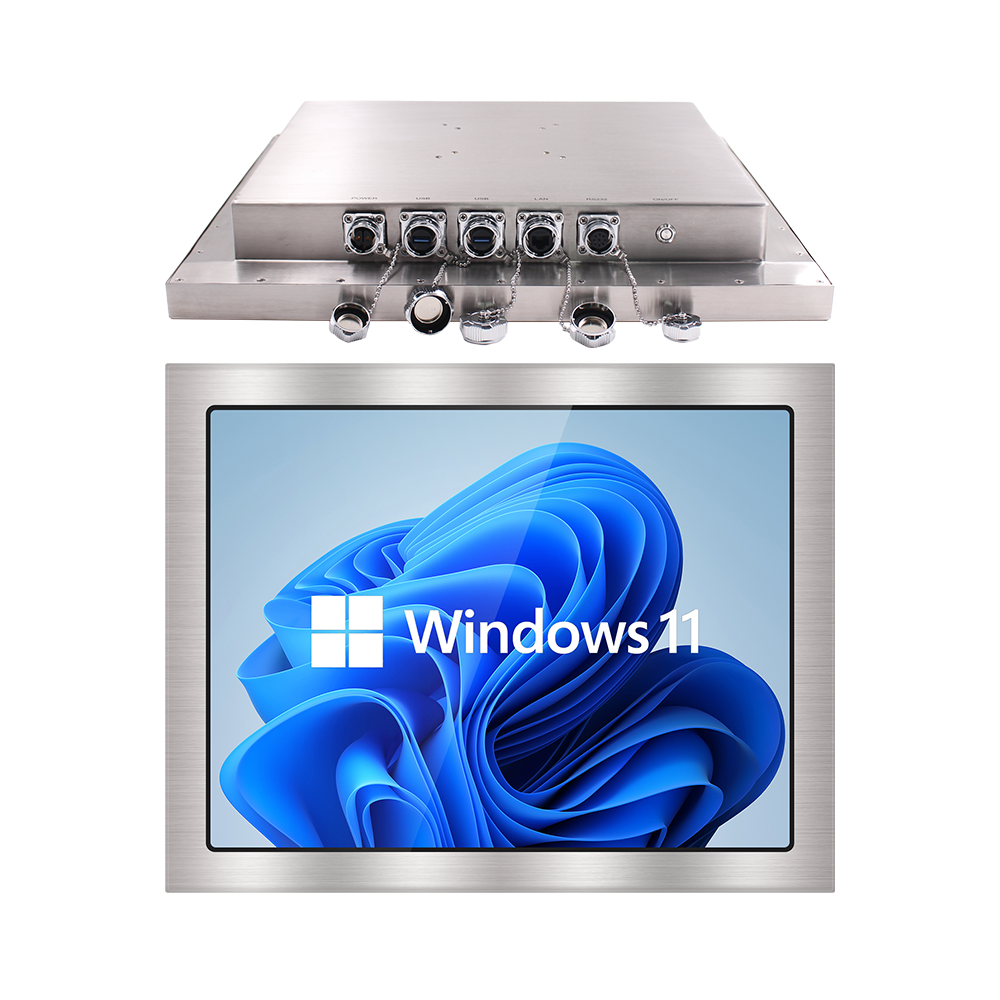
19″ Stainless Steel Waterproof Panel PC
Engineered for sanitary food lines, dairy processing, and pharmaceutical cleanrooms. Features a solid SUS304/SUS316L electropolished enclosure (Ra ≤ 0.4 µm), certified full IP66/IP69K sealing against 100-bar steam washdowns, all-metal M12 I/O, and glove-responsive touch.
2. Chromium Oxide Passivation Metallurgy & EHEDG Crevice Elimination
Achieving international sanitary compliance requires strict mechanical and chemical specifications:
- Chromium/Iron Passivation Ratio (Cr/Fe ≥ 2.0): Chemical electropolishing selectively strips free iron from the surface lattice, elevating the surface chromium oxide (Cr2O3) concentration. This creates a dense passive barrier that withstands continuous contact with chlorinated foams and peracetic acid.
- Continuous 15-Degree Self-Draining Slopes: Enclosure tops and bezel profiles feature minimum 15-degree angles without horizontal planes, ensuring cleaning fluids and rinse water drain completely under natural gravity.
- Seamless Flush Edge Transitions: The 7H chemically strengthened front glass bonds flush with the stainless bezel, eliminating steps where fluid surface tension could cause liquid pooling.
Sanitary Food Processing HMI Architecture Matrix
| Engineering Parameter | Standard Commercial Panel PC | Engineered Stainless Steel HMI |
|---|---|---|
| Surface Roughness (Ra) | Mill finished or painted (Ra > 1.6 μm) | Electropolished SUS304/SUS316L (Ra ≤ 0.4 μm) |
| Biofilm Trapping Valleys | Micro-crevices protect bacterial EPS | Zero micro-fissures (100% fluid shear cleanable) |
| CIP Chemical Resistance | Paint flakes and blisters in caustic wash | Immune to pH 1 to 13 acids and alkaline sanitizers |
| External Fasteners | Standard hex bolts with exposed threads | Zero exposed threads / hygienic blind weld studs |
| Washdown Ingress Rating | IP65 front only (Rear ports pool moisture) | Full IP66 / IP69K (Resists 100 bar steam washdown) |
3. Plant Commissioning & Passivation Maintenance Protocols
- ATP Bioluminescence Swab Testing: Following initial installation and cleaning, execute rapid ATP swab tests across the glass-to-steel bezel transition, verifying Relative Light Units (RLU < 10) to confirm zero organic residue retention.
- M12 Aviation Port Torque Calibration: Torque all stainless M12 circular cable connectors to 0.6 Nm using an open-end torque wrench, ensuring internal Viton O-rings maintain hermetic sealing without core distortion.
- Periodic Citric Acid Passivation: Wipe down exterior stainless surfaces semi-annually with a 10% citric acid passivation wipe to dissolve exogenous iron dust and regenerate the protective chromium oxide film.
Upgrading food processing, beverage bottling, and dairy packaging lines with electropolished stainless steel HMIs eliminates microbiological contamination risks and ensures seamless compliance with global sanitary audits. Contact INNODA’s sanitary HMI engineering team to request EHEDG design compliance whitepapers, 3D STEP packaging models, and custom stainless swing-arm brackets.