
Unattended public environments, automated logistics hubs, and heavy manufacturing kiosks subject touch terminals to continuous physical punishment. Equipment deployed in ticketing kiosks, outdoor payment terminals, and security gatehouses faces not only abrasive dust and liquid cleaning, but deliberate mechanical impacts, sharp-tool vandalism, and high-frequency card swiping.
Specifying an industrial interface for these demanding environments requires navigating international impact resistance classifications—primarily EN 62262 (IK Ratings)—while ensuring touch sensors, display polarizers, and integrated access peripherals survive years of continuous mechanical fatigue.
1. Impact Mechanics & Chemical Tempering Physics: IK08 vs. IK10
The standard EN 62262 defines kinetic impact energy using drop-hammer mechanisms:
- IK08 (5 Joules Impact): Corresponds to a 1.7 kg steel mass dropped from a height of 300 mm. Adequate for supervised plant floors and commercial kiosks.
- IK10 (20 Joules Impact): Represents a 5.0 kg steel element dropped from 400 mm directly onto the front faceplate. This level of kinetic energy will shatter standard annealed glass into high-velocity shards.
To achieve true IK10 impact absorption without compromising projected capacitive (PCAP) signal responsiveness, industrial glass undergo potassium-sodium ion exchange baths ($KNO_3$ at 400°C). Large potassium ions displace smaller sodium ions on the outer glass surface, establishing a continuous Compressive Stress Layer (Depth of Layer ≥ 40 μm). When mechanical point impact occurs, surface tension prevents micro-fissures from propagating inward.
For high-traffic public surveillance and control points, deploying a large-format sealed solution such as the 21.5″ Full IP65 Waterproof Touch Industrial Monitor provides the structural thickness and front IP65 sealing required to dissipate mechanical shocks while barring moisture ingress.
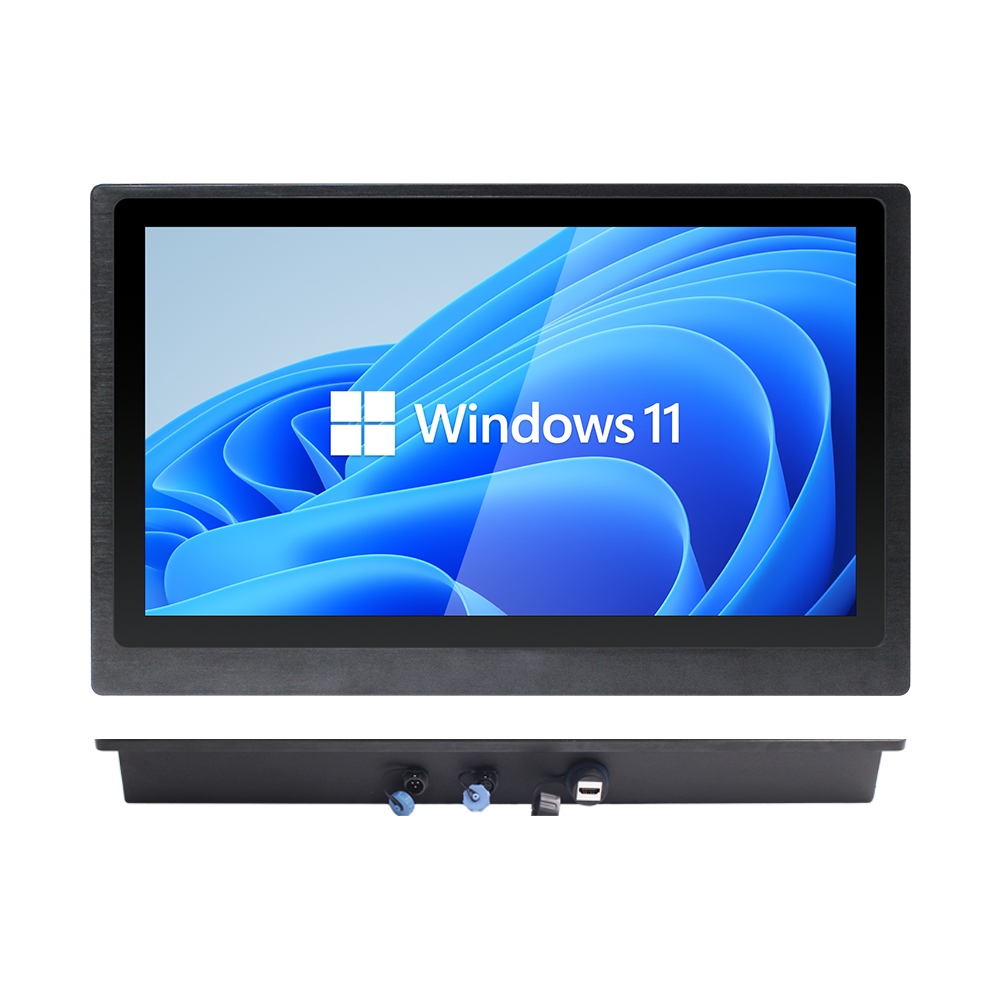
21.5″ Full IP65 Waterproof Touch Industrial Monitor
Engineered for high-traffic environments and demanding automation interfaces. Features chemically strengthened true-flat PCAP touch glass, full IP65 waterproof housing, and wide DC input options to resist physical vandalism and washdown ingress.
2. Peripheral Integration: Magnetic Stripe & RFID Access Modules
Kiosks and time-tracking terminals frequently require integrated identity verification. Consumer card readers introduce deep exterior slots that invite liquid tampering, coin jamming, and electrostatic discharge (ESD) surges.
Industrial terminals resolve these vulnerabilities by integrating potted, flush-mounted peripherals directly into the chassis. Hardware such as the 10.4″ Touch Panel PC with Magnetic Card Reader combines heavy-duty chassis grounding with sealed reader heads, shielding internal serial decoders against ±15kV air ESD discharges during physical card friction.
Impact & Access Specification Matrix
| Rating / Standard | Impact Energy (Joules) | Recommended Deployment Zone |
|---|---|---|
| IK07 (IEC 62262) | 2.0 Joules (0.5 kg drop from 400 mm) | Enclosed control rooms, clean laboratory HMIs |
| IK08 (IEC 62262) | 5.0 Joules (1.7 kg drop from 300 mm) | Supervised factory automation, packaging lines |
| IK10 (IEC 62262) | 20.0 Joules (5.0 kg drop from 400 mm) | Unattended outdoor kiosks, correctional facilities, logistics yard gates |
Are you designing an unattended access terminal or high-impact interactive kiosk requiring certified IK10 protection? Contact INNODA’s mechanical engineering specialists for impact testing compliance documentation and customized reader mounting CADs.