Selecting the best HMI to buy for a food processing line is one of the most critical hardware procurement decisions facing plant automation managers, equipment OEMs, and sanitary compliance engineers. In automated protein slaughterhouses, commercial bakeries, and dairy packaging lines, operator terminals do not operate in climate-controlled server rooms. Instead, they operate directly inside caustic sanitation washdown zones subject to daily Clean-in-Place (CIP) and Clean-out-of-Place (COP) chemical washdowns.
Procuring commercial-grade touchscreens or painted aluminum computers for food lines leads to rapid operational failure. Caustic alkaline foam dissolves painted finishes within weeks, acidic wheel cleaners cause intergranular corrosion along weld lines, and water ingress breaches perimeter seals during high-pressure spraying, shutting down entire production conveyors.
1. Chemical Cleaning Dynamics & Hydrodynamic Jet Stagnation
Modern food sanitation protocols alternate daily between concentrated alkaline detergents (2% to 4% sodium hydroxide, pH 12 to 13) to dissolve animal fats and nitric/phosphoric acid descalers (pH 1.5 to 2.5) to strip mineral scale. Simultaneously, operators blast machines using washdown spray lances at pressures between 20 bar and 40 bar:
Hydrodynamic Washdown Jet Force & Thermal Pressure Differential: Jet Impact Force: F_impact = ρ × Q × v_nozzle Where: – Fluid Density ρ ≈ 1000 kg/m³. – Flow Rate Q = 20 L/min ≈ 3.33 × 10^-4 m³/s. – Nozzle Velocity v_nozzle ≈ 63 m/s (under 20 bar system pressure). Resulting Impact Force: F_impact = 1000 × (3.33 × 10^-4) × 63 ≈ 21.0 N continuous point force. Internal Vacuum Stress (Rapid Thermal Drop): When an HMI warmed by internal computing components (T_internal = 45°C) is suddenly doused with 10°C cold sanitation water: ΔP_internal = P_0 × [ 1 – (T_cold / T_warm) ] = 101.3 kPa × [ 1 – (283.15 / 318.15) ] ≈ 11.1 kPa vacuum.
This 11.1 kPa internal negative pressure acts as a suction pump across enclosure seals. If an HMI utilizes flat foam gaskets without mechanical compression stops, sanitation washdown foam is sucked directly across the seal interface and onto internal power converters.
To eliminate washdown penetration and satisfy strict international food hygiene regulations, plant engineers standardize on the 19″ Full IP67 Stainless Steel Panel PC, which features a continuous closed-cell fluorosilicone perimeter seal seated in a CNC-machined dovetail groove that resists both high-pressure washdown and vacuum suction.
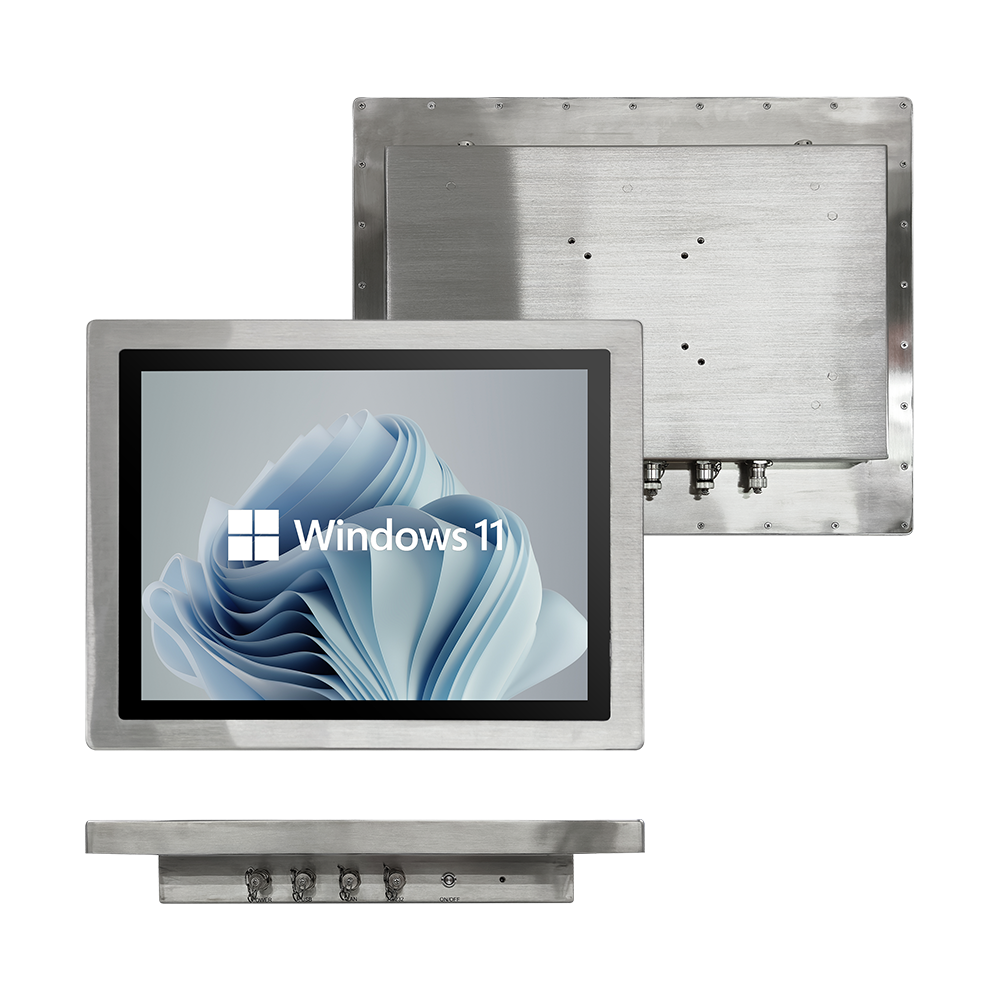
19″ Full IP67 Stainless Steel Industrial Panel PC
The premier HMI choice for food processing, dairy packaging, and CIP washdown environments. Built with heavy SUS304/316L stainless steel, seamless electropolished flush front glass, full IP67 washdown sealing, and thick-glove PCAP touch responsiveness.
2. Hygienic Metallurgy: SUS304 vs. SUS316L & Crevice-Free Geometry
Meeting EHEDG (European Hygienic Engineering & Design Group) and FDA 21 CFR standards requires strict control over surface metallurgy and housing angles:
- Austenitic Stainless Steel Grades: Standard food packaging lines deploy SUS304 stainless steel. In marine seafood processing, high-salt brine curing, or concentrated acid environments, specifying SUS316L (containing 2.0% to 2.5% Molybdenum) prevents chloride pitting attack.
- Electropolished Surface Roughness (Ra ≤ 0.4 μm): Standard mill finishes harbor microscopic pits where bacterial biofilms (such as Listeria monocytogenes) anchor. Electropolished stainless steel leaves a mirror-smooth chromium-rich passivation layer that releases organic residues during rinsing.
- Sloped Self-Draining Enclosure: The rear casing must feature a minimum 15-degree sloped roofline and rounded radius corners (≥ 3.0 mm) to ensure cleaning liquids run off immediately without forming stagnant pools.
Food Processing HMI Buyer’s Evaluation Matrix
| Evaluation Criterion | Commercial Aluminum HMI | Engineered 19″ IP67 Stainless HMI |
|---|---|---|
| Chemical Detergent Resistance | Paint flakes; caustic wash corrodes aluminum | Solid SUS304/SUS316L (Immune to pH 1-13) |
| Bacterial Harboring Risk | Raised plastic bezels and exposed screws | True seamless flush glass with Ra ≤ 0.4 μm |
| Ingress Protection Level | IP54 / IP65 front face only | Full IP67 all-round washdown & temporary immersion |
| Touchscreen Wet Tracking | Locks up or false-clicks under water foam | Water-rejection DSP with thick-glove mode |
| I/O Connectivity | Standard unsealed RJ45 and USB ports | Sealed all-metal M12 aviation connectors |
3. Commissioning Checklist for Packaging Line Integration
- Sloped Arm Mounting: Mount the HMI on a sanitary stainless steel swing arm equipped with internal cable routing to eliminate exposed harnesses where food debris accumulates.
- Gasket Torque Verification: When mounting the panel to a machine cabinet cutout, torque the perimeter clamping bolts evenly to 1.2 Nm to guarantee uniform 30% seal compression without over-squeezing the elastomer.
- Chemical Compatibility Check: Cross-check plant sanitizing detergents against the HMI material certificate to confirm fluorosilicone gasket compatibility before commissioning CIP cycles.
Standardizing packaging lines on certified IP67 stainless steel industrial panel PCs eliminates washdown electronic failures and guarantees compliance with global food safety audits. Contact INNODA’s food automation engineering team to request 3D STEP drawings, FDA material certificates, and customized washdown cable harness options.