
Industrial equipment builders designing automated metal stamping lines, robotic welding cells, and high-speed packaging machinery face a recurring field reliability challenge: commercial sheet-metal panel PCs suffer premature solder joint fractures and connector loosening when mounted directly on vibrating machine frames. Selecting a 15.0-inch 4:3 industrial panel PC (1024×768 XGA resolution) engineered with a monolithic high-pressure die-cast ADC12 aluminum enclosure resolves harmonic resonance while providing 100% fanless IP65 protection.
⚡ Commercial & Engineering Executive Summary (Buyer Takeaways):
- 5.63x Faster Vibration Attenuation: High-silicon ADC12 die-cast aluminum exhibits a Specific Damping Capacity (SDC) of 0.045 vs. 0.008 for sheet steel, quenching mechanical resonance rapidly.
- Seamless Monolithic IP65 Bezel: One-piece die-cast front frame eliminates riveted corner seams, maintaining uniform perimeter gasket compression against cutting oils and coolant mist.
- Cost-Effective OEM Scalability: High-pressure die-casting delivers CNC-grade structural rigidity at significantly lower unit cost for multi-machine OEM production runs.
When specifying rugged operator interfaces across high-shock touch panel pc deployments, understanding metallic damping physics and passive heat spreading prevents costly warranty returns. For a detailed thermal comparison between die-cast and extruded aluminum housings, read our technical guide on thermal dissipation in fanless panel PCs: die-cast vs. extrusion.
1. ADC12 Specific Damping Capacity (SDC) & Harmonic Resonance Suppression
When a hydraulic stamping press or pneumatic packaging actuator cycles at 20 Hz to 60 Hz, structural shockwaves excite natural resonant modes in thin sheet-metal enclosures. High-silicon eutectic ADC12 die-cast aluminum absorbs vibrational strain energy internally:
Harmonic Resonance Amplification (Q-Factor) & Vibration Decay Equation: Resonance Quality Factor: Q_res = (2 × π) / SDC Where: – Cold-Rolled Commercial Sheet Steel: SDC_steel ≈ 0.008 → Q_steel = 6.283 / 0.008 ≈ 785.4. – Monolithic High-Pressure Die-Cast ADC12 Aluminum: SDC_adc12 ≈ 0.045 → Q_adc12 = 6.283 / 0.045 ≈ 139.6. Vibration Decay Speed Ratio: Decay_ratio = Q_steel / Q_adc12 = 785.4 / 139.6 ≈ 5.63 × faster kinetic energy dissipation. Mechanical Protection Result: Because resonant amplification is reduced by over 82%, internal LCD ribbon cables, DDR memory modules, and BGA processor solder balls experience dramatically lower cyclic fatigue stress during continuous 24/7 machinery operation.
Integrated rear cooling fins are cast directly into the monolithic aluminum backplate, eliminating thermal interface bottlenecks between the internal heat spreader and exterior convective air.
To achieve high mechanical shock durability without exceeding OEM BOM budgets, machinery builders standardize on the 15″ Die-Cast Fanless Industrial Panel PC (IP65), which combines a seamless die-cast aluminum frame with wide-temperature fanless operation.
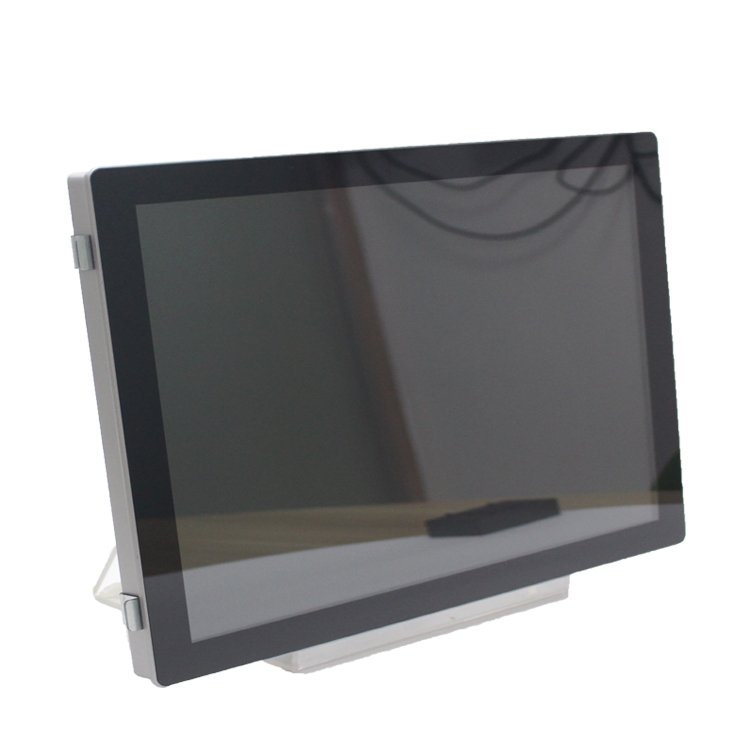
15″ Die-Cast Fanless Industrial Panel PC (IP65)
Engineered for high-vibration stamping presses, CNC machine consoles, and automated packaging lines. Features a monolithic ADC12 die-cast aluminum chassis (5.6x faster vibration damping), native 15″ 4:3 XGA display, true-flat IP65 front protection, and 100% fanless passive cooling.
Sheet-Metal Panel PC vs. INNODA 15″ Die-Cast Fanless IP65 Panel PC
| Engineering & Buyer Factor | Folded Sheet-Metal Panel PC | INNODA 15″ Die-Cast IP65 Panel PC |
|---|---|---|
| Enclosure Manufacturing | Bent sheet steel with welded/riveted seams | Monolithic high-pressure die-cast ADC12 aluminum |
| Vibration Damping Ratio | High resonant ringing (Q ≈ 785) | 5.63x faster vibration decay (Q ≈ 140) |
| Front Ingress Protection | IP54 (Corner seams leak cutting fluids) | True-flat IP65 seamless dust & oil-mist seal |
| Thermal Architecture | Requires internal fan (Clogs with shop dust) | 100% Fanless cast-in rear cooling fins |
| Mounting Versatility | Thin rear VESA tabs bend under arm torque | Reinforced cast VESA 75/100 + panel-mount clamps |
2. Frequently Asked Questions (Engineering & Procurement FAQ)
Q1: How does a die-cast aluminum panel PC compare to a CNC-machined panel PC for OEM machinery?
Both deliver 100% fanless cooling and superior rigidity over sheet metal. High-pressure die-casting provides the best cost-to-rigidity ratio for medium-to-high volume OEM machine production, while CNC billet machining is ideal for low-MOQ custom dimensions or extreme full-IP67 submersion housings.
Q2: Can the touchscreen operate reliably when operators wear work gloves or wipe away cutting oil?
Yes. The true-flat projected capacitive (PCAP) touchscreen features 7H chemically strengthened glass and industrial mutual-capacitance firmware calibrated to reject oil splashes while tracking cotton, nitrile, or light leather work gloves.
Q3: What mounting options are supported for machine-side installation?
The chassis supports both flush cabinet door panel-mounting (via included heavy-duty rear clamping brackets) and external swing-arm or pedestal mounting via standard VESA 75×75 and 100×100 threaded bosses.
Standardizing stamping presses, CNC cells, and automated assembly lines on 15-inch die-cast aluminum fanless IP65 panel PCs eliminates vibration-induced failures and lowers total cost of ownership. Contact INNODA’s OEM machinery engineering team to request 3D STEP packaging files, panel cutout templates, and volume OEM quotes.