
Competitive offshore tournament sportfishing yachts operate multi-station helm architectures, pairing a primary enclosed salon bridge console with an exposed tuna-tower or cockpit fighting-chair repeater monitor. During high-stakes billfish tournaments, captains and cockpit mates rely on synchronized dual-station sonar displays to track bait balls, thermocline breaks, and deep-water drop-offs simultaneously without shouting telemetry between decks. Maintaining crystal-clear sonar imaging across long vertical tower cable runs requires disciplined electrical isolation and marine corrosion maintenance.
However, linking a lower bridge processor to an upper tower display introduces two destructive marine failure modes: ground-loop voltage differentials between separate battery banks that inject diagonal interference bars into high-frequency CHIRP sonar screens, and galvanic salt-fog corrosion across exposed connector threads. Maintaining peak tournament reliability across modern waterproof panel pcs and marine repeater networks requires analyzing galvanic ground-loop currents, dielectric silicone port care, and freshwater salt-crystal flushing.
1. Dual-Station Ground Potential Differentials & Galvanic Isolation Barriers
On large sportfishing vessels, tower electronics and main salon consoles frequently draw DC power from separate battery banks or sub-panels. Heavy bilge pumps, livewell aerators, and gyro-stabilizers create small voltage drops across hull bonding straps, resulting in a ground potential difference (V_gnd) between stations:
Dual-Station Ground Loop Current & Sonar Interference Equation: Inter-Station Ground Potential Difference: V_gnd = 2.40 Volts AC/DC ripple. Unisolated Video Cable Shield Impedance (15m Tower Run): R_shield ≈ 0.15 Ω. Circulating Ground Loop Current (Without Isolation): I_loop = V_gnd / R_shield = 2.40 / 0.15 = 16.0 Amperes flowing through the video cable shield. Sonar Telemetry Degradation: A 16A circulating shield current induces magnetic hum into adjacent CHIRP transducer coaxial cables, cluttering the sonar water column with false vertical noise streaks and masking deep pelagic fish arches. Galvanic Isolation Solution (1.5 kV DC Isolated Power & Signal Stage): Inserting a 1.5 kV galvanic isolation barrier raises common-mode loop impedance above 100 MΩ: I_loop_isolated = 2.40 / (1.0 × 10^8) = 2.4 × 10^-8 A = 0.024 μA (Complete elimination of sonar interference).
Because the internal 1.5 kV galvanic isolation barrier breaks circulating ground currents between the main bridge and upper tower stations, CHIRP sonar screens remain noise-free even when high-draw livewell pumps and trim tabs cycle continuously.
To ensure synchronized, noise-free dual-station fishfinding across tournament hulls, marine electronics installers standardize on the Tournament Marine Fishing Touch Monitor (Dual-Station Sonar), which integrates galvanically isolated power stages and screw-locking marine video interfaces.
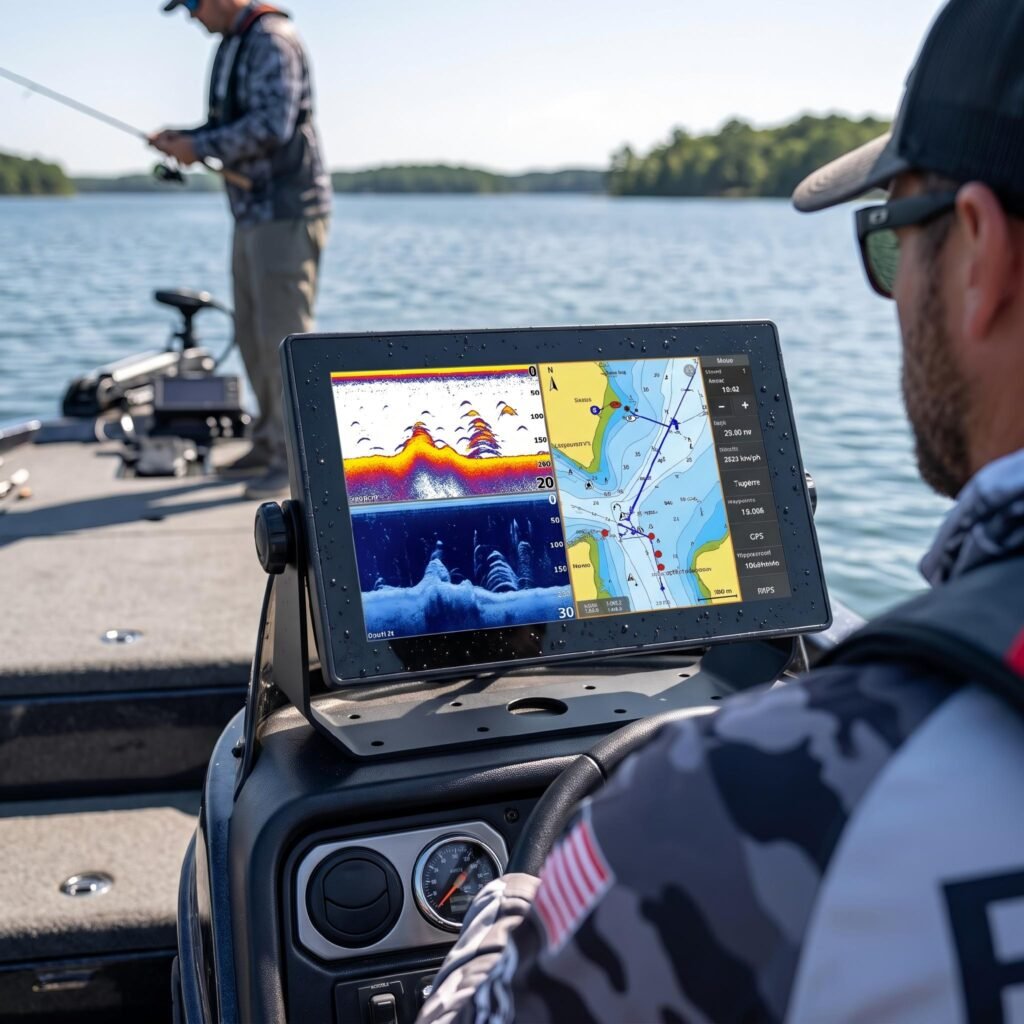
Tournament Marine Fishing Touch Monitor (Dual-Station)
Designed for offshore sportfishing yachts with dual bridge and tuna-tower stations. Features 1.5 kV galvanic ground-loop isolation for noise-free CHIRP sonar telemetry, 1500 nits sunlight & polarized readability, LOCA optical wet bonding, and marine salt-fog protection.
2. Marine Salt-Fog Passivation & Dielectric Connector Maintenance
Offshore tournament vessels endure constant salt spray that crystallizes on warm aluminum surfaces:
- Freshwater Salt-Crystal Dissolution: When seawater evaporates on warm display bezels, sharp sodium chloride crystals form. Wiping a dry, salt-crusted screen scratches anti-reflective optical coatings. Always flush displays gently with low-pressure freshwater first to dissolve salt crystals before wiping with an optical microfiber cloth.
- Dielectric Silicone Grease on Screw-Locking Connectors: Applying a thin film of marine-grade dielectric silicone grease to video thumbscrews and power connector O-rings prevents crevice corrosion and thread seizing in humid salt air.
- Sacrificial Anode & Bonding Strap Inspection: Verify that the rear chassis ground lug connects via tinned marine copper wire to the vessel’s central bonding bus, preventing stray-current electrolysis from pitting the aluminum enclosure.
Dual-Station Marine Monitor Preventative Maintenance Matrix
| Marine Maintenance Point | Inspection Procedure | Corrective Maintenance Action |
|---|---|---|
| Optical AR Front Glass | Check for dried salt spray crust or fish-slime residue | Rinse with freshwater first; wipe with 70% IPA optical cloth |
| Video & Power Connectors | Inspect thumbscrews and pins for green copper oxidation | Clean with contact cleaner; apply dielectric silicone grease |
| Chassis Bonding Strap | Measure resistance to vessel central bonding bus | Confirm resistance ≤ 0.1 Ω; replace corroded lugs |
| Gimbal Bracket Knobs | Check side friction washers for compression wear | Re-torque side knobs firmly; replace worn rubber washers |
| DC Supply Cranking Drop | Monitor input voltage during main diesel engine start | Confirm voltage stays ≥ 9.5V; tighten battery terminals |
3. Post-Tournament Preventative Maintenance Checklist
- Low-Pressure Freshwater Washdown: After returning from offshore runs, mist the tower and cockpit displays with fresh dock water (< 2 bar) to dissolve salt deposits before blotting dry with a clean chamois.
- Connector Thread Lubrication: Uncouple rear video and power plugs every 90 days to inspect O-rings for salt grit, re-applying a light coat of marine dielectric grease before re-torquing.
- Sun Cover Deployment at Dock: Snap the protective UV sun cover over exposed tower monitors when moored at the marina to shield optical coatings from continuous static solar UV exposure between charters.
Implementing a disciplined marine maintenance routine for dual-station tournament fishing touch monitors eliminates sonar ground-loop noise and prevents salt-fog corrosion. Contact INNODA’s marine support engineering team to request dual-station wiring schematics, dielectric maintenance kits, and protective sun covers.