
Offshore racing sailboats, performance cruising yachts, and marine instrumentation integrators rely on mast-mounted repeater displays to give helmsmen and tacticians an unobstructed, heads-up view of critical sailing telemetry. Positioned directly on the main mast above the boom vang and surrounded by running rigging, these compact 10.1-inch widescreen terminals (16:10 / 1280×800 resolution) must display high-contrast figures—such as Magnetic Heading, Apparent Wind Angle (AWA), Speed Through Water (STW), and Heel Angle—instantaneously across changing sea states.
⚡ Engineering Executive Summary (Field Deployment Highlights):
- Real-World Marine Validation: Vertically stacked dual 10.1″ terminals deployed on a racing yacht mast (SAILTAB integration), streaming real-time wind, speed, and heading telemetry.
- 68.9% Rear Depth Reduction: Standard 90-degree angled M12 waterproof cables reduce rear mounting clearance from 90 mm down to 28 mm, fitting inside slim aerodynamic mast pods.
- Zero-Aperture IP67 & 1500 Nits Optics: Under-glass ambient light sensor auto-scales brightness up to 1500 nits (10.33:1 contrast in 100,000-lux sun) while maintaining a 100% hole-free IP67 CNC aluminum housing.
In real-world offshore sailing installations—as demonstrated in our European marine client’s dual-screen mast deployment—computing hardware faces a brutal combination of blinding sunlit sail reflections, conductive saltwater spray, galvanic corrosion, and ultra-tight enclosure depths. Deploying a dependable terminal in these demanding sunlight readable hmi marine environments requires combining 1500-nit OCA optically bonded displays with 90-degree angled M12 connectors and corrosion-immune polymer couplings.
1. Slim Mast Pod Clearance: 90-Degree Angled M12 Cables vs. Straight Plugs
Aerodynamic mast brackets and flush yacht dash consoles offer minimal internal cavity depth behind the display chassis. Standard straight-exit M12 circular connectors require substantial rear clearance to accommodate the rigid connector body plus the cable’s minimum bend radius (typically 5× cable outer diameter):
Rear Mounting Cavity Depth & Cable Bend Radius Comparison: Cable Outer Diameter (Shielded Marine M12 Power/LAN): D_cable = 6.5 mm. Minimum Safe Dynamic Bend Radius: R_bend = 5.0 × D_cable = 32.5 mm. Case A: Traditional Straight-Exit M12 Connector Assembly: Total Rear Depth = Connector Body (45.0 mm) + Strain Relief Boot (12.5 mm) + Bend Radius (32.5 mm) = 90.0 mm. (Exceeds slim mast housing depth; forces sharp cable kinking that fractures internal waterproof seals). Case B: INNODA 90-Degree Right-Angle M12 Waterproof Harness: Total Rear Protrusion = Low-Profile Right-Angle Overmold = 28.0 mm. Rear Depth Savings: [ (90.0 – 28.0) / 90.0 ] × 100% = 68.89% space reduction. Mechanical Result: Allows dual vertically stacked 10.1″ terminals to sit flush inside a streamlined mast bracket with zero strain on internal waterproof O-rings.
Because the low-profile 90-degree M12 cables route parallel to the rear CNC aluminum cooling fins, integrators can mount two units vertically back-to-back or stacked in ultra-slim mast pods without pinching conductors.
To achieve seamless mast integration and reliable multi-sensor telemetry, marine systems integrators deploy the 10.1″ Full Waterproof Android Panel PC (1500 Nits, M12 Angled Cables), which combines an all-aluminum CNC chassis with factory-molded 90-degree waterproof harnesses.
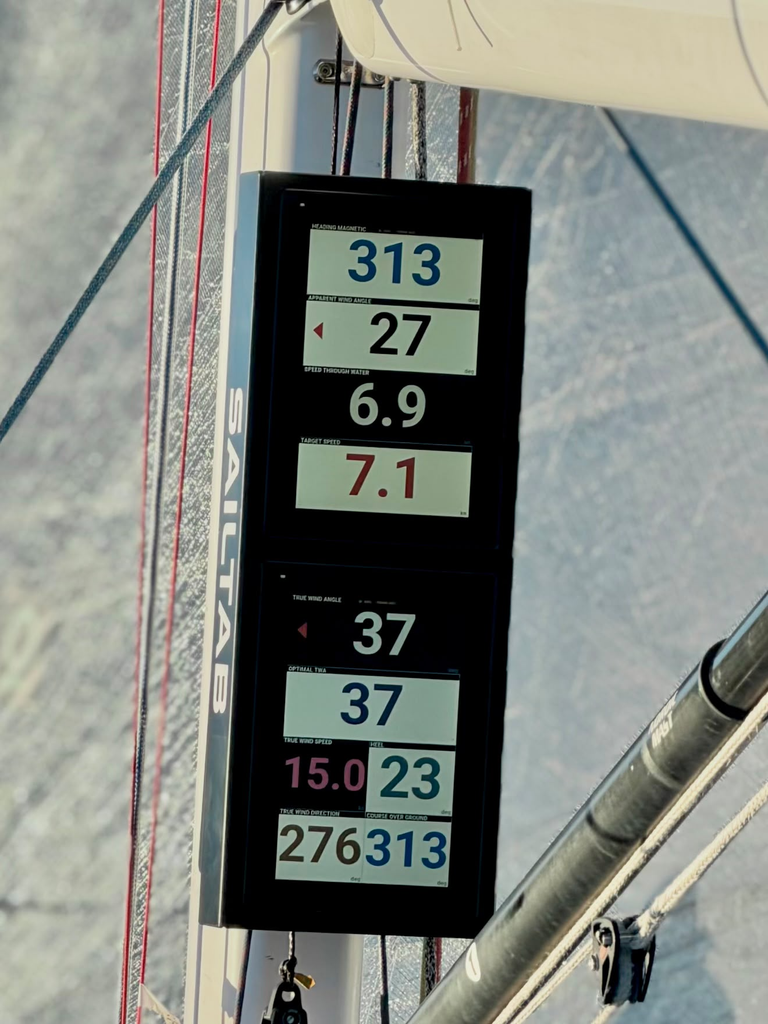
10.1″ 1500 Nits Full IP67 Android Panel PC (90° M12)
Field-proven on offshore racing sailboat masts (SAILTAB deployment). Features a 10.1″ 1500-nit sunlight-readable display with OCA optical bonding, under-glass ambient light sensor, full CNC aluminum IP67 enclosure, corrosion-immune polymer M12 ports, and space-saving 90° angled waterproof cables.
2. Galvanic Corrosion Immunity, Under-Glass Light Sensor & 1500 Nits Clarity
Analyzing the mast-mounted dual-display configuration highlights four critical hardware engineering advantages:
- Electrochemical Galvanic Corrosion Immunity: In warm seawater spray, dissimilar metals (such as nickel-plated brass connectors threaded into anodized aluminum housings) form a galvanic cell that rapidly corrodes threads and seizes connectors. Utilizing high-strength, UV-stabilized engineering polymer M12 connectors completely eliminates galvanic potential differences while preserving full IP67 sealing.
- Under-Glass Ambient Light Sensor (Zero-Hole IP67): Rather than drilling a vulnerable sensor hole through the front bezel, an optical ambient light sensor sits directly beneath the 7H chemically strengthened cover glass. It automatically ramps backlight output up to 1500 nits under blinding noon sun and dims smoothly for night watches without compromising the seamless IP67 front barrier.
- 1500 Nits + OCA Optical Bonding + Chemically Etched AG Glass: Eliminates internal air-gap reflections, delivering an Ambient Contrast Ratio exceeding 10.3:1 under 100,000-lux ocean glare so crew members can read tacking angles from the cockpit rail.
- Open Rockchip ARM (RK3568 / RK3576 / RK3588) Android Platform: Executes custom marine telemetry apps (such as SAILTAB navigation dashboards) natively with low power draw across DC 9V-36V vessel battery banks.
Standard Marine Display vs. Engineered 10.1″ Mast-Mount Android PC
| Offshore Sailing Factor | Standard Industrial Panel PC | INNODA 10.1″ 1500-Nit Marine PC |
|---|---|---|
| Rear Mounting Clearance | ≥ 90 mm required for straight plugs | 28 mm ultra-slim depth (90° angled M12 cables) |
| Saltwater Connector Corrosion | Metal plugs seize via galvanic electrolysis | Corrosion-immune polymer M12 waterproof ports |
| Direct Sun & Sail Glare | 300 – 500 Nits (Unreadable off white sails) | 1500 Nits + OCA bonding + etched AG glass |
| Auto-Dimming Sensor Seal | External bezel pinhole prone to O-ring leak | Under-glass light sensor (100% hole-free IP67) |
| Chassis Construction | Painted steel rear cover (Rusts at sea) | Full CNC-machined anti-corrosion aluminum |
3. Commissioning Best Practices for Mast & Bulkhead Installations
- 90-Degree Cable Exit Orientation: Orient the right-angle M12 connectors downward toward the mast base drainage channel so any condensation or spray runs away from connector collars.
- Salt-Crystal Freshwater Rinse: Following offshore regattas or coastal passages, mist the etched anti-glare front glass with low-pressure freshwater to dissolve dried salt crystals before wiping with a clean microfiber cloth.
- Wide-Voltage DC Bus Filtering: Connect the DC 9V-36V power harness to a dedicated marine electronics breaker to ensure uninterrupted operation during engine alternator charging spikes or autopilot hydraulic load surges.
Equipping racing yachts, cruising sailboats, and open marine helms with 10.1-inch 1500-nit full IP67 Android panel PCs featuring 90-degree M12 harnesses delivers unmatched daylight readability in ultra-compact spaces. Contact INNODA’s marine computing engineering team to request 3D STEP packaging files, 90-degree M12 cable drawings, and custom Android BSP firmware options.