
Modern brownfield factory automation retrofits, automated packaging lines, and utility substation RTU consoles face a persistent hardware integration bottleneck: connecting a modern Windows 11 IoT Enterprise SCADA workstation simultaneously to multiple legacy serial field devices. While modern PLCs utilize industrial Ethernet, thousands of reliable barcode verifiers, weigh-scale indicators, variable frequency drives (VFDs), and temperature controllers rely exclusively on deterministic RS-232, RS-422, and RS-485 serial buses.
⚡ Engineering Executive Summary (Key Selection Takeaways):
- Native Multi-Serial Density: 6x hardware DB9 COM ports (BIOS-configurable RS-232/422/485) eliminate unstable USB-to-Serial converter hubs and COM port enumeration drops.
- Signal & Surge Integrity: 2.5 kVrms galvanic isolation and 600W TVS surge clamping protect the Windows 11 motherboard from ground potential differences across 600-meter RS-485 runs.
- 100% Fanless Thermal Reliability: Solid aluminum passive conduction cools the processor without vents, preventing metallic shop dust from shorting internal serial transceivers.
Attempting to expand a standard 2-port industrial PC using external USB-to-RS485 adapter hubs leads to chronic Windows COM-port re-numbering after power cycles and frequent driver lockups. Specifying a dependable controller across modern embedded panel pc retrofits requires analyzing RS-485 RC line propagation timing, galvanic surge isolation, and native hardware UART architecture.
1. Long-Haul RS-485 RC Line Timing & 2.5 kV Galvanic Surge Isolation
When polling distributed Modbus RTU slave devices across 600 meters of shielded twisted-pair cable at 115,200 bps, distributed cable capacitance slows differential signal edges, while distant electrical cabinets introduce ground potential offsets:
RS-485 Differential Line RC Time Constant & Bit-Period Margin Equation: Shielded Twisted-Pair Characteristic Impedance: Z_0 = 120.0 Ω. Distributed Line Capacitance: C_unit = 52.0 pF/m across L_run = 600 meters → C_total = 31.2 nF. RC Signal Rise Time Constant: τ_rc = Z_0 × C_total = 120.0 × (31.2 × 10^-9) = 3.744 μs. 115,200 bps Baud Rate Bit Period: T_bit = 1 / 115,200 ≈ 8.68 μs. Timing Margin Verification: Because τ_rc (3.74 μs) < 0.5 × T_bit (4.34 μs), differential receivers sample clean eye-diagram logic levels with zero bit-framing errors. Galvanic Ground-Loop & Surge Protection: Onboard digital isolators provide 2,500 Vrms isolation paired with 600W TVS diodes, blocking up to ±15 kV ESD and ground potential shifts between distant machine panels.
Because all six serial ports connect directly to native PCIe/LPC hardware UART controllers rather than shared USB hubs, deterministic polling cycles remain locked across Windows 11 reboots.
To consolidate multi-device serial telemetry onto a single rugged touchscreen station, system integrators deploy the Fanless Industrial Panel PC with 6 COM Ports (Windows 11), which integrates six native DB9 serial ports alongside dual Gigabit Ethernet.
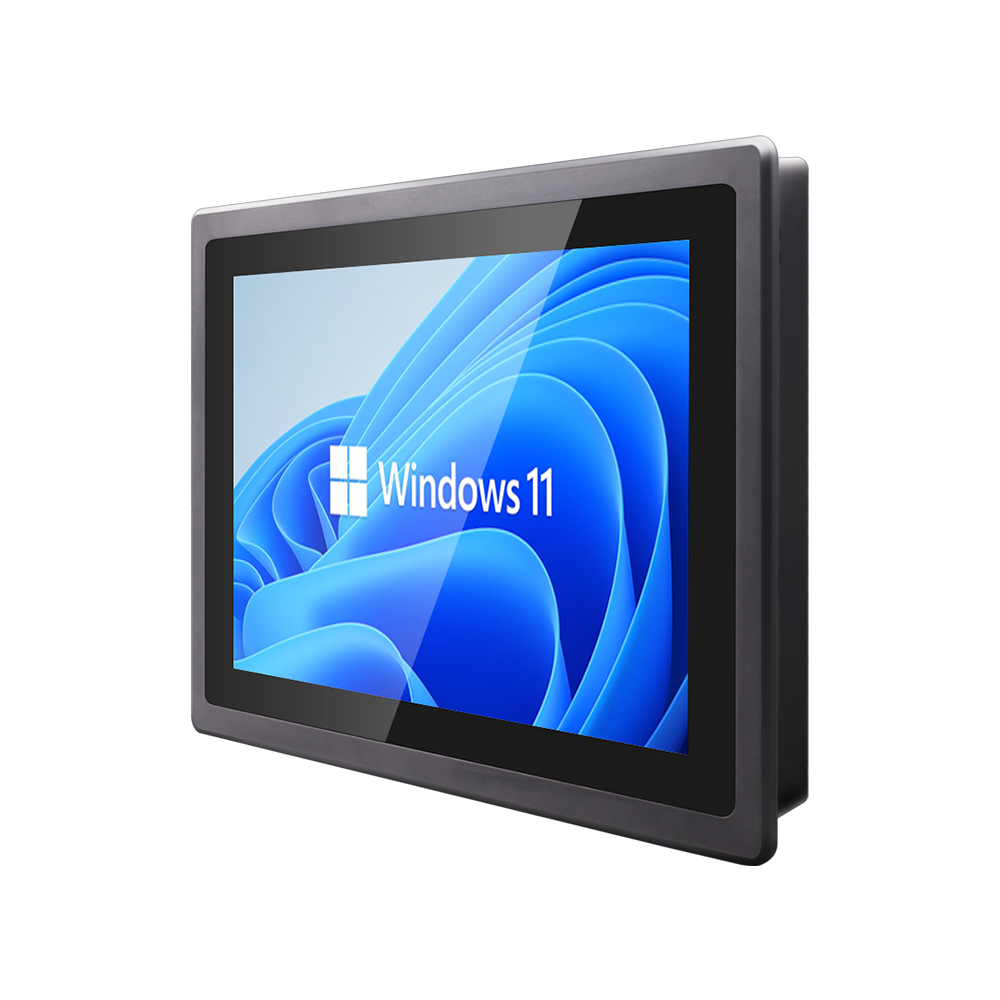
Fanless Industrial Panel PC (6 COM Ports, Win 11)
Designed for brownfield factory retrofits, utility substations, and multi-device PLC/SCADA integration. Features 6x native BIOS-configurable RS-232/422/485 DB9 serial ports, Windows 11 IoT readiness, 100% fanless aluminum cooling, and IP65 front protection.
2. BIOS-Configurable RS-232/422/485 & Fanless Industrial Construction
Modernizing brownfield production lines requires versatile hardware interfacing and rugged packaging:
- BIOS-Selectable Serial Modes + 5V/12V Pin-9 Power: Each DB9 port can be switched in BIOS between RS-232, RS-422, and RS-485 with automatic flow control, plus optional 5V/12V power output on Pin 9 to power handheld barcode scanners directly.
- Windows 11 IoT Enterprise Ready: Equipped with TPM 2.0 security and multi-core x86 processing, supporting modern .NET SCADA applications, OPC UA gateways, and SQL local buffering simultaneously.
- 100% Fanless Aluminum Heatsink Chassis: Dissipates heat passively across extruded aluminum fins, eliminating cooling fans that draw conductive dust and oil mist onto sensitive UART transceiver chips.
USB-to-Serial Hub Setup vs. Engineered 6-COM Fanless Panel PC
| Integration Criterion | Standard PC + External USB-Serial Hub | INNODA 6-COM Fanless Panel PC |
|---|---|---|
| COM Port Address Stability | USB re-enumeration scrambles COM numbers | Hardware-locked native UART COM1–COM6 |
| Ground-Loop & Surge Safety | Unisolated hubs burn out motherboard USB | 2.5 kVrms isolation + 600W TVS surge protection |
| Connector Retention | Unsecured USB plugs shake loose in cabinets | Screw-locking industrial DB9 serial connectors |
| Polling Determinism | USB 1 ms frame polling adds latency jitter | Direct PCIe/LPC interrupt-driven zero-jitter I/O |
| Front Ingress Protection | IP50 / Exposed desktop hub on cabinet | IP65 dust-tight and splash-proof front bezel |
3. Field Commissioning & RS-485 Wiring Best Practices
- 120-Ohm Bus Termination: Enable the internal 120-Ω termination resistor via jumper or BIOS only at the two physical ends of each RS-485 daisy-chain trunk to eliminate signal reflections.
- DB9 Thumbscrew Torque: Hand-tighten all six DB9 serial connector thumbscrews to 0.4 Nm so cable shields maintain continuous 360-degree grounding contact with the chassis.
- Single-Point Shield Grounding: Bond RS-485 cable drain shields to earth ground at the panel PC end only, preventing ground-loop currents from circulating across long factory runs.
Standardizing brownfield automation retrofits on fanless industrial panel PCs with six native COM ports eliminates USB adapter failures and delivers deterministic Windows 11 SCADA control. Contact INNODA’s industrial automation engineering team to request DB9 pinout diagrams, 3D STEP packaging files, and custom I/O configurations.