

Outdoor smart video intercom kiosks and automated pedestrian turnstiles installed at corporate headquarters, logistics distribution hubs, and chemical refineries operate at the physical boundary of facility security. Unlike climate-controlled indoor terminals, outdoor intercom kiosks face severe mechanical vandalism, solar thermal loading up to 1000 W/m², driving rain, and loud ambient traffic noise (exceeding 85 dBA).
Achieving clear full-duplex communication and reliable identity access demands robust hardware engineering. Without proper structural hardening and acoustic isolation, outdoor terminals suffer shattered touchscreens, garbled voice communication, and thermal lockups during extreme seasonal weather shifts.
1. Mechanical Hardening: IK09 Kinetic Impact Physics
Vandal resistance is quantified under standard IEC 62262 (IK Rating). Outdoor public-access kiosks must withstand deliberate strikes from heavy tools, skateboards, or blunt objects without cracking cover glass or dislodging internal camera modules:
Kinetic Impact Energy Equation (IEC 62262 IK09): E = m × g × h Where striking steel mass m = 5.0 kg, drop height h = 0.20 m, and gravity g = 9.81 m/s². Kinetic Impact Energy: E = 5.0 × 9.81 × 0.20 = 9.81 Joules ≈ 10.0 Joules. Required Glass Hardness: 7H surface rating, chemically toughened aluminosilicate glass (≥ 3.0 mm thickness).
Standard soda-lime glass with perimeter adhesive shatters under 2 Joules of impact energy (IK07). When struck, the glass fragments pierce the display layer beneath, causing catastrophic terminal failure.
To eliminate vandalism vulnerabilities, secure facilities deploy the CNC Aluminum Smart Video Intercom Access Control Kiosk (7″-15″), which combines 4 mm chemically toughened safety glass with an integrated CNC aluminum perimeter bezel that absorbs kinetic shock loads directly into the building structure.
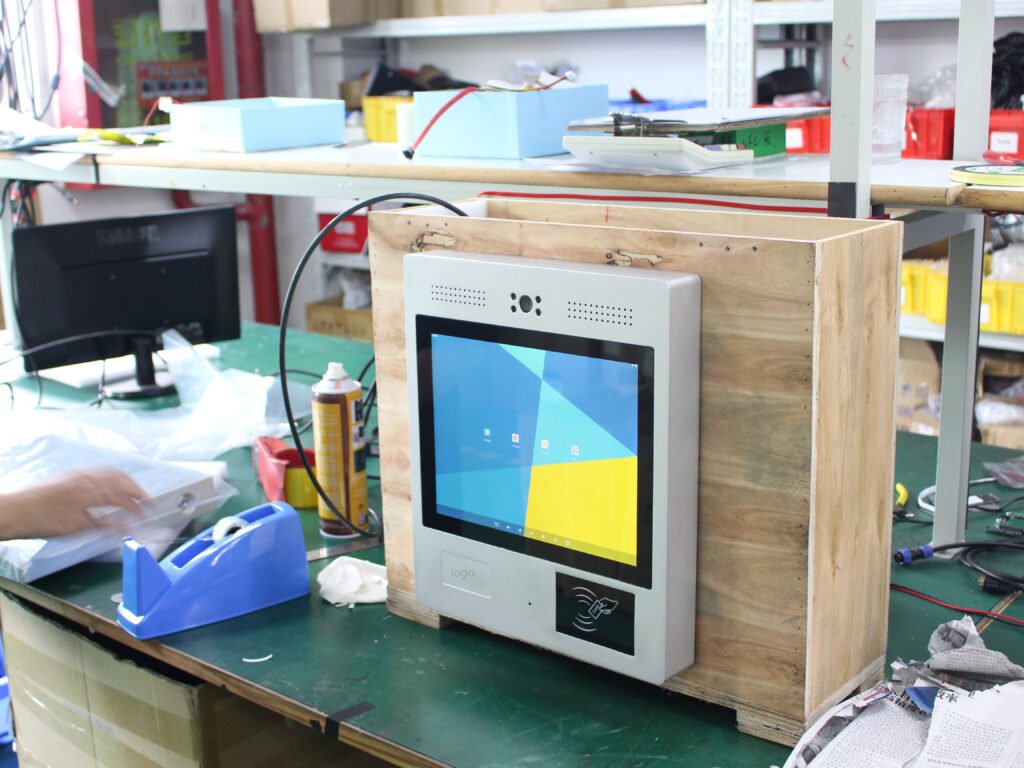
CNC Aluminum Smart Video Intercom Access Control Kiosk
Built for harsh outdoor security bollards and turnstiles. Features solid CNC aluminum casing, IK09 impact-resistant glass, dual-microphone acoustic echo cancellation, and -20°C to +70°C wide-temperature operation.
2. Acoustic Echo Cancellation (AEC) and Mechanical Voice Isolation
Outdoor video intercoms require full-duplex hands-free voice transmission. When high-volume speakers discharge sound, acoustic energy travels along two primary paths:
- Direct Airborne Feedback: Sound waves exit the speaker grille and enter the microphone opening.
- Structure-Borne Mechanical Transmission: Acoustic vibrations resonate through the metal housing directly into the microphone transducer diaphragm.
Without physical structural isolation, digital Acoustic Echo Cancellation (AEC) algorithms cannot differentiate between far-end speech and local enclosure resonance, resulting in severe howling, chopped words, and dropped sentences.
Acoustic Isolation Requirement: Mechanical Damping Attenuation: ΔA_structure ≥ 25 dB Microphone Isolation: High-density closed-cell silicone isolation boots (Shore 30A hardness) decouple the electret/MEMS microphone from the CNC chassis. Dual-Mic Array Spacing: d ≈ 65 mm to create beamforming spatial noise cancellation.
Outdoor Access Kiosk Maintenance & Diagnostic Matrix
| Diagnostic Checkpoint | Standard Commercial Intercom | Engineered CNC Aluminum Kiosk |
|---|---|---|
| Impact Protection (IK) | IK07 (2 Joules) – Acrylic or thin glass | IK09 (10 Joules) – Toughened aluminosilicate glass |
| Acoustic Performance | Single mic, rigid housing mount (Severe howling) | Dual-mic beamforming with silicone acoustic boots |
| Wide Operating Temp | 0°C to +40°C (Freezes in winter, shuts down in sun) | -20°C to +70°C wide-temperature industrial components |
| Camera Optical Clarity | Plastic lens yellowing and internal condensation | Multi-layer AR-coated glass with hydrophobic seal |
3. Preventative Maintenance Routine for Outdoor Kiosks
- Semi-Annual Seal Inspection: Inspect the perimeter door gasket for micro-cracks or UV embrittlement. Clean any accumulated debris from drainage weeping holes located at the bottom of the bollard mounting frame.
- Acoustic Mesh Cleaning: Clear fine particulate matter and dust build-up from the speaker and microphone hydrophobic acoustic membranes using clean, dry compressed air (regulated below 2 bar).
- Optical Lens Calibration: Wipe the optical camera window using an alcohol-free microfiber cloth to remove oily road dust film, ensuring sharp facial recognition performance at night.
Standardizing outdoor entry points on IK09-hardened CNC aluminum intercom kiosks eliminates vandal downtime and guarantees crystal-clear visitor communication. Contact INNODA’s technical support team to request architectural CAD files, customized bollard mounting plates, and SIP 2.0 integration guides.