
In high-throughput protein processing, dairy bottling plants, and active pharmaceutical ingredient (API) manufacturing, human-machine interfaces face extreme sanitary cleaning regimens. Standard waterproof ratings such as IP65 or IP66 fail when sanitation crews deploy automated Clean-in-Place (CIP) spray lances that blast hot chemical detergents at pressures reaching 100 bar (1450 PSI) and temperatures up to 80°C. Under these conditions, the kinetic energy of water jets combined with thermal shock can breach commercial gasket seals within seconds.
Specifying a resilient washdown automation terminal demands strict adherence to the DIN 40050-9 and ISO 20653 IP69K testing protocols. Every physical boundary—including the housing alloy, weld passivations, gasket compression channels, and I/O connectors—must maintain hermetic mechanical integrity under continuous dynamic pressure pulses.
1. Hydrodynamic Stagnation Pressure and Jet Kinetic Energy
The DIN 40050-9 IP69K standard mandates blasting test enclosures with water jets directed at 0°, 30°, 60°, and 90° angles from distances of 100 mm to 150 mm, delivering water flow rates between 14 L/min and 16 L/min at 80°C. The localized fluid dynamic impact generates massive stagnation pressure across enclosure seams:
Hydrodynamic Stagnation Pressure Formula (Bernoulli Principle): p_stagnation = 0.5 × ρ × v_nozzle^2 Where ρ (water density at 80°C) ≈ 971.8 kg/m³, nozzle exit velocity v ≈ 142 m/s (under 100 bar system pressure). Resulting Impact Pressure: p_stag = 0.5 × 971.8 × (142)^2 = 9.79 × 10^6 Pa = 97.9 bar localized dynamic shear force striking the gasket interface.
Flat silicone gaskets compressed by standard sheet-metal screws distort and experience localized mechanical lifting under 98 bar of direct jet impingement. When combined with the sudden thermal contraction that occurs when cold room air is hit by 80°C water, the resulting internal enclosure pressure drop sucks washdown fluids straight into internal circuit boards.
To eliminate this catastrophic failure vector, hygienic food plants deploy the 15.6″ Full IP69K Stainless Steel Panel PC with M12 I/O, which utilizes a CNC-milled dovetail retaining groove that captures a continuous solid fluorosilicone gasket, maintaining a calibrated 35% compression limit that prevents seal movement under high-pressure blasts.
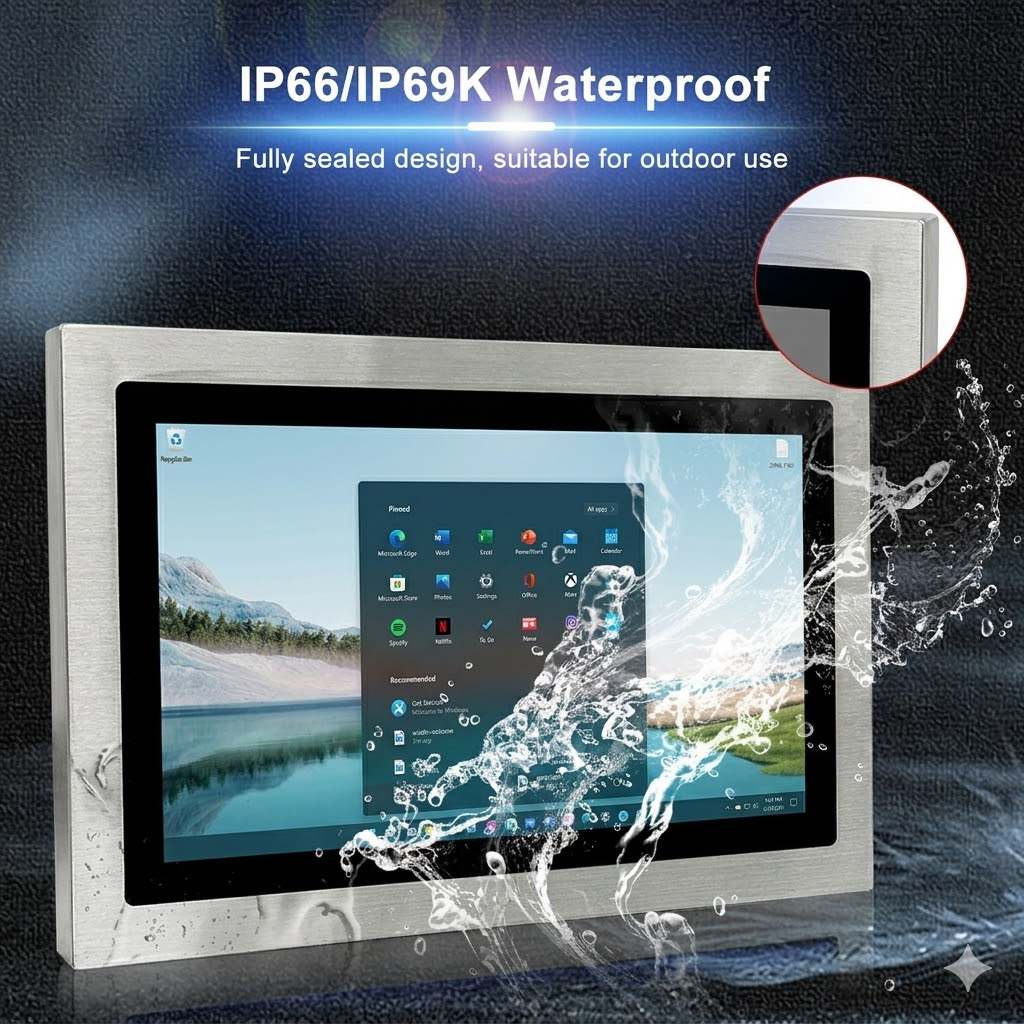
15.6″ Full IP69K Stainless Steel Industrial Panel PC
Built to survive 100-bar, 80°C high-pressure hot water washdowns and aggressive caustic CIP chemicals. Features heavy-gauge SUS304/SUS316L stainless steel, all-metal M12 aviation connectors, and an electropolished anti-bacterial finish.
2. All-Metal M12 Aviation Connectors vs. Plastic Cable Glands
Field data from food manufacturing installations demonstrates that over 75% of washdown liquid ingress originates at the cable entry point rather than the front display bezel:
- Plastic Gland Creep Failure: Nylon cable glands have high thermal expansion coefficients (CTE ≈ 80 × 10^-6 / K) compared to stainless steel (CTE ≈ 16 × 10^-6 / K). Repeated 80°C thermal wash cycles loosen plastic gland locknuts, destroying the cable seal.
- 360-Degree Shielded M12 Screw Locking: Heavy-gauge stainless steel M12 aviation connectors use precision knurled locknuts that compress internal O-rings to a fixed stop. They withstand >200 N of cable pull force without compromising ingress sealing.
- True Chemical Resistance: Stainless steel M12 connectors resist corrosion from concentrated sodium hydroxide (NaOH) alkaline foams and nitric acid descalers, preventing thread seizure and intergranular rust.
Washdown Enclosure Protection Level Comparison
| Specification Parameter | Standard IP65/IP66 Enclosure | Engineered Full IP69K Stainless PC |
|---|---|---|
| Water Jet Pressure | 0.3 – 1.0 bar (Low-pressure spray only) | 100 bar (1450 PSI) high-pressure steam jet |
| Washdown Temperature | Ambient water temp (≤ 25°C) | 80°C hot washdown thermal shock rated |
| Cable Connection Interface | Plastic compression glands (Prone to creep) | Machined SUS316/304 M12 circular connectors |
| Chemical Detergent Rating | Degrades under caustic wash foams (pH > 11) | FDA-compliant fluorosilicone (Resists pH 1-13) |
| Surface Finish Quality | Standard brushed Ra > 0.8 μm (Harbors bacteria) | Electropolished Ra ≤ 0.4 μm (EHEDG compliant) |
3. Commissioning Guidelines for CIP Washdown Environments
- M12 Connector Torque Calibration: Use a calibrated torque wrench to tighten all M12 aviation cable connectors to precisely 0.6 Nm to 0.8 Nm. Under-tightening permits fluid entry, while over-tightening crushes internal O-rings beyond their elastic limit.
- Ventilation Membrane Verification: Ensure the hydrophobic Gore pressure-equalization vent located on the rear chassis is free of grease accumulation, allowing air pressure to equalize during sudden 80°C thermal shocks without drawing in moisture.
- VESA Sanitary Mount Sealing: Seal all rear VESA mounting bolt threads using food-grade thread sealant (FDA 21 CFR compliant) to eliminate crevice corrosion between the mounting arm and the stainless chassis.
Upgrading food processing, beverage bottling, and chemical synthesis lines with certified IP69K stainless steel panel PCs eliminates water ingress failures and meets rigorous hygienic inspection standards. Contact INNODA’s washdown automation team to request complete CAD dimensional drawings, M12 cable assemblies, and material certification reports.