
Outdoor chemical dosing skids, municipal wastewater aerators, coastal oil-water separators, and marine fuel dispensing kiosks require industrial computers capable of continuous operation under open skies. These installations combine two aggressive environmental hazards: intense direct solar radiation and regular high-pressure chemical washdowns. Operating in these conditions requires pairing a 1000-nit sunlight-viewable display with a hermetically sealed full IP67 stainless steel enclosure.
However, stainless steel exhibits a relatively low thermal conductivity (k ≈ 16.2 W/(m·K) for SUS304/SUS316L) compared to aluminum. When high-intensity solar radiation (up to 1,000 W/m²) strikes a dark or passivated steel housing, passive solar heat gain adds to the internal heat generated by the high-brightness backlight and CPU. Without thermal modeling and passive conduction balancing, internal cabinet temperatures can exceed the liquid crystal clearing point (T_ni), causing dark isotropic solar blotches. Sizing an outdoor stainless terminal requires structured thermodynamic calculations and a disciplined engineering decision tree.
1. Solar Radiation Heat Gain & Steady-State Chassis Temperature Rise
The total heat load on an outdoor sealed stainless panel PC equals internal electrical power dissipation plus external absorbed solar radiation flux:
Thermodynamic Solar Heat Balance Equation: Total Heat Influx: Q_total = Q_internal + Q_solar Where: – Internal Electrical Dissipation: Q_internal = P_cpu (15.0W) + P_backlight (18.0W) = 33.0 Watts. – Peak Incident Direct Solar Radiation: q_sun = 1000 W/m². – Solar Absorptivity of Passivated Stainless Steel: α_solar ≈ 0.45. – Projected Enclosure Top Surface Area: A_top = 0.12 m². Absorbed Solar Heat Flux: Q_solar = α_solar × q_sun × A_top = 0.45 × 1000 × 0.12 = 54.0 Watts. Total Thermal Dissipation Burden: Q_total = 33.0 + 54.0 = 87.0 Watts. Chassis Convective Temperature Rise (ΔT): ΔT = Q_total / (h_convection × A_total_surface) With overall surface area A_total_surface = 0.45 m² and convective coefficient h = 12.0 W/(m²·K): ΔT = 87.0 / (12.0 × 0.45) = 87.0 / 5.40 ≈ 16.11 °C. Operating Surface Temperature at 40°C Tropical Ambient: T_chassis = 40.0 + 16.11 = 56.11 °C (Well below the 70°C industrial operating threshold).
Because the thermal balance calculations confirm a steady-state surface temperature of 56.1°C at 40°C ambient, internal electronics operate well within their rated range, provided the internal heatsink routes processor heat to outer conduction surfaces.
To eliminate solar blackening and chemical corrosion failures in outdoor skids, process engineers deploy the 1000 Nits IP67 Outdoor Stainless Steel Panel PC, which combines high-clearing-point liquid crystals (T_ni ≥ 105°C) with an electropolished SUS304/SUS316L housing.
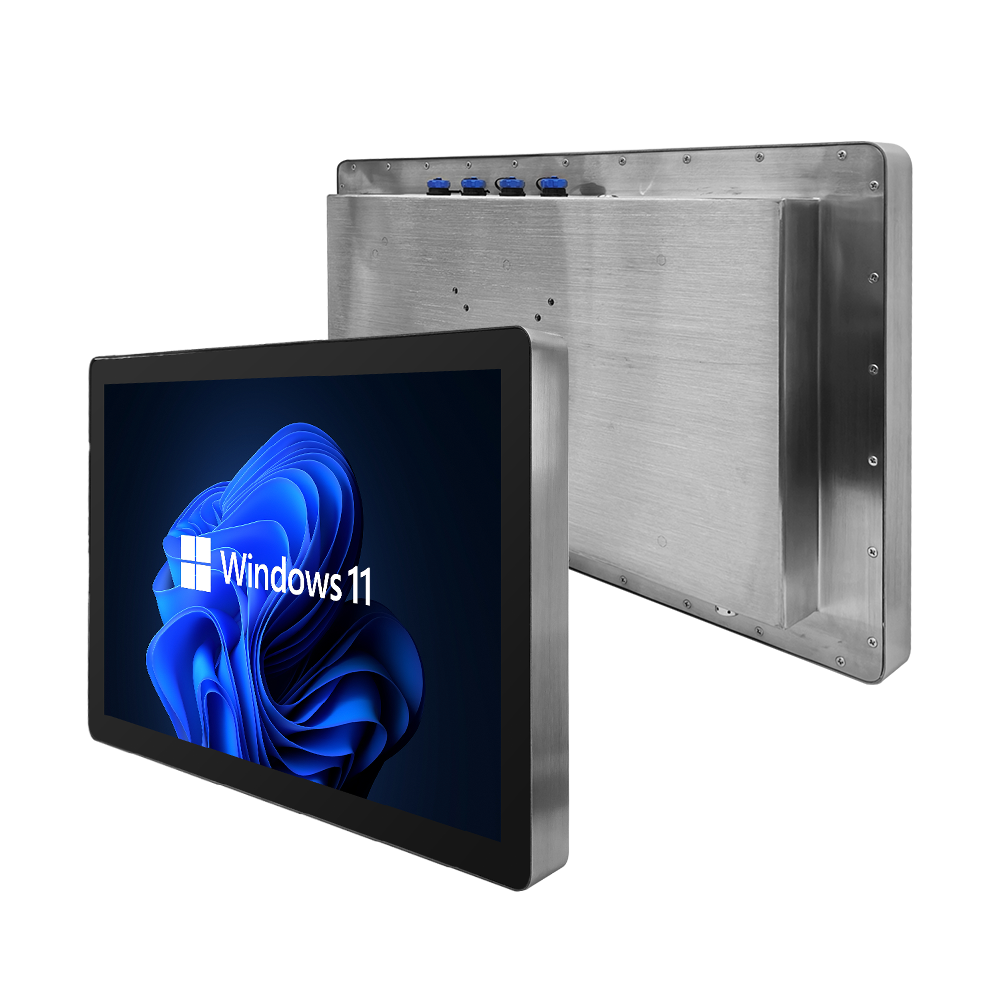
1000 Nits IP67 Outdoor Stainless Steel Panel PC
Built for outdoor chemical dosing skids, wastewater consoles, and marine fuel dispensing terminals. Features 1000 nits daylight readability, high-clearing-point liquid crystals (T_ni ≥ 105°C), solid SUS304/316L stainless steel housing, full IP67 sealing, and fanless architecture.
2. Outdoor Industrial Terminal Engineering Decision Tree
Selecting the optimal outdoor computing architecture requires evaluating environmental factors systematically:
- Corrosive Washdown vs. Airborne Dust: If high-pressure chemical washdowns or coastal salt spray are present, specify full IP67 stainless steel (SUS316L). For standard dusty outdoor kiosks without caustic washdown, hard-anodized CNC aluminum is typically preferred for lighter weight.
- Ambient Lighting Assessment: Locations subject to direct unshaded noon sun require 1000 to 1500 nits with optical bonding. Sheltered or north-facing installations can operate effectively with 500 to 800 nits.
- Connector Architecture: Outdoor environments require all-metal M12 circular connectors with thread-locking collars rather than unsealed RJ45/USB ports with rubber dust flaps.
Outdoor Terminal Sizing Specification Matrix
| Operational Metric | Standard Commercial Outdoor PC | Engineered 1000 Nits Stainless PC |
|---|---|---|
| Peak Screen Luminance | 350 – 450 Nits (Unreadable in full sun) | 1000 Nits daylight-viewable industrial WLED |
| Solar Blackening Limit | T_ni ≈ 75°C (Black blotches in summer) | High-clearing liquid crystal (T_ni ≥ 105°C) |
| Chemical Corrosion Durability | Painted steel blisters in salt fog | Electropolished SUS304/SUS316L stainless steel |
| Ingress Protection Rating | IP65 front only (Rear ports leak in rain) | Full IP67 (Front, rear chassis, and M12 ports) |
| Thermal Dissipation Type | Internal ventilation fan (Draws moisture) | 100% Fanless passive internal heat spreading |
3. Commissioning Guidelines for Outdoor Process Skids
- Solar Hood Integration: When installing on south-facing consoles, integrate a simple mechanical sunshade hood extending 150 mm beyond the top bezel to reduce direct solar thermal loading by up to 50%.
- M12 Aviation Port Torque: Hand-tighten all stainless M12 circular connectors, then apply 0.6 Nm of torque using an open-end torque wrench to ensure internal Viton O-rings compress evenly.
- Citric Acid Passivation Wipe: Following field installation, wipe down exposed stainless steel surfaces with a 10% citric acid solution to remove shop handling residues and restore the protective chromium oxide film.
Standardizing outdoor chemical skids and marine fueling stations on 1000-nit full IP67 stainless steel panel PCs prevents solar blackening and eliminates washdown failure downtime. Contact INNODA’s process engineering team to request solar thermal calculation spreadsheets, 3D STEP models, and custom stainless sunshade mounting brackets.