Commercial fishing vessel operators, offshore charter skippers, and marine electronics installers frequently face a costly operational bottleneck: replacing discontinued or exorbitantly priced marine chartplotter displays from legacy marine brands. When an existing bridge or center-console display fails, vessel managers are often told they must replace the entire proprietary sonar transducer array, radar dome, and wiring harness just to upgrade the screen. Installing an open-architecture, high-luminance industrial marine monitor provides a cost-effective drop-in replacement that interfaces directly with existing black-box sonars, PC chartplotters (TimeZero, OpenCPN), and radar processors.
However, operating a drop-in replacement display on an open flybridge introduces severe environmental demands. Tropical midday sunlight reaching 100,000 lux washes out standard 800-nit marine displays, while salt spray and damp morning mists cause internal fogging in unbonded screens. Sizing an open-architecture marine fishing display requires analyzing Ambient Contrast Ratios (ACR), Liquid Optical Clear Adhesive (LOCA) lamination, and wide-range DC electrical isolation.
1. Ambient Contrast Ratio (ACR) Dynamics under 100,000 Lux Marine Glare
Readability on an open helm is determined by the ratio between active backlight luminance and reflected solar glare. Comparing an unbonded 800-nit legacy screen against an optically bonded 1500-nit industrial marine display illustrates the contrast gap:
Ambient Contrast Ratio (ACR) Mathematical Model: ACR = (L_on + L_reflected) / (L_off + L_reflected) Where: – Ambient Tropical Sunlight Illuminance: E_amb = 100,000 lux. – Equivalent Solar Glare Luminance: L_amb = E_amb / π ≈ 31,831 cd/m². – Black State Display Luminance: L_off = 1.5 cd/m². Case A: Legacy Air-Gap Marine Screen (Luminance L_on = 800 cd/m², Surface Reflectance R = 4.5% = 0.045): L_reflected = 31,831 × 0.045 ≈ 1,432.4 cd/m². ACR_legacy = (800 + 1432.4) / (1.5 + 1432.4) = 2232.4 / 1433.9 ≈ 1.56 : 1 (Faded, washed out). Case B: INNODA 1500 Nits with LOCA Wet Optical Bonding (L_on = 1500 cd/m², Reflectance R ≤ 0.5% = 0.005): L_reflected = 31,831 × 0.005 ≈ 159.2 cd/m². ACR_bonded = (1500 + 159.2) / (1.5 + 159.2) = 1659.2 / 160.7 ≈ 10.33 : 1 (High contrast, crisp contours).
Because LOCA optical bonding eliminates internal air-glass refractive boundaries, internal reflection drops below 0.5%. The resulting 10.33:1 contrast ratio delivers clear visibility of fine fish arches and bathymetric depth contours even under intense tropical sunlight.
To deliver high daylight clarity and open-platform sonar compatibility, commercial fleet managers deploy the 1500 Nits Marine Fishing Touch Monitor, which combines a sunlight-viewable 1500-nit panel with full LOCA optical wet bonding and universal video inputs.
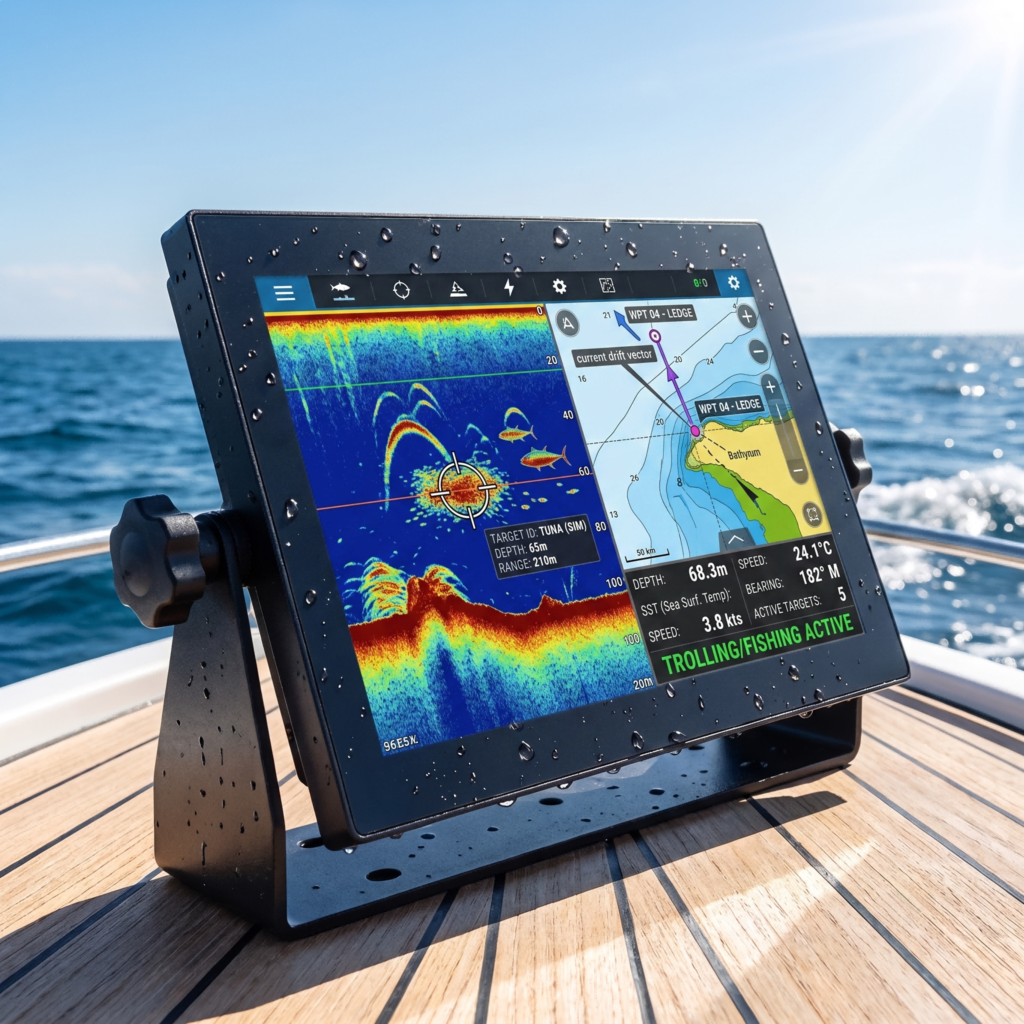
1500 Nits Marine Fishing Touch Monitor
Designed as an open-architecture drop-in replacement for commercial fishing trawlers and sports yachts. Features 1500 nits daylight readability, full LOCA optical wet bonding, 0-100% deep night dimming, multi-signal video inputs, and IP67 waterproof sealing.
2. Open-Architecture Drop-in Compatibility & Marine Salt Fog Protection
Replacing proprietary marine screens requires broad electrical and mechanical versatility:
- Universal Video Interface Matrix (HDMI + DVI + VGA + Composite): Directly accepts digital chartplotter feeds alongside legacy analog NTSC/PAL composite video from underwater fish cameras and engine-room monitoring sensors.
- Console Flush-Mount & Gimbal Bracket Versatility: Designed with standard front mounting flanges and rear VESA 75/100 patterns, fitting existing helm console cutouts with minimal fiberglass modification.
- Isolated Marine Power Stage (DC 9V-36V): Features 1.5 kV galvanic isolation that protects display electronics from ground loops and starter motor voltage dips during offshore engine cranking.
Legacy Marine Brand vs. Open-Architecture Drop-In Display Comparison
| Engineering Parameter | Proprietary Marine Brand Display | INNODA 1500 Nits Marine Monitor |
|---|---|---|
| Sonar Compatibility | Proprietary black-box brand locked | Universal HDMI/DVI/VGA (Works with all systems) |
| Peak Screen Luminance | 700 – 900 Nits (Fades in direct midday sun) | 1500 Nits daylight-viewable industrial WLED |
| Optical Bonding Stack | Air-gap or thin perimeter gel tape | Full solid LOCA wet resin optical lamination |
| Night Watch Dimming | Stepped OSD menu dimming (>15 nits minimum) | Smooth hardware PWM dimming down to < 1 nit |
| Replacement Lead Time | 8 to 16 weeks backorder (High OEM premium) | Standard industrial stock (Fast global dispatch) |
3. Helm Installation & Electrical Commissioning Best Practices
- Drip Loop Cable Dressing: Form a 100 mm downward drip loop on all incoming video and power cables beneath the console to shed condensation away from connector ports.
- Cathodic Bonding Continuity: Connect the rear chassis ground stud to the vessel’s central bonding strap using 12 AWG tinned copper wire to prevent galvanic corrosion between aluminum housings and bronze through-hull fittings.
- Glove Touch Calibration: Test multi-touch responsiveness while wearing wet commercial rubber deck gloves, ensuring the touch controller’s mutual-capacitance baseline handles saltwater spray cleanly.
Upgrading commercial fishing bridges and sportfishing center-consoles with 1500-nit optically bonded marine touch monitors eliminates proprietary brand lock-in and provides high daylight readability. Contact INNODA’s marine electronics engineering team to request helm cutout dimensional templates, video adapter schematics, and custom dual-station bracket options.