
Modern Computer Numerical Control (CNC) machining centers, automated laser cutting cells, and precision electronic assembly skids require compact operator control interfaces. Moving beyond legacy 4:3 square monitors, equipment builders are standardizing on 13.3-inch widescreen displays (16:9 Full HD 1920×1080 resolution). A 13.3-inch form factor delivers high pixel density (165 PPI) within a compact footprint, allowing operators to view multi-axis toolpath graphics, G-code execution lines, and spindle load meters side-by-side without horizontal scrolling.
However, running modern 64-bit operating platforms such as Windows 11 IoT Enterprise inside an unventilated machine console creates severe thermal challenges. Confined electrical cabinets frequently reach ambient temperatures between 45°C and 55°C. Without active cooling fans, system reliability depends entirely on mechanical thermal conduction across the aluminum bezel and chassis. Solving this challenge requires analyzing thermal interface material (TIM) contact conductance, structural bezel rigidity, and real-time OS process scheduling.
1. Thermal Interface Conductance & Phase-Change Contact Physics
In a fanless 13.3-inch industrial computer, processor heat must flow through a mechanical conduction bridge to the outer extruded aluminum bezel. Microscopic surface roughness on metal interfaces traps air pockets (thermal conductivity k_air ≈ 0.026 W/(m·K)), creating high thermal contact resistance. Applying a phase-change thermal interface material (TIM) eliminates interfacial micro-voids:
Thermal Interface Conductance & Temperature Drop Equation: R_tim = t_tim / (k_tim × A_contact) Where: – Thermal Interface Thickness: t_tim = 0.20 mm = 2.0 × 10^-4 m. – Bulk Thermal Conductivity of Phase-Change TIM: k_tim = 3.50 W/(m·K). – Mechanical Heat Spreader Contact Area: A_contact = 0.015 m² (150 cm²). Interfacial Thermal Resistance Calculation: R_tim = (2.0 × 10^-4) / (3.50 × 0.015) = (2.0 × 10^-4) / 0.0525 ≈ 0.00381 K/W. Operating Temperature Drop across Thermal Joint (at 18W Processor TDP Load): ΔT_joint = Q_thermal × R_tim = 18.0 × 0.00381 ≈ 0.0686 °C (~0.07 °C). Comparison: – Dry Metal-to-Metal Joint (without TIM): R_dry ≈ 0.85 K/W → ΔT_joint ≈ 15.3 °C (Triggers severe CPU throttling). – Engineered Phase-Change TIM Joint: Preserves thermal flux with negligible temperature gradient across the internal heat pipe junction.
Because the phase-change polymer softens at 45°C, it flows into microscopic machining grooves under mounting screw preloads, reducing joint thermal resistance by over 99% compared to bare dry contact and transferring heat directly into the extruded aluminum bezel cooling fins.
To guarantee deterministic processing under heavy CNC workloads, machine tool OEMs deploy the 13.3″ Aluminum Bezel Industrial Panel PC (Windows 11), which couples an industrial multi-core processor with a heavy extruded 6061 aluminum front frame.
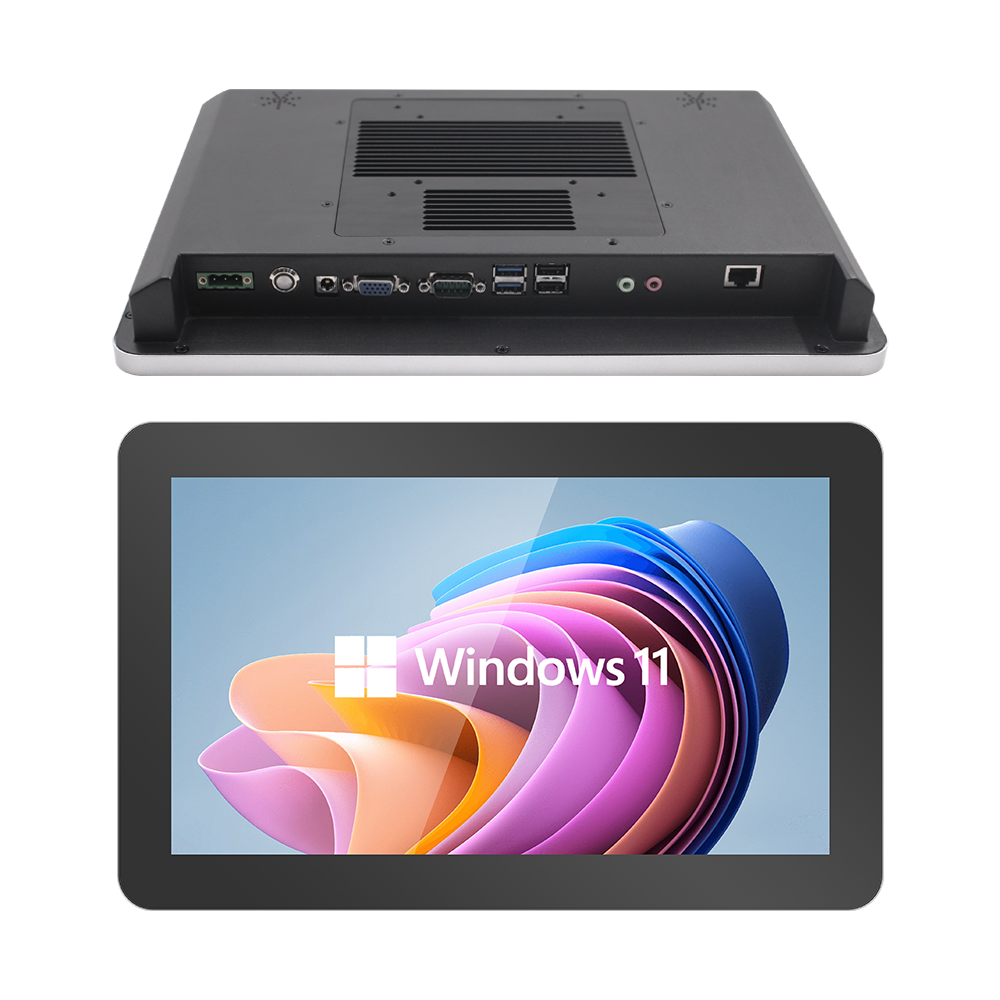
13.3″ Aluminum Bezel Industrial Panel PC
Designed for CNC machine consoles, automated test skids, and precision factory automation. Features an extruded 6061 aluminum front bezel, 13.3″ Full HD 16:9 widescreen display, 100% fanless passive cooling, IP65 front protection, and Windows 11 IoT Enterprise.
2. Windows 11 IoT Enterprise Real-Time OS Hardening
Modern machine automation requires deterministic operating system execution:
- 10-Year Long-Term Servicing Channel (LTSC): Windows 11 IoT Enterprise LTSC eliminates unexpected consumer feature upgrades, providing an immutable operating framework that prevents unscheduled machine reboot interruptions.
- Unified Write Filter (UWF): Diverts all runtime operating system writes to volatile RAM, protecting the onboard solid-state storage from corruption caused by sudden industrial power loss.
- Extruded 6061 Aluminum Bezel Rigidity: The precision-machined aluminum front bezel maintains IP65 ingress protection against cutting fluids and flying chips while resisting torsional twisting under continuous operator touch force.
Machine Console HMI Architecture Comparison
| Engineering Parameter | Commercial Desktop Touch PC | Engineered 13.3″ Aluminum Panel PC |
|---|---|---|
| Chassis Thermal Design | Internal cooling fan (Sucks cutting oil mist) | 100% Fanless solid aluminum passive conduction |
| Operating System Lifecycle | Consumer Windows 11 (Forced updates) | Windows 11 IoT Enterprise (10-Year LTSC locked) |
| Thermal Joint Conductance | Low-cost silicone pad (Dries and cracks) | Phase-change TIM (ΔT < 0.1°C across interface) |
| Front Ingress Protection | IP50 (Cutting fluid penetrates seams) | True IP65 dust-tight and oil-resistant front face |
| Power Stage Conditioning | External 12V plastic power brick | Integrated wide DC 9V to 36V with surge clamp |
3. Panel Cutout Commissioning Guidelines
- Cabinet Cutout Tolerances: Ensure the sheet-metal door aperture matches the engineering template within ±0.5 mm to maintain uniform perimeter compression on the closed-cell neoprene gasket.
- Panel Clamp Torquing Pattern: Tighten the rear panel-mount retaining clamps in a cross-diagonal sequence to 1.0 Nm of torque to prevent localized warping along the 330 mm horizontal bezel span.
- UWF Overlay Configuration: Following software commissioning, enable the Windows Unified Write Filter (UWF) on the system partition to protect the operating environment from sudden main-breaker shutdowns.
Upgrading CNC machine consoles and automated testing skids with 13.3-inch aluminum bezel fanless panel PCs provides crisp widescreen visualization while eliminating thermal throttling downtime. Contact INNODA’s machine automation engineering team to request 3D STEP packaging models, Windows 11 IoT image customizer documentation, and panel cutout drawings.