
Modern pharmaceutical sterile suites, semiconductor fabrication airlocks, and biological containment laboratories (BSL-3/BSL-4) require strict personnel identity verification at every air shower and gowning boundary. In these cleanroom environments, access control terminals cannot rely on physical keys or standard plastic keypads that harbor viable contaminants. A 10.1-inch widescreen (16:10 / 1280×800 WXGA) human-machine interface delivers an ideal physical footprint for wall-mounted personnel authentication, displaying real-time gowning protocols, room pressure differential cascades, and user validation credentials.
However, engineering a biometric access terminal for cleanrooms introduces strict physical constraints. Running separate high-voltage AC conduits through sealed sandwich panel walls increases air leakage risks and installation costs. Simultaneously, cleanroom operators wearing thin disposable latex or nitrile gloves require rapid biometric enrollment without repetitive authentication failures. Specifying a dependable 10.1-inch cleanroom biometric terminal requires analyzing Power over Ethernet (PoE 802.3at) line loss mechanics, optical vs. capacitive sensor resolution, and chemical wipe resilience.
1. IEEE 802.3at PoE Power Budgeting & Cat6 Loop Resistance Loss
Utilizing Power over Ethernet (PoE+) allows a single twisted-pair network cable to deliver both gigabit Ethernet data and direct-current operating power to the 10.1-inch terminal, eliminating high-voltage wall cutouts. Calculating voltage drops across maximum 100-meter field cable runs ensures operational stability under peak computing loads:
PoE IEEE 802.3at Type 2 Line Loss & Operating Voltage Equation: PSE Source Minimum Output Voltage: V_pse = 50.0 Volts DC. Total Cat6 Loop Conductor Resistance (100 m run at 20°C): R_loop ≈ 12.5 Ω. Target Powered Device (PD) Power Requirement: P_pd = 25.5 Watts (Max 802.3at class limit). Current Draw Calculation: P_pd = V_pse × I – I^2 × R_loop → 12.5 × I^2 – 50.0 × I + 25.5 = 0. Solving for Operating Loop Current: I = [ 50.0 – (2500 – 4 × 12.5 × 25.5)^0.5 ] / (2 × 12.5) = [ 50.0 – 35.0 ] / 25.0 = 0.60 Amperes. Voltage Delivered at Terminal (PD): V_delivered = V_pse – (I × R_loop) = 50.0 – (0.60 × 12.5) = 42.50 Volts DC. Line Transmission Loss: P_cable_loss = I^2 × R_loop = (0.60)^2 × 12.5 = 4.50 Watts. Total PSE Power Supplied: P_pse = P_pd + P_cable_loss = 25.5 + 4.50 = 30.00 Watts (Fully compliant with 802.3at Type 2 limit).
Because the internal DC-DC buck converter accepts delivered voltages down to 42.5V DC, the terminal operates reliably across 100-meter structural cable drops, powering the 10.1-inch high-brightness LCD, quad-core processor, RFID badge reader, and biometric optical scanner simultaneously over a single RJ45 drop.
To eliminate supplementary high-voltage wiring in cleanroom airlocks, automation engineers standardize on the 10.1″ Biometric Fingerprint Industrial Panel PC Access Control, which incorporates certified PoE 802.3at power management with an integrated 500 DPI optical fingerprint reader.
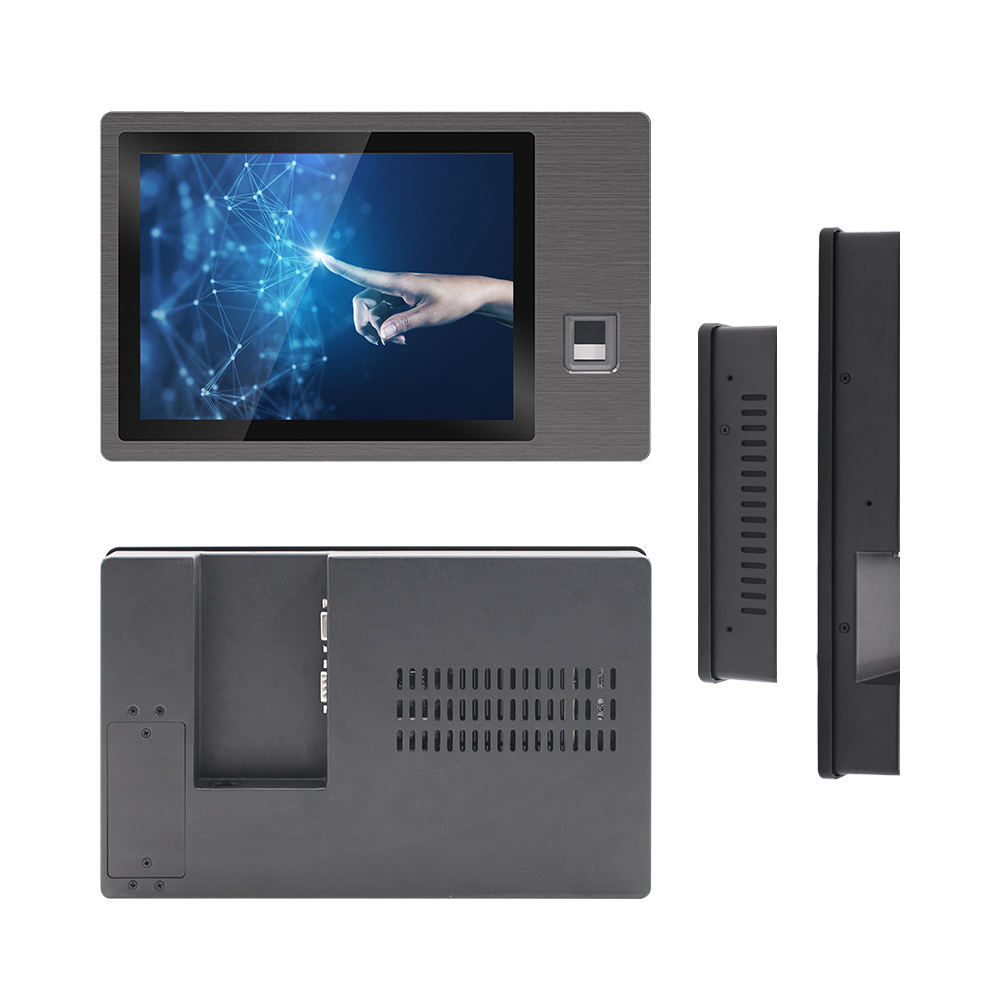
10.1″ Biometric Fingerprint Industrial Panel PC
Designed for pharmaceutical cleanrooms, semiconductor airlocks, and secure access portals. Powered by IEEE 802.3at PoE+, featuring an industrial 500 DPI optical fingerprint reader, integrated 13.56 MHz RFID/NFC, IP65 flush stainless front, and fanless architecture.
2. Biometric Verification Performance: FAR vs. FRR Mechanics
Biometric authentication in cleanrooms requires balancing security stringency against operator throughput:
- False Acceptance Rate (FAR ≤ 0.0001%): Advanced optical fingerprint algorithms map minutiae ridge bifurcations and ridge endings, ensuring less than one false authorized match in 1,000,000 random verification attempts.
- False Rejection Rate (FRR ≤ 0.1%): High-dynamic-range (HDR) optical sensors penetrate surface skin dry spots caused by repetitive cleanroom alcohol sanitization, verifying authentic operators on the first touch in over 99.9% of scans.
- Flush SUS304/SUS316L Enclosure Geometry: The true-flat front fascia eliminates dirt-collecting gaps and withstands continuous daily wipes with 70% Isopropyl Alcohol (IPA) and Vaporized Hydrogen Peroxide (VHP).
Cleanroom Access Control Terminal Comparison
| Engineering Parameter | Commercial Plastic Keypad Terminal | Engineered 10.1″ Biometric Cleanroom PC |
|---|---|---|
| Power Sourcing Architecture | Requires separate 110V/220V conduit drop | Single-cable PoE+ (IEEE 802.3at Type 2) |
| Chemical Disinfectant Care | Plastic crazes and yellows under alcohol | Solid 304 stainless & chemically toughened 7H glass |
| Biometric Sensor Rating | Low-resolution consumer sensor (FRR > 5%) | Industrial 500 DPI optical sensor (FRR ≤ 0.1%) |
| Cleanroom Wall Sealing | Unsealed housing bleeds positive room pressure | IP65 hermetic perimeter silicone gasket |
| Multi-Factor Authentication | PIN code only (Shared credential hazard) | Biometric fingerprint + 13.56 MHz RFID/NFC reader |
3. Installation & Commissioning Guidelines
- PoE Midspan Calibration: Verify that the network switch or PoE injector port is configured to IEEE 802.3at Type 2 (30W allocated budget) to prevent port power shutdowns during simultaneous biometric scanning and camera streaming.
- In-Wall Cutout Gasket Sealing: When mounting the terminal into a cleanroom sandwich wall panel, tighten the rear perimeter retention clamps to 1.0 Nm, ensuring uniform 30% compression across the silicone gasket to prevent pressure leakage.
- Ground Continuity Verification: Test electrical continuity between the stainless front bezel and the cleanroom facility equipotential bonding bus, confirming ground resistance remains below 0.1 Ω for ESD safety.
Standardizing cleanroom airlocks and gowning stations on PoE-powered 10.1-inch biometric industrial panel PCs eliminates penetration wiring and provides seamless multi-factor identity validation. Contact INNODA’s cleanroom access engineering team to request PoE wiring schematics, biometric API integration SDKs, and custom in-wall mounting backboxes.