
In modern industrial control cabinets (NEMA 4/4X and IP65/IP66 enclosures), internal ambient temperatures routinely climb beyond 55°C (131°F) due to thermal output from Variable Frequency Drives (VFDs), servo power stages, and multi-axis motion controllers. Within these sealed environments, active ventilation is strictly prohibited to prevent airborne conductive dust, cutting fluid aerosols, and ambient humidity from depositing onto sensitive silicon circuitry.
Consequently, touch panel PCs and Human-Machine Interfaces (HMIs) must rely entirely on pure conductive and passive natural convective heat dissipation through their structural enclosures. Automation architects and mechanical hardware engineers face a fundamental selection trade-off: precision CNC-machined aerospace-grade aluminum alloy (6063-T5 / 6061) versus stamped cold-rolled carbon sheet steel (SPCC). Understanding the thermal physics, junction-to-case resistance, and MTBF implications is critical to preventing thermal throttling and processor degradation.
1. Governing Physics: One-Dimensional Heat Conduction & Thermal Resistance
Thermal transfer across an enclosure wall is governed by Fourier’s Law of Heat Conduction, defined mathematically as:
q = -k × A × (dT / dx)
Where q is the heat transfer rate (Watts), k represents the thermal conductivity coefficient of the material (W/m·K), A is the surface dissipation area (m²), and dT/dx is the temperature gradient along the chassis thickness.
The total thermal resistance path from the CPU silicon die to the external plant atmosphere consists of a series network:
R_total = R_junction-to-case + R_tim + R_spreader + R_conduction + R_convection
- Aluminum 6063-T5 Thermal Superiority: High-purity extruded aluminum provides an exceptional thermal conductivity rating of k ≈ 201–209 W/m·K. Because of this high thermal conductivity, lateral heat spreading across the chassis is nearly instantaneous, transforming the entire unibody housing into a massive, uniform heatsink. In space-restricted control cabinets, deploying a solid unibody system like the 10.1″ CNC Aluminum Embedded Panel PC ensures the junction temperature ($T_j$) remains safely below 75°C even under 100% multicore CPU utilization.
- Cold-Rolled Carbon Sheet Steel (SPCC): Possesses a thermal conductivity of merely k ≈ 45–52 W/m·K—less than 25% that of aluminum. Under identical processor heat dissipation loads (e.g., a 15W TDP Intel Core U-Series platform), steel exhibits localized thermal hot spots around the processor bracket. Heat stagnates locally rather than radiating outwards, increasing thermal resistance ($R_{conduction}$) by a factor of 4.2.
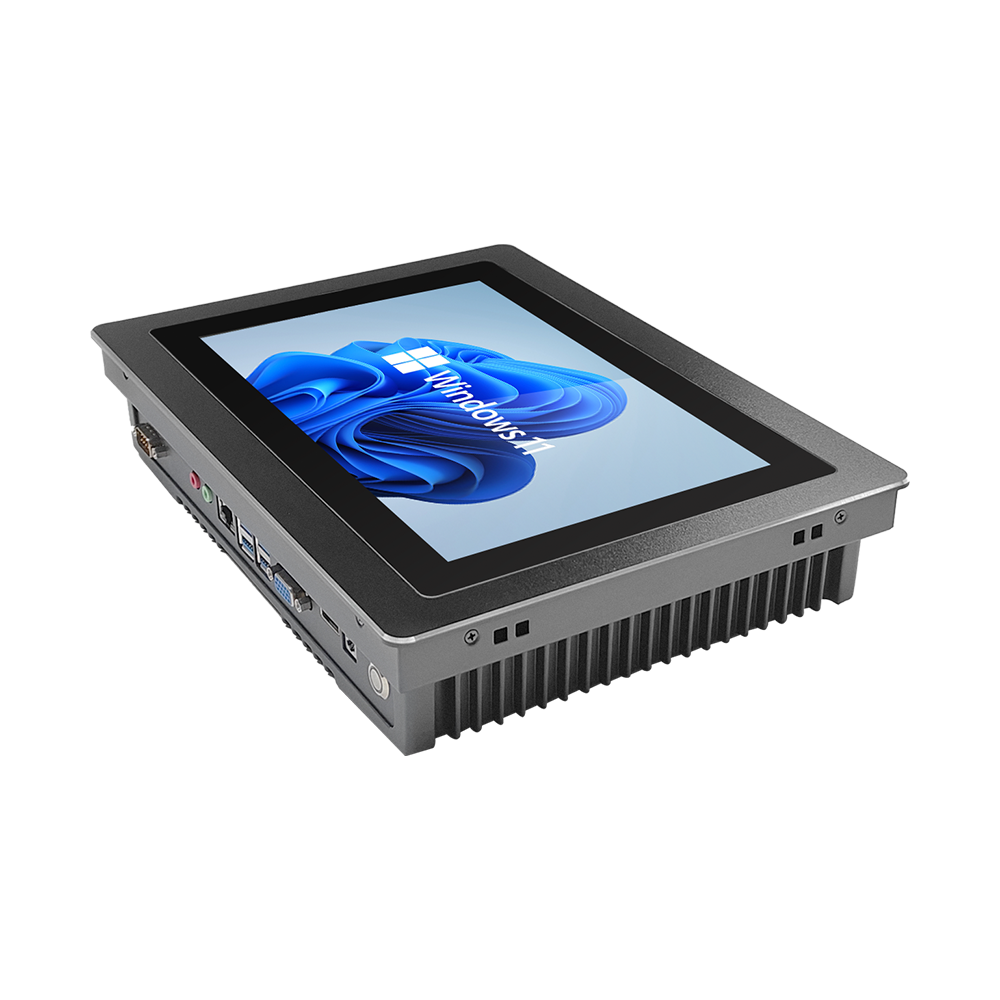
10.1″ CNC Aluminum Fanless Embedded Industrial Panel PC
Engineered for high-temperature sealed electrical cabinets. Features a solid 6063 aerospace-grade aluminum chassis for passive conductive thermal dissipation, zero throttling up to 60°C ambient, true-flat IP65 PCAP touch, and low-power multicore processing.
2. Thermal Boundary Layer Dynamics & Passive Heatsink Fin Geometry
Once heat conducts to the exterior enclosure surface, it must dissipate into ambient plant air via natural convection and thermal radiation. The convective heat transfer coefficient ($h_c$) depends strictly on surface boundary layer development:
- Optimal Fin Spacing and Height: To prevent boundary layer interference in natural convection, cooling fins must maintain a minimum spacing of 8mm to 12mm. CNC-machined and extruded aluminum architectures allow precise integration of high-aspect-ratio longitudinal fins directly into the chassis rear profile.
- Surface Emissivity ($\varepsilon$): Bare, polished aluminum has poor radiative emissivity ($\varepsilon \approx 0.05$), meaning it dissipates heat almost exclusively through slow air contact. High-grade industrial computers utilize black anodized surface oxidation (MIL-A-8625 Type II), raising the surface emissivity coefficient to $\varepsilon \approx 0.85–0.90$. This enhancement increases total heat dissipation by 20% to 35% purely through infrared thermal radiation.
- Limitations of Stamped Sheet Steel: Sheet metal enclosures cannot incorporate monolithic thick fins; they rely on bent sheet brackets with thin wall gauges (1.2mm–1.5mm). When mounted on machine panels alongside displays like the 15.6″ Flat Touch Industrial Monitor, maintaining front-bezel thermal decoupling is crucial to ensure that backlight LED heat does not back-propagate into sensitive motherboard capacitors.
3. Thermal Throttling, Silicon Degradation, and Arrhenius Reliability
Modern industrial CPUs (such as Intel Core i5/i7 and Elkhart Lake J6412) incorporate Thermal Velocity Boost and Prochot (Processor Hot) protection registers. When the silicon die temperature approaches $T_{j,max}$ (typically 100°C–105°C), the internal power control unit (PCU) forces down the core clock multiplier from 2.6GHz+ down to 800MHz base frequencies to prevent destructive thermal breakdown.
This dynamic throttling introduces critical system latency: real-time motion control algorithms drop packets, optical vision frame inspection falls behind conveyor speeds, and SCADA updates lag. Furthermore, according to the Arrhenius Reaction Rate Law, for every 10°C increase in internal operating temperature above 50°C, the chemical aging rate of solid tantalum and aluminum electrolytic filter capacitors doubles, reducing mean time between failures (MTBF) by 50%.
Engineering Material & Thermodynamic Benchmark
| Thermal Parameter | CNC Aluminum Alloy (6063-T5) | Cold-Rolled Sheet Steel (SPCC) |
| Thermal Conductivity ($k$) | 201 – 209 W/m·K (Rapid heat spreading) | 45 – 52 W/m·K (High thermal resistance) |
| Heat Dissipation Efficiency | Uniform temperature distribution across entire chassis | Severe localized hot spots directly over CPU module |
| Surface Emissivity ($\varepsilon$) | 0.85 – 0.90 (Hard black anodized coating) | 0.70 – 0.80 (Standard powder coat/paint) |
| Thermal Throttling Margin | Maintains sustained Turbo Boost at 60°C ambient | Requires clock throttling or reduced TDP at >45°C |
Are you designing a completely sealed NEMA 4X cabinet or compact embedded machine console with stringent thermal envelopes? Contact INNODA’s thermal simulation engineers for FloTHERM computational fluid dynamics (CFD) reports and custom heatsink profiles.