
In harsh automated production environments—including automotive paint booths, metal CNC machining cells, and chemical batch compounding suites—industrial display systems are classified under strict environmental protection standards: NEMA 4/4X, IP65, and IP67 (IEC 60529). However, plant maintenance records consistently show that over 65% of water and aerosol ingress failures occur not at the point of initial commissioning, but 12 to 24 months post-installation.
This delayed mechanical failure is rarely due to housing cracks. Instead, it stems from a poorly understood polymer degradation phenomenon: elastomeric gasket compression set, continuous mechanical stress relaxation, and chemical plasticizer leaching. To maintain true zero-downtime operations, facility maintenance engineers must master the tribology and sealing dynamics of industrial display interfaces.
1. The Physics of Seal Failure: Compression Set & Stress Relaxation
When an industrial panel PC or monitor is clamped into a cabinet cutout, the perimeter elastomeric gasket is compressed by 25% to 35% of its original thickness to deform against microscopic surface roughness and create an airtight hydraulic seal. Over time, under continuous mechanical strain and thermal cycling, elastomer cross-links undergo permanent irreversible realignment.
The standard measure of permanent seal degradation is defined by ASTM D395 (Method B):
C_B = [ (t_0 – t_i) / (t_0 – t_n) ] × 100%
Where $t_0$ is the initial original gasket thickness, $t_i$ is the recovered thickness after load release, and $t_n$ is the spacer thickness during compression. When an elastomer exhibits a high compression set ($C_B > 40\%$), it permanently loses its elastic recovery force ($F_r$). As ambient temperatures swing from winter lows to summer peaks, the metal chassis and enclosure expand and contract at different rates ($CTE$ mismatch). The inelastic gasket fails to bridge the expanding microscopic gap, allowing washdown water or cutting oil vapor to be siphoned inside by internal negative pressure.
2. Elastomer Material Comparison: EPDM vs. Silicone vs. Neoprene
Selecting the correct polymer matrix dictates long-term chemical permeation resistance across specific factory contaminants:
- Cellular EPDM (Ethylene Propylene Diene Monomer): Offers exceptional resistance to ozone, polar solvents, caustic clean-in-place (CIP) alkaline detergents, and steam. With a low compression set (<15% at 70°C), closed-cell EPDM is standard on severe-duty systems like the 19″ Full IP67 CNC Aluminum Waterproof Panel PC. However, EPDM swells rapidly if subjected to non-polar petroleum hydrocarbons and mineral cutting oils.
- Fluorosilicone / Viton (FKM): Possesses absolute chemical immunity against aromatic hydrocarbons, synthetic cutting fluids, and hydraulic fuels, retaining high elasticity across a continuous -40°C to 200°C envelope. Used in high-end chemical and petrochemical control cells.
- Closed-Cell Neoprene (Chloroprene): Provides a balanced cost-to-performance profile for light industrial machinery, but suffers accelerated embrittlement under outdoor ultraviolet (UV) solar exposure.
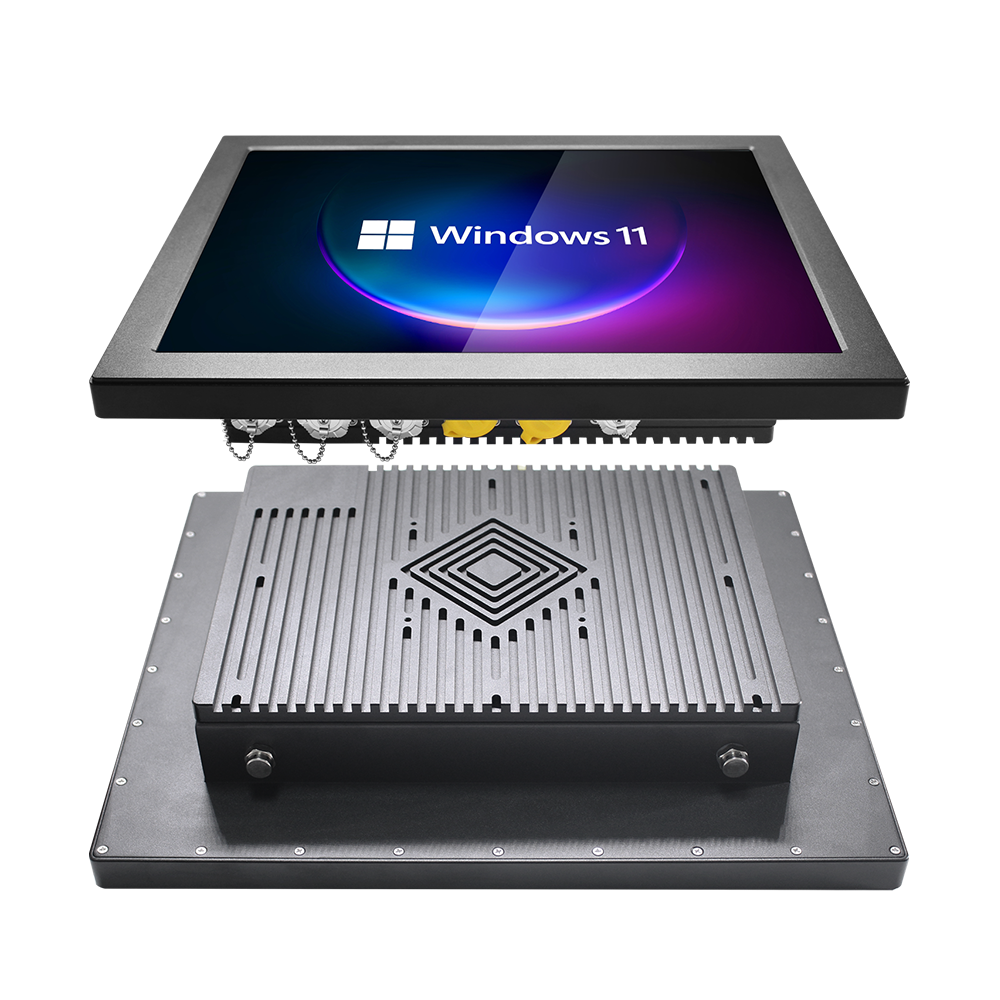
19″ Full IP67 CNC Aluminum Waterproof Industrial Panel PC
Engineered with seamless O-ring encapsulation and high-recovery EPDM sealing to permanently resist compression creep. Built with solid CNC aerospace aluminum, sealed aviation I/O, and fanless architecture for extreme plant washdowns.
3. Panel Cutout Rigidity vs. Standalone Rackmount Integration
In centralized server bays and climate-controlled control rooms, avoiding gasket degradation altogether can be accomplished by standardizing on 19-inch rack enclosures. Deploying open-frame or rackmount solutions like the 19″ 1000 Nits Rackmount Open Frame Monitor isolates computing hardware within positive-pressure, filtered enclosures, eliminating gasket stress entirely while ensuring instant slide-out maintenance access.
Conversely, for field-mounted panel installations, improper torque sequence during mounting clip installation causes uneven gasket deformation:
- Overtightening Failure: Torquing cabinet mounting clamps beyond recommended limits (typically 0.6–0.8 N·m) crushes the cellular structure of foam gaskets, tearing the closed-cell skins and creating permanent moisture capillaries.
- Star-Pattern Fastening: Always torque mounting studs in an alternating cross-star sequence rather than tightening sequentially around the perimeter, ensuring uniform linear gasket deflection ($\pm 0.1\text{mm}$).
- Surface Roughness Compliance: The sheet-metal cutout perimeter must be deburred and finish-ground to a surface roughness of $Ra \le 3.2\,\mu\text{m}$. Heavy burrs or laser slag cut through protective elastomeric barriers immediately upon torque application.
Industrial Ingress Gasket Comparison Matrix
| Elastomer Type | Compression Set (ASTM D395) | Chemical Resistance Profile | Recommended Industrial Zone |
| Closed-Cell EPDM | 10% – 15% (Superior recovery) | Caustic cleaners, hot water, ozone, steam | Food processing, beverage washdowns, outdoor kiosks |
| Fluorosilicone / Viton | 12% – 18% (High stability) | Mineral oils, diesel fuels, synthetic coolants | CNC wet machining cells, automotive paint lines |
| Polyurethane (PU) Foam | 25% – 35% (Moderate creep) | Airborne dry dust, light moisture splash | General indoor warehousing, clean assembly lines |
Are you experiencing premature ingress failures, gasket swelling, or condensation in your facility’s operator consoles? Contact INNODA’s mechanical sealing specialists for customized gasket material compatibility charts and IP67/NEMA 4X integration kits.