
Deploying outdoor interactive human-machine interfaces under intense direct sunlight demands high-luminance display backlights capable of producing 1000 to 1500 nits (cd/m²). In outdoor marine ports, petrochemical tank terminals, and exposed mining operations, ambient illuminance routinely exceeds 50,000 to 100,000 lux. Under these lighting conditions, standard 350-nit commercial screens appear washed out and unreadable, forcing operators to shade the display manually.
However, generating 1500 nits of luminous flux produces substantial electrical heat. An array of high-power white LEDs (WLED) driven at maximum forward current dissipates between 25W and 45W of pure thermal energy directly into the rear optical cavity. Inside a completely sealed, fanless full IP67 stainless steel enclosure, this concentrated heat density presents an engineering challenge that requires precise conduction modeling.
1. Optical Contrast Ratio and Ambient Sunlight Legibility
Visual readability in direct sunlight depends not only on raw backlight luminance, but on the perceived contrast ratio (CR) between white text and dark display backgrounds. Every unbonded glass-air interface introduces internal specular reflections that wash out screen graphics:
Sunlight Effective Contrast Ratio Formula: CR = 1 + [ L_display / (L_ambient × R_specular) ] Where: – Direct Sun Ambient Reflection Luminance: L_ambient ≈ 31,800 cd/m² (under 100,000 lux illumination). – Case A (Unbonded Air Gap): Total reflectance R_specular ≈ 4.5% (Fresnel loss across two air-glass interfaces). CR = 1 + [ 1500 / (31,800 × 0.045) ] = 1 + [ 1500 / 1431 ] ≈ 2.05 : 1 (Barely readable, heavy visual fatigue). – Case B (Full Optical LOCA Bonding + Anti-Reflective Coating): R_specular ≤ 0.5%. CR = 1 + [ 1500 / (31,800 × 0.005) ] = 1 + [ 1500 / 159 ] ≈ 10.43 : 1 (Crisp, high-contrast sunlight readability).
Optical wet bonding utilizing Liquid Optical Clear Adhesive (LOCA) matches the refractive index of the cover glass (n ≈ 1.51), eliminating internal air reflection boundaries while simultaneously acting as an efficient thermal conduction bridge that pulls heat away from the LCD panel.
To ensure daylight legibility in outdoor industrial installations, systems like the 15.6″ Full IP67 Stainless Steel Panel PC (1500 Nits) combine high-luminance LED matrices with full optical bonding to deliver exceptional contrast without internal fogging.
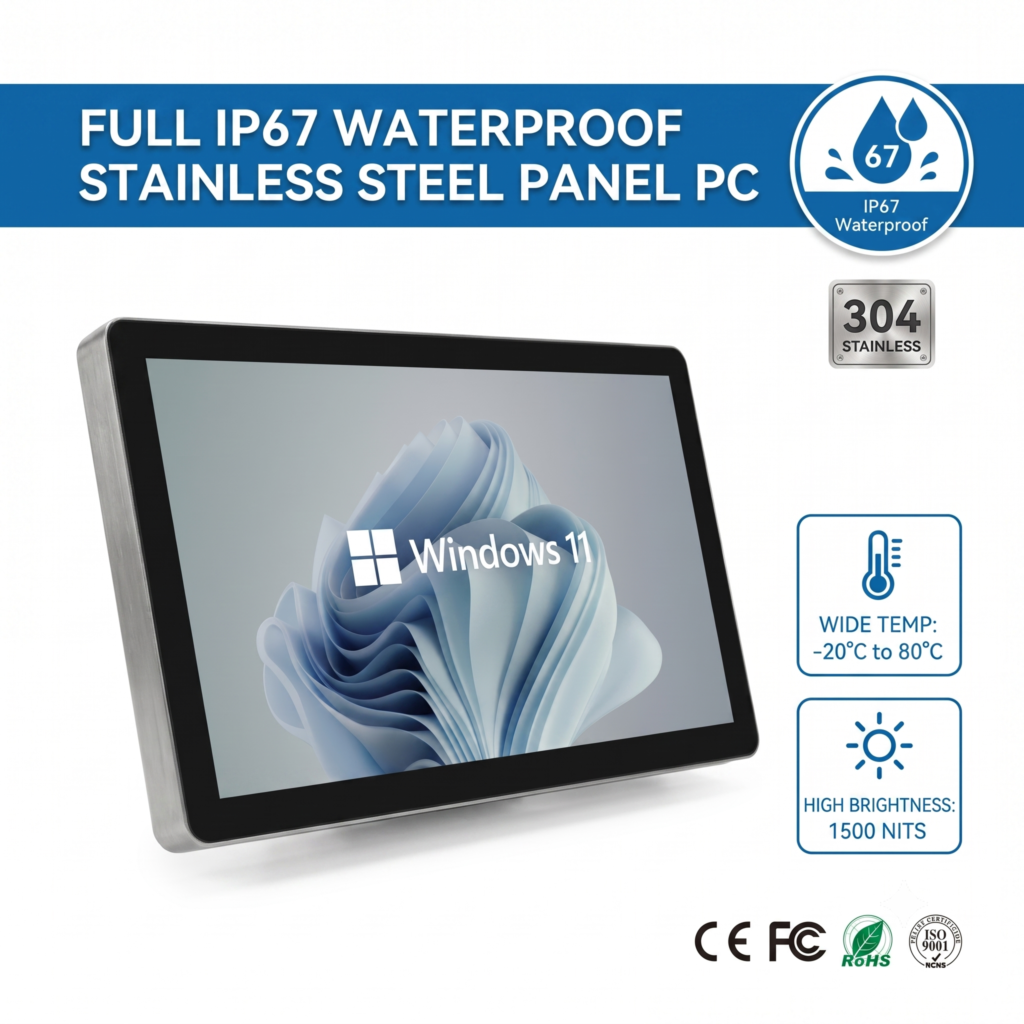
15.6″ Full IP67 Stainless Steel Panel PC (1500 Nits)
Engineered for direct outdoor sunlight and harsh chemical washdowns. Combines 1500 nits high-luminance WLED backlighting, full optical wet bonding, 304/316L stainless steel enclosure, and high-clearing-point liquid crystal fluids to eliminate solar blackouts.
2. Thermal Conduction Bottlenecks in Stainless Steel Alloys
While aluminum is an exceptional thermal conductor, stainless steel is selected for chemical resilience despite its substantially lower thermal conductivity:
- Conductivity Comparison: Pure aluminum achieves k ≈ 205 W/(m·K), whereas austenitic stainless steel (SUS304) exhibits a low thermal conductivity of only k ≈ 16.2 W/(m·K).
- Backlight Heat Spreading: Without internal heat spreading, LED backlight strips create localized thermal gradients exceeding 90°C along the edge of the display, causing premature LED phosphor aging, color shifting toward blue, and liquid crystal clearing.
- Engineered Copper/Aluminum Heat Pipe Spreader: The backlight chassis incorporates high-conductivity electrolytic copper heat pipes bonded directly to the LED mounting rail. These heat pipes rapidly distribute localized thermal energy across the broad rear stainless steel casing, expanding convective cooling surface area.
High-Brightness Display Architecture Comparison
| Thermal & Optical Metric | Standard 350-Nit Industrial PC | Engineered 1500-Nit IP67 Stainless PC |
|---|---|---|
| Luminance (cd/m²) | 350 – 450 Nits (Unreadable in full sun) | 1500 Nits high-efficiency WLED array |
| Optical Bonding Stack | Air gap (Prone to condensation & 4.5% glare) | Full wet optical bonding (LOCA, <0.5% glare) |
| Solar Blackening Clearing Point | Standard LC fluid (T_ni ≈ 70°C blackouts) | High-clearing-point LC fluid (T_ni > 105°C) |
| Thermal Dissipation Path | Natural air convection inside plastic chassis | Conduction-coupled copper/stainless chassis sink |
| LED Backlight MTBF | 30,000 Hours (Thermal degradation at high drive) | > 50,000 Hours with constant-current dimming |
3. Preventing Solar Isotropic Transition (Black Out Phenomenon)
When solar radiation directly strikes an outdoor touch panel, it injects up to 1000 W/m² of radiant energy through the front glass. If internal display temperatures cross the nematic-isotropic phase transition point (T_ni), liquid crystal molecules lose their directional orientation, turning the screen into an opaque, expanding black blotch.
To prevent solar blackening, engineered 1500-nit stainless panel PCs implement high-clearing-point liquid crystal fluids rated for T_ni ≥ 105°C. Paired with anti-reflective/infrared-blocking (AR/IR) front cover glass coatings, incoming solar thermal radiation is reflected away while maximizing visible light transmission.
Selecting high-brightness stainless hardware with verified optical bonding and thermal dissipation ensures reliable human-machine operation under harsh outdoor environments. Inquire with INNODA’s thermal engineering team to review solar loading simulations, optical transmission curves, and custom IP67 stainless enclosure designs.