
Modern commercial shipping vessels, offshore dredging platforms, port container cranes, and open-pit mining operations require expansive command-and-control displays. Operating multi-sensor ECDIS marine navigation, radar collision avoidance, and automated winch telemetry demands large-format visual interfaces. A 27-inch widescreen format provides the resolution and screen real estate required to combine multiple critical data feeds onto a single glass surface.
However, wheelhouses and heavy machinery cockpits present extreme operating environments. Sun glare pouring through wrap-around glass bridges reaches illuminance levels exceeding 80,000 to 100,000 lux, rendering standard screens illegible. Furthermore, bare polished stainless steel bezels reflect blinding light into operator eyes, while airborne marine salt fog rapidly corrodes standard painted metals.
1. Direct Sunlight Ambient Contrast Ratio (ACR) Mathematical Modeling
Visual clarity under extreme sunlight requires optimizing the display Ambient Contrast Ratio (ACR). ACR evaluates the ratio between the active light emitted by the LCD backlight and the reflected solar glare bouncing off the display glass:
Ambient Contrast Ratio (ACR) Equation: ACR = (L_on + L_ambient_reflected) / (L_off + L_ambient_reflected) Where: – Reflected Ambient Glare: L_ambient_reflected = (E_ambient / π) × R_total. – Under Peak Solar Illuminance: E_ambient = 100,000 lux → (E_ambient / π) ≈ 31,830 cd/m². Comparison: Case A (Standard 350-nit panel, unbonded air-gap with R_total ≈ 4.5%): L_reflected = 31,830 × 0.045 ≈ 1,432 cd/m². ACR = (350 + 1,432) / (0.35 + 1,432) = 1,782 / 1,432.35 ≈ 1.24 : 1 (Total washout, unreadable). Case B (Engineered 1500-nit panel, LOCA optical bonding + AR coating with R_total ≤ 0.5%): L_reflected = 31,830 × 0.005 ≈ 159.15 cd/m². ACR = (1500 + 159.15) / (1.5 + 159.15) = 1,659.15 / 160.65 ≈ 10.33 : 1 (Crisp, high-contrast readability).
International maritime standards (such as IEC 60945) recommend an ACR of at least 5:1 for safe tactical navigation. As proven by mathematical modeling, achieving this under 100,000 lux direct sun requires coupling 1500-nit backlighting with full optical wet bonding.
To eliminate solar washouts on open bridges, marine operators deploy the 27″ 1500 Nits Black Stainless Steel Touch Monitor, which pairs high-power constant-current WLED arrays with Liquid Optical Clear Adhesive (LOCA) index-matching bonding.
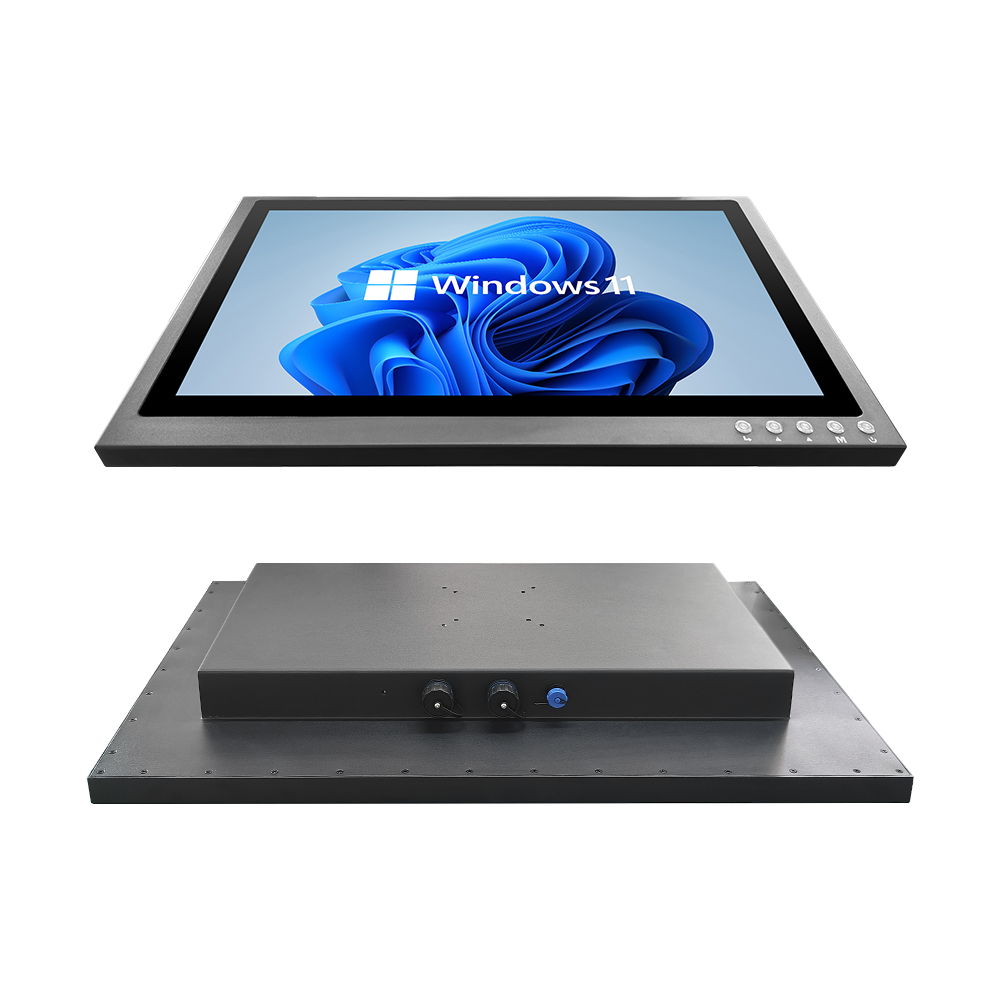
27″ 1500 Nits Black Stainless Steel Touch Monitor
Designed for marine wheelhouses, harbor crane cabs, and outdoor industrial cockpits. Features an expansive 27″ Full HD display, 1500 nits sunlight readability with LOCA optical bonding, non-reflective matte black stainless steel chassis, and 0-100% smooth night dimming.
2. Black PVD Stainless Coating & Anti-Reflective Optical Design
In high-glare control cabs, enclosure surface treatment is as important as screen brightness:
- Black PVD (Physical Vapor Deposition) Titanium Coating: Traditional stainless steel reflects harsh light into operator eyes. Applying a vacuum PVD titanium carbonitride layer creates a non-reflective matte black surface that preserves the corrosion resistance of 316-grade stainless while eliminating bridge reflection hazards.
- Ultra-Wide PWM Dimming (0% to 100%): Marine navigation requires seamless transitions from 1500 nits under midday sun down to less than 1 nit during nighttime watches. High-resolution PWM controllers ensure flicker-free dimming to preserve operator night vision.
- Thermal Conduction via Stainless/Aluminum Hybrid Sink: The massive 27-inch backlight matrix dissipates approximately 45W of thermal power. High-conductivity internal copper heat pipes spread thermal flux across the heavy rear chassis, preventing solar isotropic blackening.
Heavy Marine & Crane Display Comparison
| Technical Parameter | Standard Desktop 27″ Monitor | Engineered 27″ Black Stainless Monitor |
|---|---|---|
| Luminance Output | 300 – 350 Nits (Unreadable in wheelhouse) | 1500 Nits daylight-viewable WLED matrix |
| Optical Bonding Stack | Air gap (Prone to condensation and glare) | Full LOCA wet bonding (Refractive index n=1.51) |
| Chassis Material & Finish | Plastic housing (Cracks under UV exposure) | Heavy SUS304/316L with matte black PVD coating |
| Deep Night Dimming | Minimum dimming 20% (≈ 70 nits, blinds crew) | Deep dimming down to < 1 nit (Night navigation safe) |
| Operating Temperature | 0°C to +40°C (Solar blackouts in summer) | -20°C to +70°C wide temperature industrial panel |
3. Real-World Field Case: Container Terminal Gantry Cranes
An automated container terminal in Rotterdam retrofitted operator cabs on 12 ship-to-shore gantry cranes with 27″ 1500 Nits Black Stainless Steel Touch Monitors. Previous 400-nit consumer screens suffered high failure rates from solar heat buildup and salt fog corrosion. Following the installation, crane operators achieved 100% visual telemetry legibility under direct glare and sea mist, eliminating daytime blind-spot delays across 14 consecutive months of continuous operation.
Standardizing marine wheelhouses and heavy equipment cabs on optically bonded 1500-nit black stainless monitors ensures continuous situational awareness and operational safety. Contact INNODA’s marine display support team to request ECDIS color calibration profiles, dimming curve documentation, and custom console mounting drawings.