
Modern automated beverage bottling lines, industrial pharmaceutical formulation suites, and multi-lane meat packaging stations require large visual displays suspended directly at the operator workstation. A 21.5-inch widescreen (16:9 Full HD 1920×1080) human-machine interface delivers the visual canvas necessary to display real-time line telemetry, batch validation data, and vision-inspection feeds side-by-side. However, suspending a heavy stainless steel computing terminal on an articulating bracket arm exposes the mechanical structure to continuous dynamic torsional stresses.
Unlike stationary cabinet-mounted panel PCs, bracket-mounted terminals withstand operator touch forces applied at the extreme ends of long moment arms, as well as high-velocity washdown jet impacts. Without proper torsional stiffness engineering and thermal shock seal compensation, bracket assemblies experience structural fatigue, and perimeter seals develop leak paths during daily CIP washdowns.
1. Cantilever Torsional Moments & Washdown Jet Deflection Physics
When an operator taps the corner of a 21.5-inch widescreen display mounted on an extended cantilever support arm, or when a high-pressure washdown lance strikes the outer edge of the chassis, significant torsional shear stress transmits through the mounting bracket interface:
Torsional Shear Stress & Angular Deflection Equation: Torsional Moment: T = F_load × r_moment_arm Where: – Washdown Jet Strike Force F_load ≈ 35.0 N (at 25 bar washdown pressure). – Half-Width of 21.5″ Display r_moment_arm ≈ 0.27 m (270 mm from center bracket axis). Resulting Torque: T = 35.0 × 0.27 = 9.45 N·m dynamic twisting torque. Torsional Stress in Bracket Tube: τ_max = (T × r_outer) / J Where polar moment of inertia J = (π / 2) × (r_outer^4 – r_inner^4). For a thin-wall 30 mm tube (wall = 1.5 mm): τ_max ≈ 18.2 MPa. Angular Deflection: θ = (T × L_arm) / (G × J).
Thin sheet-metal brackets flex excessively under this dynamic load, creating continuous oscillating shear forces across the rear mounting bolts. Over repeated washdown cycles, this mechanical rocking relieves gasket compression along the rear entry gland, allowing washdown fluids to penetrate the electronics compartment.
To withstand extreme torsional moments while maintaining hermetic integrity, process facilities deploy the 21.5″ Full IP67 Stainless Steel Panel PC with Mounting Bracket, which incorporates a heavy-duty reinforced SUS304/SUS316L mounting yoke engineered to absorb high twisting loads without seal deflection.
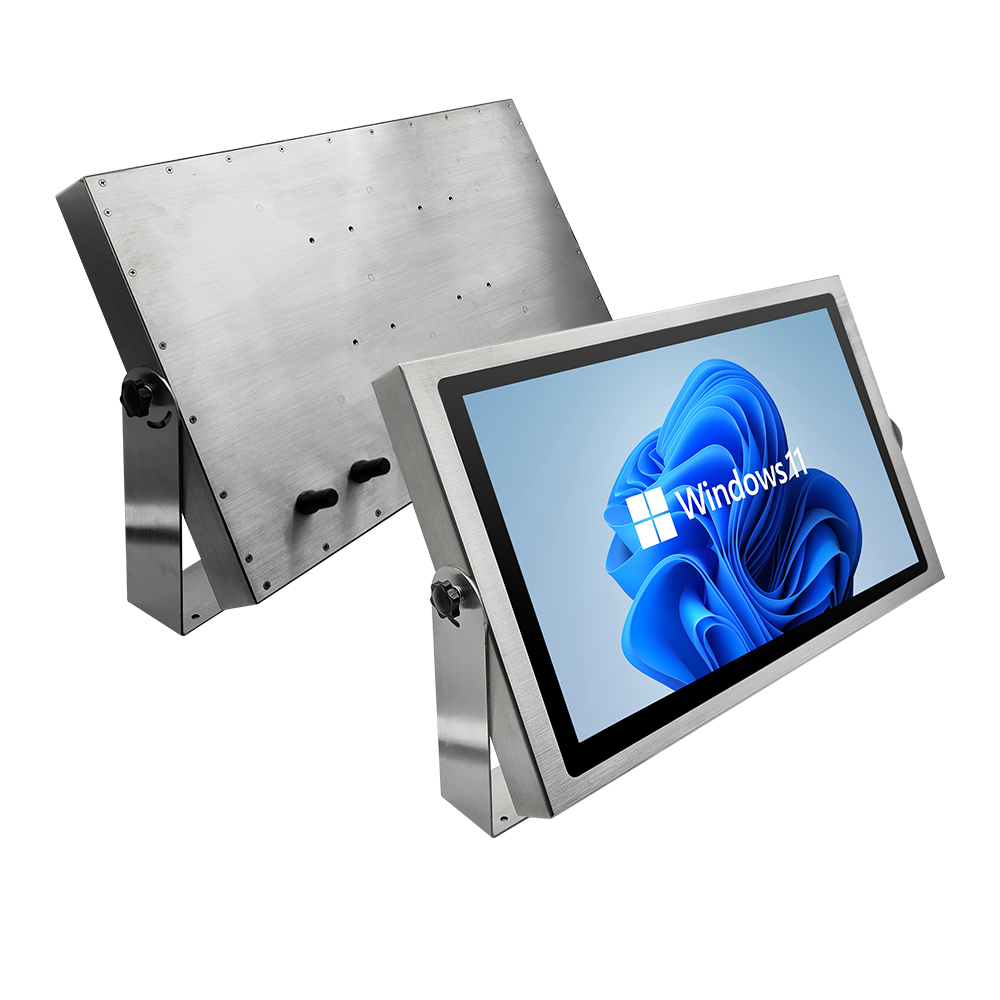
21.5″ Full IP67 Stainless Steel Panel PC with Bracket
Engineered for sanitary food lines, chemical plants, and bottling suites. Features an expansive 21.5″ Full HD display, heavy-duty SUS304/316L stainless steel enclosure with integrated mounting bracket, full IP67 washdown sealing, and all-metal M12 connections.
2. Thermal Shock Differential Contraction & M12 Gland Sealing
CIP cleaning protocols frequently expose warm operating terminals to cold washdown solutions:
- Coefficient of Thermal Expansion (CTE) Mismatch: Stainless steel has a low thermal expansion coefficient (α ≈ 16 × 10^-6 / K), whereas elastomeric seals expand and contract significantly faster (α ≈ 180 × 10^-6 / K). A rapid 35°C thermal drop causes the gasket to shrink faster than the metal housing.
- Dovetail Compression Retainers: Rather than relying on adhesive-backed flat gaskets, the chassis integrates a CNC-milled dovetail retaining channel that holds a closed-cell fluorosilicone O-ring under a fixed 35% mechanical pre-compression, preventing seal movement during thermal contraction.
- All-Metal Stainless M12 Aviation Connectors: External power, dual Ethernet, and USB connections route through heavy-gauge SUS316 M12 circular connectors that screw down to a metal-to-metal positive stop, ensuring IP67 sealing regardless of cable movement.
Bracket-Mount Stainless HMI Comparison
| Engineering Parameter | Standard VESA Swivel Mount | Engineered 21.5″ IP67 Bracket PC |
|---|---|---|
| Torsional Yield Strength | Sheet metal brackets deform under > 5 N·m | Heavy SUS304/316L yoke rated for > 35 N·m |
| Ingress Protection Level | IP65 front only (Rear ports exposed to splash) | Full IP67 (Front, rear chassis, and M12 glands) |
| Thermal Shock Recovery | Flat gasket lifts during sudden 30°C drops | Dovetail fluorosilicone maintains sealing stress |
| Touch Tracking in Water | Ghost clicks and cursor freezing in water spray | Mutual-capacitance DSP water-rejection firmware |
| Sanitary Cleanability | Exposed screw threads trap organic debris | Smooth electropolished finish (Ra ≤ 0.4 μm) |
3. Installation Guidelines for Articulating Swing Arms
- Internal Cable Routing: Route all M12 pre-molded cables through the hollow interior of the stainless support arm rather than zip-tying cables externally, eliminating chemical pooling areas.
- Bracket Pivot Torque: Calibrate bracket swivel tensioning nuts to 12.0 N·m to permit smooth operator re-positioning while preventing screen drift during high-pressure washdown spraying.
- Equipotential Earth Bonding: Verify electrical continuity between the stainless bracket arm and the facility ground bus (≤ 0.1 Ω) to eliminate static charge buildup from steam cleaning lances.
Upgrading food, beverage, and chemical workstations with bracket-mounted full IP67 stainless panel PCs delivers ergonomic visualization without sacrificing mechanical sealing. Contact INNODA’s mechanical engineering team to request swing-arm load calculation sheets, 3D CAD models, and customized bracket mounting adapters.