Navigating commercial cargo vessels, high-speed patrol craft, and offshore fishing boats requires skippers to wear polarized sunglasses to cut through intense surface water glare. However, standard commercial Liquid Crystal Displays (LCDs) emit linearly polarized light. When an operator wearing polarized eyewear views an uncalibrated marine screen, tilting the head or rotating the display creates complete optical blackout, rendering critical radar and chartplotter screens invisible.
This blackout phenomenon poses severe maritime navigational safety hazards during critical docking maneuvers or high-speed rough-water transits. Eliminating polarization blackout without sacrificing display contrast or touchscreen durability requires integrating a circular-polarizing quarter-wave retarder (QWP) optical film stack directly into the display lamination.
1. Malus’s Law Linear Extinction & Quarter-Wave Optical Phase Retardance
Standard TFT-LCD modules utilize an outer linear polarizing film oriented at a fixed angle (typically 45° or 135°). Polarized sunglasses contain a vertical linear polarizer designed to block horizontally polarized sea glare. Light transmission through two sequential linear polarizers is governed by Malus’s Law:
Malus’s Law & Circular Retarder Transmission Equations: Linear Polarizer Transmission (Malus’s Law): I(θ) = I_0 × cos^2(θ) Where: – I_0 = Peak incident linearly polarized light intensity. – θ = Angle between LCD transmission axis and polarized sunglass analyzer axis. Extinction Hazard: When θ = 90° (crossed polarizers during head tilt), I(90°) = I_0 × cos^2(90°) = 0.0 (Total visual blackout). Quarter-Wave Retarder (QWP) Solution: By laminating a birefringent retarder film oriented at 45° relative to the LCD’s linear polarizer, orthogonal electric field components experience a phase shift of δ = π / 2 radians (90°): E_x(t) = E_0 × cos(ωt), E_y(t) = E_0 × sin(ωt) The transmitted beam transforms from linearly polarized to circularly polarized light. Transmission through Polarized Sunglasses at Any Angle θ: I_transmitted(θ) = 0.50 × I_0 (Uniform 50% optical transmittance across all 360° orientation angles).
Because circularly polarized light presents equal electric field vector amplitudes in every radial direction, polarized sunglasses transmit exactly 50% of screen luminance regardless of whether the skipper looks straight ahead, tilts their head, or switches from portrait to landscape orientation.
To eliminate helm screen blackouts under polarized sunglasses, marine system integrators deploy the Polarized Sunglasses Readable Marine Touch Monitor Chartplotter, which incorporates a precision-aligned quarter-wave retarder film laminated within a full optical bonding stack.
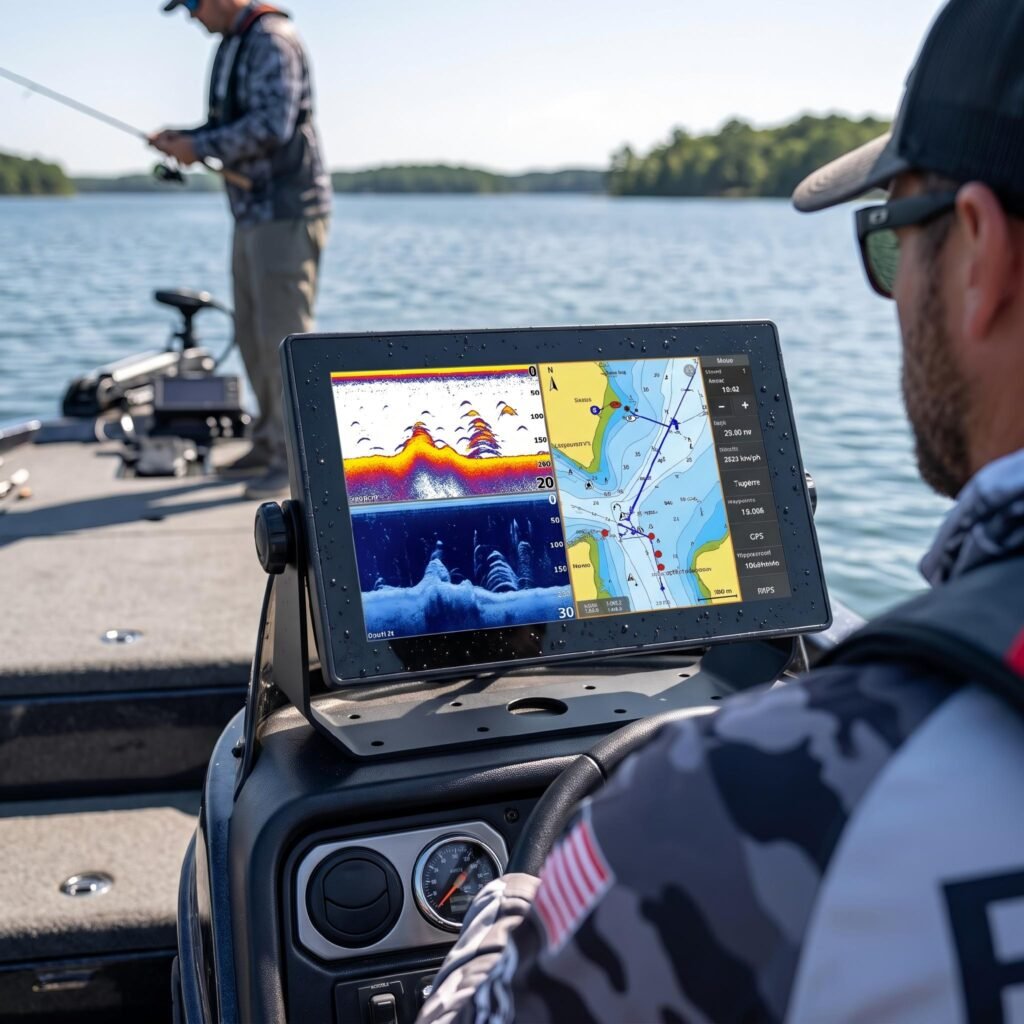
Polarized Sunglasses Readable Marine Touch Monitor
Engineered for open bridge consoles, sports flybridges, and naval vessels. Features circular-polarizing quarter-wave retarder optics for 360-degree zero-blackout viewing with polarized sunglasses, 1500 nits daylight readability, LOCA optical bonding, and 0-100% deep night dimming.
2. Birefringent Film Matching & Anti-Reflective (AR) Etched Glass
Achieving true sunlight legibility across broad operating temperatures requires advanced optical layer engineering:
- Broadband Polycarbonate Retarder Film: Wide-temperature birefringent optical films maintain precise π/2 phase retardance across the entire visible spectrum (400 nm to 700 nm) and operating temperatures from -20°C to +70°C, preventing rainbow-colored chromatic fringing.
- Anti-Reflective Chemical Etched Glass: The outer 7H chemically strengthened cover glass features sub-micron chemical surface etching combined with multi-layer metal oxide vacuum sputtering, reducing specular glare below 0.5%.
- High-Clearing-Point (T_ni > 105°C) Liquid Crystals: Absorbed solar radiation inside sealed wheelhouses can heat display surfaces beyond 85°C. High-clearing-point liquid crystal fluid prevents isotropic transition dark spots from forming on the display.
Marine Optical Display Architecture Comparison
| Engineering Parameter | Standard Commercial Marine Screen | Engineered Polarized-Readable Monitor |
|---|---|---|
| Polarized Eyewear Blackout | Blacks out at 90° head angle (Malus extinction) | Zero blackout across 360° rotation (Circular QWP) |
| Optical Bonding Stack | Air-gap perimeter tape (Severe surface glare) | Full LOCA wet bonding (Refractive index n = 1.49) |
| Solar Clearing Point | Standard T_ni ≈ 75°C (Forms black solar blotches) | High-clearing T_ni ≥ 105°C industrial fluid |
| Night Watch Dimming | Bottoms out at 15% (≈50 nits, blinds crew) | Smooth PWM dimming down to < 1 nit (Night safe) |
| Front Enclosure Ingress | IP54 / light spray resistant only | True IP65/IP67 waterproof front console seal |
3. Bridge Console Integration & Dimming Calibration
- Orientation Verification: Because the circular polarizing retarder provides full 360-degree visibility, the display can be mounted in standard horizontal landscape or vertical portrait orientation without custom optical re-alignment.
- Potentiometer Dimming Interface: Connect the external rotary dimming potentiometer to the dedicated 3-pin marine dimming header, verifying smooth linear resistance control from full 1500-nit daylight down to sub-nit night modes.
- Ground Continuity Check: Verify electrical continuity between the rear aluminum chassis and the ship’s primary cathodic bonding bar (≤ 0.05 Ω) to prevent RF interference from radiating into marine VHF radios.
Upgrading vessel bridge consoles and open flybridges with circular-polarized sunlight-readable marine monitors ensures continuous chartplotter visibility under polarized sunglasses. Contact INNODA’s marine optical engineering team to request optical spectrophotometer curves, polarization test samples, and custom console bezel drawings.