
Modern competitive tournament bass fishing, coastal sports angling, and shallow-water navigation demand rapid underwater target separation. Professional anglers rely on helm-mounted fish finder displays to visualize multi-frequency Compressed High-Intensity Radiated Pulse (CHIRP) sonar returns, high-definition down-scanning, and real-time bathymetric vector charts. However, operating an open-cockpit touch display on a high-speed bass boat introduces severe environmental and acoustic challenges.
Consumer-grade marine tablets and unbonded leisure chartplotters suffer rapid operational failure under harsh tournament conditions. Direct tropical sun (reaching 100,000 lux) washes out low-luminance displays, continuous deck washdown and water spray cause capacitive touchscreens to register erratic phantom clicks, and standard pulse sonar lacks the target resolution to distinguish game fish hugging submerged timber structure. Specifying a dedicated tournament fish finder touch monitor requires analyzing acoustic pulse compression physics, optical liquid bonding, and mutual-capacitance water rejection.
1. Acoustic CHIRP Pulse Compression & Range Resolution Physics
Traditional single-frequency pulse sonars transmit a short sinusoidal burst at a fixed frequency (e.g., 200 kHz). While short pulses improve target resolution, they severely restrict total acoustic energy delivered into the water column. CHIRP sonar overcomes this physical trade-off by sweeping across a wide frequency band over a longer pulse duration, applying mathematical matched filtering upon reception:
CHIRP Matched Filter Range Resolution & Pulse Compression Gain: Speed of Sound in Water: c ≈ 1500 m/s. Swept Acoustic Bandwidth: B = 40 kHz (High-CHIRP band: 130 kHz to 170 kHz). Pulse Duration: τ = 1.0 ms = 1.0 × 10^-3 s. Standard Pulse Sonar Resolution (Without Compression): ΔR_raw = (c × τ) / 2 = (1500 × 1.0 × 10^-3) / 2 = 0.75 m = 75.0 cm. CHIRP Matched Filter Range Resolution: ΔR_chirp = c / (2 × B) = 1500 / (2 × 40,000) = 0.01875 m ≈ 1.88 cm (~0.74 inches). Pulse Compression Ratio (PCR) & Signal-to-Noise Processing Gain: PCR = B × τ = 40,000 × (1.0 × 10^-3) = 40.0. SNR Processing Gain: G_snr = 10 × log10(PCR) = 10 × log10(40) ≈ 16.02 dB.
Because CHIRP pulse compression enhances range resolution from 75 cm down to 1.88 cm while delivering a 16 dB processing gain, anglers can resolve individual predator fish suspended just inches off hard rocky bottoms or hidden within dense weed beds.
To render high-frequency CHIRP sonar returns with absolute clarity under blazing midday sun, boatbuilders deploy the Bass Boat Fish Finder Touch Monitor CHIRP Sonar Display , which integrates a 1500-nit high-luminance panel with Liquid Optical Clear Adhesive (LOCA) wet bonding.
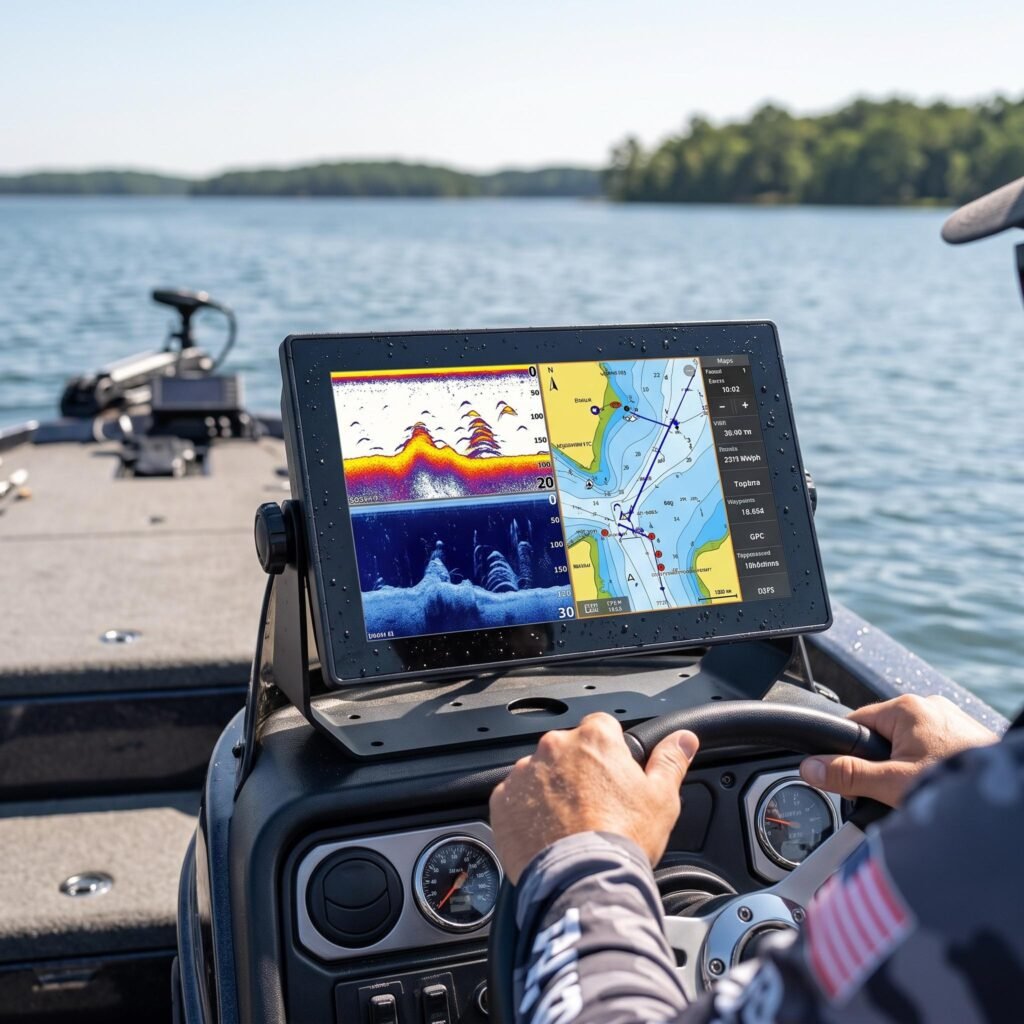
Bass Boat CHIRP Sonar Touch Monitor
Engineered for tournament bass boats, sports center-consoles, and coastal skiffs. Features 1500 nits daylight readability, full LOCA optical wet bonding, advanced water-rejection PCAP touch tracking, full IP67 waterproof sealing, and high-resolution CHIRP sonar clarity.
2. LOCA Optical Wet Bonding & Dynamic Water-Film Touch DSP
Operating an open-helm display requires advanced optical and capacitive surface management:
- LOCA Wet Optical Bonding: Injecting an optically clear silicone polymer (refractive index n = 1.49) between the cover glass and LCD eliminates internal air gaps, suppressing internal Fresnel reflections below 0.5% and preventing internal fogging during cold dawn runouts.
- Mutual-Capacitance Water Suppression: Surface water droplets create broad conductive charge distributions. Advanced touch DSP scans discrete intersection nodes, rejecting continuous water films while accurately tracking high-speed finger gestures.
- Full IP67 Submersion Sealing: The monolithic aluminum front bezel incorporates CNC dovetail fluorosilicone gaskets, withstanding continuous bow-wave splashes and torrential rain without seal breaches.
Tournament Bass Boat Display Architecture Comparison
| Engineering Parameter | Standard Leisure Marine Chartplotter | Engineered CHIRP Bass Boat Monitor |
|---|---|---|
| Peak Screen Luminance | 600 – 800 Nits (Fades in direct midday sun) | 1200 – 1500 Nits ultra-high daylight visibility |
| Optical Bonding Stack | Air-gap assembly (Fogs up on damp mornings) | Full LOCA wet bonding (Zero condensation) |
| Wet Surface Touch Control | Locks up or tracks phantom water clicks | DSP water-rejection with thick-glove support |
| Chassis Material | Molded plastic casing (Cracks under UV/vibration) | Marine-grade anodized aluminum alloy |
| Video & Sonar Interface | Proprietary closed bus (Restricts third-party sonars) | Standard HDMI, DVI, VGA, and industrial NMEA/USB |
3. Commissioning Guidelines for Bass Boat Helm Consoles
- Gimbal Mount Vibration Isolation: When bolting the display gimbal bracket to fiberglass helm decks, use high-durometer neoprene isolation bushings to absorb 60-mph hull chop vibrations.
- Dedicated Marine Battery Bus Wiring: Connect the display’s DC 12V power leads directly to the dedicated electronics battery bus using 14 AWG tinned marine copper wire, bypassing the main outboard cranking circuit to avoid voltage sags.
- Freshwater Flush Protocol: After fishing brackish or saltwater estuaries, rinse the display front face with low-pressure clean freshwater (< 2 bar) to dissolve dried salt crystals and preserve the anti-fingerprint surface coating.
Standardizing bass boat helms and bow casting decks on dedicated 1500-nit CHIRP sonar touch monitors delivers sub-inch target resolution and eliminates wet-screen lockups. Contact INNODA’s marine electronics engineering team to request 3D CAD helm cutout templates, sonar interface compatibility matrices, and custom dual-mount bracket kits.