
Modern CNC machining centers, automated robotic transfer cells, and pharmaceutical MES stations require robust computing performance combined with strict network architecture separation. An industrial panel PC equipped with an Intel Core i5-6200U processor and dual independent Gigabit Ethernet (GbE) controllers delivers the computing power needed to execute local vision inspection, high-speed SCADA telemetry, and database transactions simultaneously. The classic 15.0-inch 4:3 display format (1024×768 XGA resolution) provides native 1:1 pixel rendering for standard industrial control interfaces.
However, running high-performance computing hardware in dusty, unventilated industrial electrical enclosures presents severe maintenance challenges. Without scheduled thermal and network maintenance, hardware faces two major operational hazards: thermal throttling caused by blocked heatsink fins, and cybersecurity cross-contamination between enterprise Information Technology (IT) networks and real-time Operational Technology (OT) machine fieldbuses. Establishing a rigorous preventative maintenance protocol ensures uninterrupted 24/7 industrial uptime.
1. Dual Independent Gigabit LAN Architecture & IEC 62443 Subnet Segmentation
In modern automated factories, connecting machine-level controllers directly to corporate office networks introduces cyber risks and broadcast traffic latency. Integrating two physically independent Intel Gigabit Ethernet MAC/PHY controllers enables complete physical and logical network separation adhering to IEC 62443 industrial cybersecurity standards:
Network Subnet Segmentation & Broadcast Storm Isolation: Network Topology Configuration: – LAN Port 1 (OT Machine Subnet): 192.168.10.0/24 → Dedicated strictly to machine PLCs, VFDs, and I/O blocks. – LAN Port 2 (IT Plant MES Subnet): 10.20.0.0/16 → Dedicated strictly to enterprise ERP, MES servers, and cloud telemetry. Broadcast Isolation Impact: If a misconfigured office switch generates an ARP/multicast broadcast storm (up to 100,000 packets/second): LAN 2 interface handles enterprise network traffic while LAN 1 remains 100% isolated. Result: Deterministic real-time I/O scan cycles (≤ 2.0 ms jitter) on LAN 1 are completely insulated from enterprise network congestion, preventing machine emergency-stop line halts.
Maintaining separate physical network interfaces prevents rogue IP traffic from interfering with time-critical Modbus TCP or EtherNet/IP machine controls, eliminating packet collisions and enhancing plant floor cybersecurity.
To achieve reliable network segmentation and high computing throughput, electrical engineers deploy the 15″ Industrial Panel PC (Intel i5-6200U, Dual LAN), which integrates dual hardware-isolated Intel GbE ports with an industrial fanless thermal architecture.
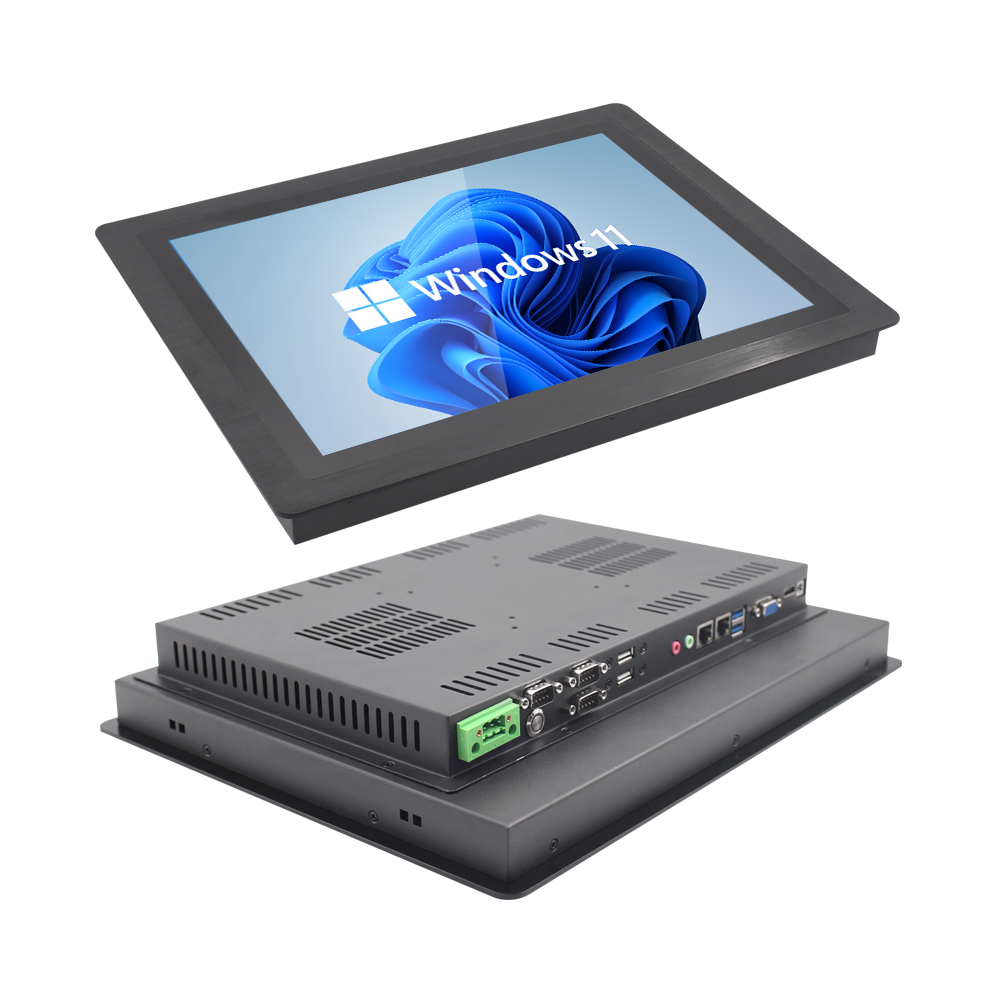
15″ Industrial Panel PC (i5-6200U, Dual LAN)
Designed for CNC machine consoles, automated test skids, and factory MES terminals. Powered by the Intel Core i5-6200U processor, featuring dual independent Intel Gigabit LAN ports for OT/IT subnet isolation, 100% fanless passive cooling, and IP65 front protection.
2. Thermal Resistance Budgets & Solid Passive Conduction
In a sealed fanless industrial panel PC, the mechanical aluminum heatsink chassis dissipates all thermal energy generated by the 15W TDP Intel Core i5 processor:
Thermal Resistance Budget & Heatsink Performance: R_th_allowable = (T_j_max – T_ambient_max) / P_tdp Where: – Maximum Processor Junction Temperature: T_j_max = 85.0°C (conservative industrial margin). – Maximum Cabinet Internal Ambient Temperature: T_ambient_max = 55.0°C. – Processor Thermal Design Power: P_tdp = 15.0 Watts. Allowable System Thermal Resistance: R_th_allowable = (85.0 – 55.0) / 15.0 = 30.0 / 15.0 = 2.00 K/W. Engineering Margin: The monolithic aluminum chassis achieves an effective thermal resistance R_chassis ≈ 0.85 K/W, operating comfortably within allowable budgets and preventing CPU thermal throttling up to 55°C cabinet temperatures.
Accumulated shop dust and oily grime on rear heatsink fins increase convective thermal resistance. Maintaining clean aluminum fin surfaces preserves convective airflow, keeping processor core temperatures safely within operating limits.
Industrial Control Panel PC Diagnostic Matrix
| Diagnostic Checkpoint | Inspection Procedure | Corrective Maintenance Action |
|---|---|---|
| Rear Heatsink Fins | Check for dust, lint, and oil film buildup | Clean using dry compressed air (< 2 bar) and degreaser wipe |
| Dual LAN Ports | Verify link speed indicators (Amber = 1 Gbps) | Check Cat6 patch leads; ensure OT/IT cable separation |
| Hardware Watchdog Timer | Simulate software freeze via BIOS watchdog utility | Verify automatic hardware reset triggers within 60 seconds |
| Front IP65 Perimeter Seal | Inspect gasket for cutting oil embrittlement | Re-torque panel clamps to 1.0 Nm; replace degraded seal |
| DC Power Rail Ripple | Measure DC voltage ripple with an oscilloscope | Ensure ripple remains ≤ 100 mV peak-to-peak under load |
3. Scheduled Preventative Maintenance Checklist
- Quarterly Thermal Clearance: Blow dry, filtered compressed air through the rear aluminum heatsink channels to clear airborne particulate and preserve passive cooling performance.
- Semi-Annual Port Inspection: Inspect the RJ45 LAN jacks, USB ports, and COM headers for mechanical pin bending or oxidation, cleaning contacts with electronic contact cleaner.
- Annual Panel Clamp Torque Check: Verify all rear panel-mount retaining clamps maintain 1.0 Nm torque to prevent machine frame vibration from breaking the front IP65 oil-tight seal.
Standardizing automated machine consoles on fanless 15-inch industrial panel PCs with dual Gigabit LAN ensures robust OT/IT network security and eliminates thermal downtime. Contact INNODA’s industrial automation team to request BIOS watchdog configuration guides, Ethernet throughput benchmarks, and custom panel cutout drawings.