
Modern Computer Numerical Control (CNC) milling machinery, automated metal stamping presses, and semiconductor packaging skids require rugged human-machine interface (HMI) displays integrated directly into electrical control cabinet doors. Across these demanding production cells, machine operators rely on 15.0-inch 4:3 format displays (1024×768 XGA resolution) to supervise multi-axis toolpaths, spindle load metrics, and real-time PLC ladder logic. The native 4:3 aspect ratio provides 1:1 pixel rendering for legacy and modern SCADA platforms without distorted font stretching.
However, factory machine enclosures expose computing hardware to harsh environmental hazards. Ambient cutting oil aerosols, conductive metallic dust, and continuous mechanical vibrations (from 15 Hz to 60 Hz) quickly destroy consumer-grade touch computers. Fan-cooled units draw airborne oil mists inside, coating power electronics and causing catastrophic short circuits. Specifying a long-term reliable 15-inch industrial terminal requires analyzing ADC12 high-pressure die-cast aluminum thermal fin efficiency, structural harmonic damping, and closed-cell IP65 perimeter sealing.
1. High-Pressure Die-Cast Aluminum (ADC12) Convective Fin Efficiency
In true fanless industrial computing, the mechanical rear housing acts as the primary thermal dissipation engine. High-pressure die-casting (HPDC) allows complex vertical cooling fins to be cast monolithically with the rear chassis, eliminating thermal contact resistance between heatsink components:
Convective Heatsink Fin Parameter & Efficiency Equation: Fin Parameter: m_fin = [ (2 × h) / (k_adc12 × t_fin) ]^0.5 Where: – Natural Air Convective Coefficient: h ≈ 10.0 W/(m²·K). – Bulk Thermal Conductivity of ADC12 Alloy: k_adc12 = 96.0 W/(m·K). – Individual Cooling Fin Thickness: t_fin = 3.0 mm = 0.003 m. Fin Parameter Calculation: m_fin = [ (2 × 10.0) / (96.0 × 0.003) ]^0.5 = [ 20.0 / 0.288 ]^0.5 ≈ 8.33 m^-1. Individual Fin Efficiency (Fin Height L_fin = 20 mm = 0.02 m): η_fin = tanh(m_fin × L_fin) / (m_fin × L_fin) m_fin × L_fin = 8.33 × 0.02 ≈ 0.1666. η_fin = tanh(0.1666) / 0.1666 ≈ 0.1651 / 0.1666 ≈ 0.991 (99.1% thermal fin efficiency). Thermal Result: The monolithic ADC12 fin architecture operates at near-unity thermal efficiency, transferring internal processor TDP flux directly to ambient air currents without thermal bottlenecks.
Because the die-cast cooling fins operate at 99.1% efficiency, internal processor core temperatures remain safely below 65°C even when the electrical control cabinet interior warms to 50°C, completely eliminating CPU thermal clock throttling without noisy cooling fans.
To deliver continuous processing uptime on harsh machining floors, automation engineers deploy the 15″ Die-Cast Fanless Industrial Panel PC (IP65), which pairs a solid ADC12 aluminum die-cast rear housing with a true-flat IP65 dust-tight and liquid-sealed front bezel.
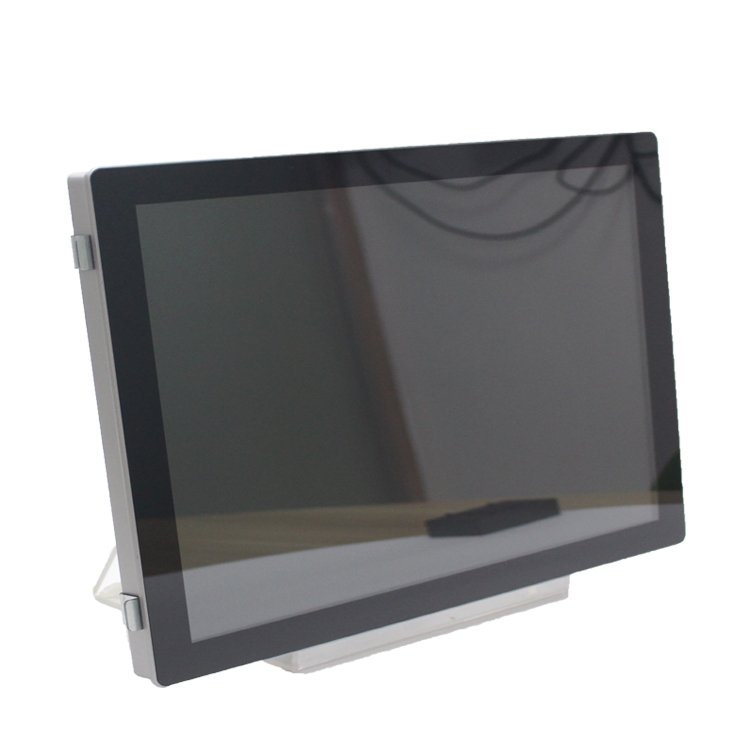
15″ Die-Cast Fanless Industrial Panel PC (IP65)
Designed for CNC machine consoles, automated stamping cells, and industrial SCADA terminals. Features a monolithic ADC12 die-cast aluminum chassis, 100% fanless passive cooling, certified IP65 oil-resistant front sealing, and native 4:3 XGA resolution.
2. Structural Vibration Damping & Eutectic Silicon Phase Microstructure
Machining centers generate high dynamic shock pulses that induce fatigue failures in electronic solder joints:
- Eutectic Silicon Damping Matrix: High-pressure die-cast ADC12 aluminum contains 9.6% to 12.0% silicon, creating a multi-phase grain structure that dissipates mechanical vibration energy 5 times faster than standard stamped sheet metal.
- Closed-Cell Neoprene Perimeter Gasket: Provides uniform compressive contact stress (≥ 0.85 MPa) along the panel-mount cutout boundary, blocking cutting coolant mist and pressurized washdowns from penetrating the cabinet.
- Industrial Wide-Voltage DC Input (9V-36V): Integrates multi-stage LC filters and Transient Voltage Suppressors (TVS) that clamp heavy inductive load-dump voltage spikes generated when high-power spindle motors cycle.
Die-Cast vs. Stamped Industrial Panel PC Comparison
| Engineering Parameter | Commercial Stamped Steel PC | Engineered 15″ Die-Cast Panel PC |
|---|---|---|
| Chassis Manufacturing | Folded sheet metal with riveted corners | Monolithic high-pressure die-cast ADC12 aluminum |
| Thermal Dissipation Type | Internal fan (Clogs with oil mist) | 100% Fanless monolithic fin array (η ≈ 99%) |
| Vibration Damping Capacity | Low damping (Amplifies press resonance) | 5x Higher Specific Damping Capacity (SDC) |
| Front Ingress Protection | IP50 / IP54 (Coolant leaks past seam) | Certified IP65 dust-tight and water-jet sealed |
| Display Aspect Ratio | 16:9 consumer stretch (Distorts SCADA) | Native 5:4/4:3 SXGA/XGA pixel-matched format |
3. Installation Guidelines for Machine Tool Doors
- Cutout Deburring: Ensure all laser-cut edges on the control enclosure door are smooth and free of burrs before setting the panel PC into position to avoid tearing the closed-cell perimeter gasket.
- Criss-Cross Clamp Torque: Tighten the rear panel-mount retaining clamps in an alternating diagonal pattern to a uniform torque of 1.0 Nm, ensuring even gasket compression across all four sides.
- Power Supply Isolation: Feed the terminal’s DC power rail from a dedicated 24V DC regulated industrial power supply equipped with galvanic isolation to prevent ground loop noise from coupling into the touch controller.
Standardizing automated machine tool consoles on 15-inch die-cast aluminum fanless industrial panel PCs ensures maximum thermal stability and eliminates vibration-induced downtime. Contact INNODA’s machine automation engineering team to request 3D STEP packaging models, vibration test certificates, and custom BIOS firmware options.