
Modern protein processing facilities, industrial slaughterhouses, and commercial dairy packaging lines require large-format human-machine interfaces capable of surviving severe sanitation regimens. A 19.0-inch 5:4 display (1280×1024 SXGA resolution) delivers the screen real estate required to supervise high-speed packaging conveyors, multi-zone temperature logs, and automated weight grading skids simultaneously. However, operating large-screen electronic terminals inside caustic sanitation washdown bays presents severe structural and chemical engineering challenges.
Daily Clean-in-Place (CIP) and Clean-out-of-Place (COP) sanitation protocols blast machinery with high-velocity water lances operating at pressures up to 100 bar (1,450 PSI) and temperatures up to 80°C. Concurrently, alternating chemical baths of concentrated sodium hydroxide (pH 12 to 13) and nitric acid descalers (pH 1.5 to 2.5) attack metal enclosures. Deploying a durable 19-inch stainless steel HMI requires analyzing high-pressure hydrodynamic jet impact forces, electropolished surface passivation, and CNC dovetail gasket retention.
1. 100-Bar Hydrodynamic Jet Strike & Dovetail Gasket Stress Mechanics
Under the ISO 20653 IP69K washdown test protocol, high-temperature water strikes the enclosure from close range (100 mm to 150 mm) under 100 bar line pressure. The kinetic energy of the high-velocity stream creates high dynamic stagnation pressure and surface shear forces:
Hydrodynamic Jet Velocity & Dynamic Impact Force: Nozzle Water Velocity (Bernoulli Law): v_jet = [ (2 × P_system) / ρ ]^0.5 = [ (2 × 10 × 10^6) / 1000 ]^0.5 ≈ 141.42 m/s. Continuous Dynamic Force on Enclosure (Flow Rate Q = 15 L/min ≈ 2.5 × 10^-4 m³/s): F_impact = ρ × Q × v_jet = 1000 × (2.5 × 10^-4) × 141.42 ≈ 35.36 N concentrated point force. Gasket Retention Mechanics: If a flat adhesive gasket is exposed to 35.4 N dynamic shear at 141 m/s, lateral hydrodynamic peeling occurs. Dovetail Solution: Seating a continuous closed-cell fluorosilicone O-ring inside a CNC-machined dovetail groove with a 15-degree undercut locks the elastomer mechanically: Hydrodynamic spray forces push the O-ring deeper into the groove root, maintaining contact stress σ_contact ≥ 1.85 MPa (far exceeding the 0.55 MPa penetration threshold).
Because the CNC dovetail channel mechanically traps the elastomeric seal, high-pressure water jets cannot extrude or lift the gasket edge, preserving complete hermetic ingress resistance across thousands of daily sanitation cycles.
To eliminate washdown leakage risks across heavy food processing lines, plant automation managers standardize on the 19″ Stainless Steel Waterproof Panel PC (IP66/IP69K), which combines a solid electropolished SUS304/SUS316L housing with dovetail-retained fluorosilicone perimeter sealing.
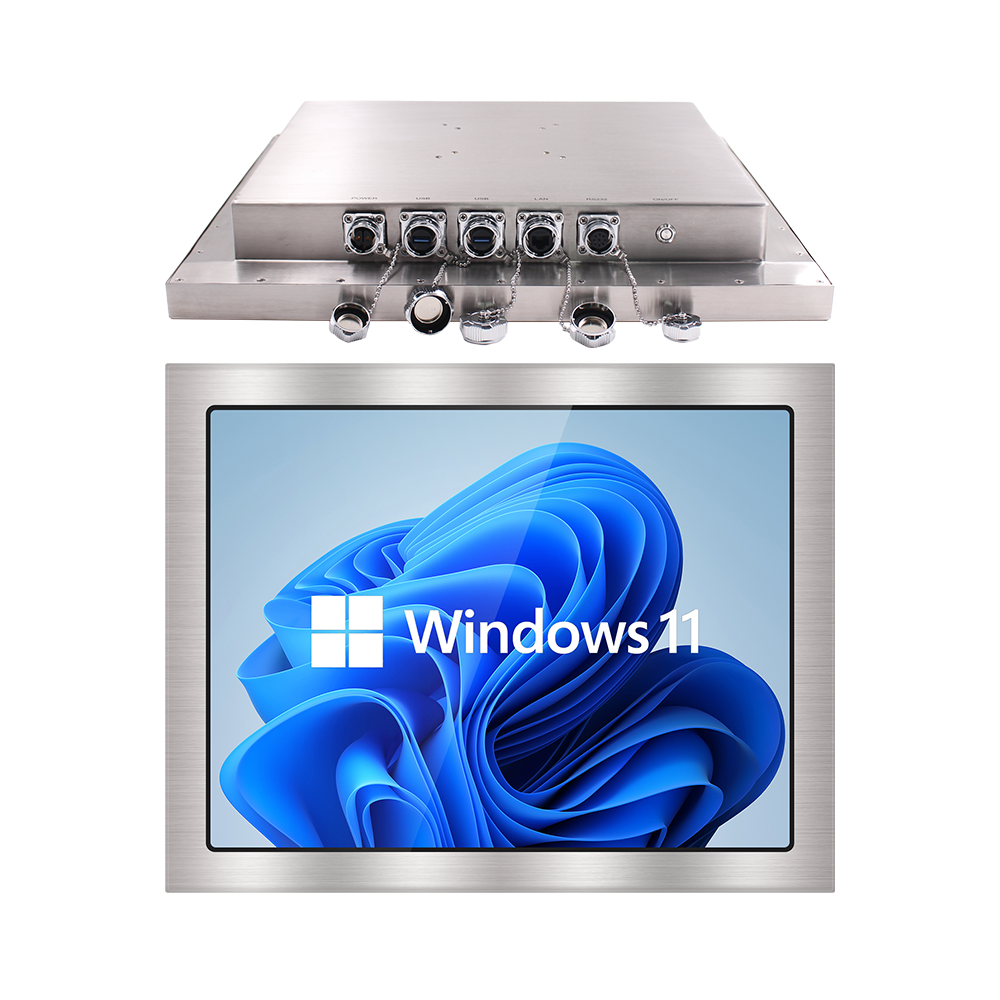
19″ Stainless Steel Waterproof Panel PC (IP66/IP69K)
Built for meat processing plants, commercial bakeries, and daily CIP sanitation washdowns. Features a heavy SUS304/316L stainless steel enclosure (Ra ≤ 0.4 µm), certified IP66/IP69K sealing against 100-bar hot water jets, all-metal M12 I/O, and glove-responsive PCAP touch.
2. Hygienic Metallurgy: Ra ≤ 0.4 μm Electropolishing & M12 Circular I/O
Meeting EHEDG sanitary engineering standards requires strict metallurgical and geometric control:
- Electropolished Surface Passivation (Ra ≤ 0.4 μm): Standard mill finishes harbor microscopic pits that trap organic residues. Electropolishing dissolves microscopic surface peaks, leaving a mirror-smooth chromium-rich passivation layer that prevents bacterial biofilm colonization.
- All-Metal Stainless M12 Aviation Connectors: External power, dual Ethernet, USB, and COM lines route through thread-locking SUS304/316 M12 circular connectors, eliminating unsealed RJ45 boot leaks and resisting cable pull-out.
- Internal ePTFE Breather Valve: A rear-mounted hydrophobic membrane neutralizes internal vacuum differentials created when 80°C steam-washed housings cool down in 10°C refrigerated rooms, preventing moisture suction.
Food Grade Washdown Terminal Comparison
| Diagnostic Checkpoint | Standard IP65 Commercial HMI | Engineered 19″ IP69K Stainless PC |
|---|---|---|
| Washdown Rating | IP65 (Gaskets fail under 1 bar jet) | Full IP66 / IP69K (Resists 100-bar 80°C steam spray) |
| Surface Roughness | Brushed sheet metal (Ra > 1.2 μm) | Electropolished SUS304/SUS316L (Ra ≤ 0.4 μm) |
| Connector Sealing Mechanism | Plastic glands with rubber push-in plugs | Screw-locking all-metal stainless M12 circular ports |
| Gasket Retention Method | Surface adhesive foam tape (Blows out) | CNC-machined dovetail groove with O-ring undercut |
| Touchscreen Wet Response | Ghost clicks and cursor freezing in foam | Water-rejection DSP with thick rubber glove tracking |
3. Commissioning Guidelines for Washdown Packaging Lines
- M12 Thread Torque Verification: Torque all stainless M12 cable connectors to 0.6 Nm using a calibrated open-end torque wrench to ensure internal Viton O-rings compress uniformly against the receptacle shoulder.
- Sloped Sanitary Arm Mount: Install the terminal on an electropolished stainless support arm angled forward by at least 15 degrees to facilitate natural gravity runoff of sanitation detergents and rinse water.
- Chemical Passivation Check: Following mechanical installation, wipe the exposed housing with a 10% citric acid passivation solution to remove shop handling residues and restore the continuous chromium oxide layer.
Upgrading food processing and dairy packaging lines with 19-inch full IP66/IP69K stainless steel panel PCs eliminates moisture penetration failures and ensures strict sanitary compliance. Contact INNODA’s food automation engineering team to request 3D CAD models, EHEDG material certificates, and custom M12 cable harness configurations.